
In Defence and Celebration of Roald Dahl
When the price you pay for social acceptance is personality
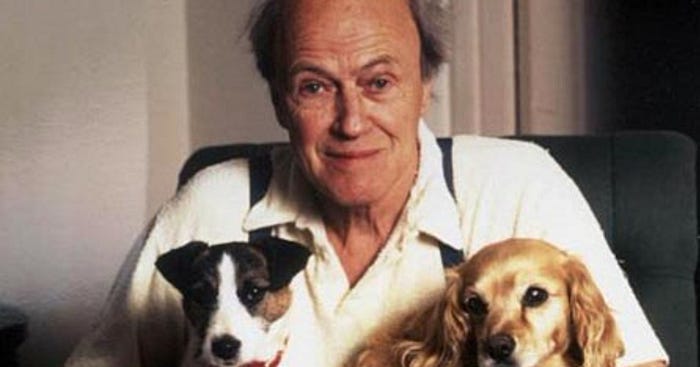
Just like millions of other children, Roald Dahl was my favourite writer when I was 7–9 years old. I remember reading his books at home, borrowing them from the local library when my school went there on Thursdays and our teachers reading to us from The Twits, Charlie and the Chocolate Factory, and Danny, the Champion of the World.
I also remember when Roald died. I was eight years old and went to school that day only to hear many of the other kids saying the writer had died. I recall arguing with some of them about it, maintaining that he was still alive. Returning home later, I asked my parents about it and they said it was true, he had passed away. They also told me that they hadn’t wanted to tell me earlier, which was and is quite sweet, although it would have saved me from getting into arguments and looking somewhat silly had they admitted it a little earlier.
Roald Dahl got his fantastic double-monosyllabic name thanks to his Norwegian heritage and this wonderfully mellifluous pair of sounds is deeply interwoven into my childhood. I suppose you could call it ‘Dahl mania’, and really I am not sure whether the illness gripped a particular generation of children or whether it grips every generation of kids as some right of passage into one’s later prepubescent years.
At present, Mr. Dahl is being overhauled so as to make him safe for new generations of children. The publisher Puffin has hired sensitivity readers from a group called Inclusive Minds to go through Dahl’s work to remove anything that could be overly offensive or hurtful to readers and make sure that the books take into account ‘those who have lived experience of any facet of diversity.’
The Roald Dahl Story Company claims that all alterations are ‘small and carefully considered’ and that ‘the irreverence and sharp-edged spirit’ of the originals is very much preserved. They also point out that making adjustments and edits as views and values shift is standard practice for literature.
But is it just business as usual and is the response to the changes a massive overreaction in a hyperreactive era?
Let’s take a look at some of the amendments.
The re-education of Roald Dahl
The list of amendments and deletions is extensive, so I will have to be summary.
‘Mothers’ and ‘fathers’ are henceforth ‘parents’ or ‘family’.
The word ‘fat’ is to be expunged with a vengeance. Aunt Sponge was once ‘terrifically fat’, whereas now she has shed the weight and is merely a ‘nasty old brute’, thus retaining her wicked ways but definitely not being fat no matter what anyone says.
We are presumably to believe that Dahl intended Gloop to be some kind of mountainous behemoth possessed of prodigious might rather than a gluttonous butterball, despite all wording to the contrary.
Augustus Gloop is no longer ‘enormously fat’ but simply ‘enormous’. We are presumably to believe that Dahl intended Gloop to be some kind of mountainous behemoth possessed of prodigious might rather than a gluttonous butterball, despite all wording to the contrary.
And it continues.
Dahl’s imaginings of supernatural women have been altered to suggest they may now be working as scientists or running businesses but most assuredly not working as cashiers or typing letters for businessmen.
The Oompa Loompas existed once as black pygmies that Willy Wonka smuggled out of the deepest darkest Africa in what is an example of really quite vile and vicious racism until given a much-needed rewrite by Dahl himself to remove the racial elements. Well, they’ve been given another rewrite and have had their genitals promptly excised. They are now free to be who they always were, and that is gender-neutral seemingly.
‘Ugly’ is gone.
‘Black’ and ‘white’ are gone.
‘Kipling’ is now ‘Steinbeck’.
‘His father was a farmer’ is now ‘his parents were farmers’.
‘Old hag’ is ‘old crow’.
‘Old cow’ is ‘old shrew’.
‘Adorable dress’ has become ‘lovely dress’ (truly the mind boggles).
‘Boys and girls’ are ‘children’, ‘him’ is ‘them’, and ‘men and women’ and ‘males and females’ are now described simply as ‘people’.
Salman Rushdie, among countless others, was quick to slam the sheer scale of the alterations and removals, saying, ‘Roald Dahl was no angel but this is absurd censorship’.
A demolition job
Indeed, Dahl was anything but an angel. His antisemitism may have been somewhat cynically laughed off by Isaiah Berlin, but it ran a deep course through his being to rear its bilious visage every now and again. Charges of racism and misogyny can also be easily levelled at Dahl with enough evidence for both to make it hard to defend him with any seriousness without at least some sticking.
Equally, I think it hard to say with a straight face that the aforementioned ‘alterations’ are just a small restyling, a little revamping, and a little bit of varnish.
This is a demolition job. There is no other word for it. A Liston knife has been taken to his body of work and Dahl has been eviscerated.
The classics have stood the test of time which means they should not change with the times.
Roald Dahl’s stories have entered into the annals of the classics. And the whole point of the classics is that they contain something within them that has stood the test of time. The classics have stood the test of time which means they should not change with the times.
Sure, a little bit of pruning and general upkeep is justified. Sure, if something has become bestial and abhorrent to most, then, of course, it should be weeded out and removed. But what we see here is the complete overhaul of the Dahl literary gardens. What we see here is nothing short of authorial castration.
To my mind, it would be far better to just cancel Roald Dahl in one fell swoop, putting him and his work down in a humane manner, than gut him from top to bottom and yet somehow expect to preserve his essence. This would have the advantage of at least not reanimating the writer as some soulless mouthpiece for wokeism — an undead automaton telling kids whatever the false left deems sufficiently woke at the time.
Alternatively, Puffin could take the route that would be ten times easier, ten times more logical, and ten times more acceptable for most people — simply put a big, fat disclaimer at the start of his books, just like Disney does with some of its cartoons.
The great and the ghastly
You cannot have it both ways. You cannot shine a light into all those dark nooks and crannies strewn throughout Dahl’s work and preserve the murky macabre world he conjured up intact. You cannot deracinate the treacherous vines which creep about waiting to sweep you off your feet and throttle you and expect the fear and foreboding to perdure unscathed. You cannot get rid of the grotesqueness and black humour and expect the awful irresistible attraction of his stories to still pull children in.
Roald Dahl’s inimitable style trades in the grotesque as basic currency. For better or worse, the syncretisation of physical form and moral integrity or lack thereof are Dahl’s bread and butter. His characters are not just ugly or fat, they’re hideously ugly and enormously fat. Take the ugliest possible person and this still would not be enough for Roald Dahl. He would have to give them putrid breath and pop a pustulous pimple on their nose for good measure.
The witches of Roald’s eponymous tale are foul, monstrous creatures, both inside and out. This teaches a lesson that kids will have to unlearn or disregard sooner or later– that one’s outward appearance has any bearing on the content of their character — but it’s also a big part of the power and potency of the Dahlian universe.
The fact that these ghastly alopecic fiends are all women seems to give credence to the charges of misogyny. But then the novel’s deuteragonist, Grandmamma, is one of the greatest witch hunters in the world and the real hero of the story. So, where does this leave the charge of misogyny?
To my mind, the ghastly and the grotesque are simply omnipresent in Dahl’s creations and swim through his tales. He painted a world that is rarely just nice and nothing more. But that’s the point.
The world children inhabit is not particularly nice in many ways and kids are not particularly moral. We have to guide and nurture them in order for a strong moral compass to take root and this takes many years. Dahl understood what children see and he understood what they need to see.
If Dahl liked scaring children, it’s because children like scaring children. If Dahl could be mean and malevolent, it’s because children can be mean and malevolent. That these things are not nice is beside the point.
Children’s writers almost always stand on the other side of the fence from children, surreptitiously schooling them, imparting useful wisdom, and telling them about what they should and shouldn’t do. And children know and feel this perfectly well.
Roald Dahl was different. He stood with children on their side of the fence, looking at their own patch of ground and over at the hallowed earth trodden by adults. This is the world children inhabit, a world that exists inside that of the world of adults but also unto itself. It is also a world where the wonderful and the wicked lie around every corner.
They are true and Roald Dahl understood these truths more than most anyone else, and instead of shying away from them and hiding them, he celebrated them and exaggerated them in the form of his creations — the fantastical, the fearsome, the great and the ghastly.
If Dahl liked scaring children, it’s because children like scaring children. If Dahl could be mean and malevolent, it’s because children can be mean and malevolent. That these things are not nice is beside the point.
They are true and Roald Dahl understood these truths more than almost anyone else, and instead of shying away from them and hiding them, he celebrated them and exaggerated them in the form of his creations — the fantastical, the fearsome, the great, and the ghastly.
Children love Roald Dahl because he speaks their language. The new woke-friendly Dahl speaks the language of a small but very vocal segment of the population who need to have their moral convictions mollified. It also speaks to the bank balance of Puffin and the Roald Dahl Story Company who think that Dahl Light will make more dollars for them than the original in all its authentic glory.
People suffering from mental illness are often prescribed extremely powerful medicine to obliterate those tendencies deemed dangerous for themselves and for society. Sometimes this works perfectly well and yields positive results. Sometimes it doesn’t and the price of ridding the patient of their aberrant problems is the demolition of their very personality.
Puffin and Inclusive Minds have force-fed Roald Dahl powerful medicine to rid him of his transgressive proclivities. I fear, however, that the price of this rehabilitation will be Roald Dahl’s essential personality.


