
In Clarity Lies Your Success And Well-Being
Hacks that I learned while writing a journal that can help you find clarity in life.

All this time I was wrong.
I always thought that financially successful people would be brave-hearted.
In college, I’ve always seen guys with guts succeed at things they did. Then, I came across a quote that changed my trajectory.
“Confidence is no substitute for clarity. To be successful, you need clarity, not confidence.”
— Sadhguru
Sadhguru, a mystic who has lived an exuberant life, changed my perspective. The next day, I started taking steps to rewire my mindset.
I stopped chasing confidence and started discovering where is my true inclination.
I Took Help Of My Journal Diary
Initially, I used to write my thoughts and ideas on bits and pieces of paper. But then I realized that keeping a journal would be a more sustainable option.
I started penning down my thoughts of the day in a journal diary. It is such a powerful habit.Within a few weeks, I was able to think clearly about new ideas. Moreover journaling:
- Boosted my self-esteem
- Helped me keep track of my day
- Helped me realize where I need to improve
- I Took notice of my learning goals
The new routine started revealing a constructive pattern. When I looked back at my days on paper, I was able to outline where I am heading.
After a year or so, I discovered that I can do more with the process and so came the idea of creating my own trajectory of life. That’s where I started to find clarity in what I wanted in life.
Here are the steps that will help you find yours —
Step 1-Go Get A Journal Diary
A journal diary will save your time and effort to recollect past non-sensical things that you’re going to write from now.
They might make sense at a later stage or at least help you to trace back your success journey.
Go get one to start it up
Step 2— Materialize Your Future On A Paper
Warren Buffet says — “Write down your 25 most ambitious goals. Cross 80% of those and come with the top 5 most crucial ones. Work on those 5 for the whole of your life.”
- Follow this 80–20 rule for bringing clarity in your life. Begin with writing as many ambitions as you can. Don’t limit yourself. There is no one here to judge you. Your journal won’t go viral nor will it be auctioned at Christie’s.
2. Once you’ve written everything, shuffle them as per the relevance by grouping them.
3. Divide your ambitions(and desires) into short-term and long-term.
→ Short-term goals are those which you think you can achieve within 6 months. They might take a year to realize!
→Long-term goals are those which take 6 months to start making sense.
4. Write your bucket list in your journal.
Focus on ambitions and don’t worry about your desires. Desires change as you grow.
Change your mindset from chasing desires to working on 3–5 sustainable unconquerable long-term goals.
Unconquerable goals will save you from the dilemma of — What’s next in life? People who accomplish their biggest ambitions get blank once they achieve them. They don’t have more to do in life.
Not failure, but low aim, is a crime.
— James Russell Lowell
When you’ll have something bigger than achievable, you’ll remain proactive till your last breath.
One more tip: Life’s biggest goals should not be selfish.
Desires are selfish goals.
Desires may or may not get fulfilled. Accept this reality.
Unfulfilled desires will make you unhappy. Instead, aim for something bigger than yourself — A cause or a movement that’ll bring positive change in the world.
Note: Make a digital format of your list so that you can keep track of your progress. Plus, you can build a second brain out of it.
5. Divide long-term goals and short-term goals. Sequence them as per priority. Use the 80–20 rule to figure out which 20% goals will scale you to succeed faster irrespective of effort (As you’ll need to put your 100% effort).
6. Among these short-term goals, 1–2 goals should be intermediate steps that somehow will be aligned with your long-term goals.
This balancing of goals in your portfolio of activities for the day will help you scale up in your uphill race.
Once you’ve written this rough draft of your life’s project, you’re ready to start your ‘Mission-Driven Life.’
Step 3— Build A Daily Writing Habit
Yay! the good thing is — There’s no prescription about when to pick up a journal; except one — Pick it up daily! Well, even that’s not necessary.
Rule 1 — Plan a day before
When you plan your day before, your subconscious works on your To-Do list while you’re asleep. On judgment day, your cache memory, which has only four slots, remains unoccupied. This helps you get more usable space to think and store ideas of the present day.
Rule 2 — Schedule and Keep track of your time
Time table sucks. But sometimes it helps you feel accomplished! Prepare a timetable. After 10s of unsuccessful attempts to follow a timetable, I was able to figure out one thing — Keep it simple and don’t over-commit.
Here’s how you can distribute your time —
5–6: Get your feet on the ground, relieve yourself, and Meditate
6–7: Yoga/fitness
7–8: Morning routine — Massage, Bath, Breakfast, etc.
8–10:Learn/Write/Priority tasks
10–1:First things first/ (Work hours)
1–2: Lunch break
2–4: Do what you like to get rid of afternoon slump/(Work hours)
4–6: Finish your day’s tasks
6–7: Commute/WFH — Listen/Read/ E-mail replies
7–8:Play/Walk/Run — Mix up with friends via call or personally/Family time
8–9.30: Family time + Healthy Discussions over Dinner
9.30–10.30: Read books
Go to bed after chanting positive thoughts or mantras/Bedtime activities!
This is a rough roadmap for your day. It is divided into 1-2 hour chunks of time. You can make your own. Do not forget to group similar tasks.
Note: I am satisfied with the advice given in the book Deep Work by Cal Newport — Do not overload yourself with work. The book will help you become productive by lessening your efforts.
Step 4— Make A Weekly Checklist
Once you are ready with your To-Do things, you’ll need to have accountability.
You cannot achieve your ambitious targets with randomness in your routine.
I use Microsoft OneNote to create a checklist of in-hand tasks that I need to accomplish in the upcoming week. Take reference from the image below.
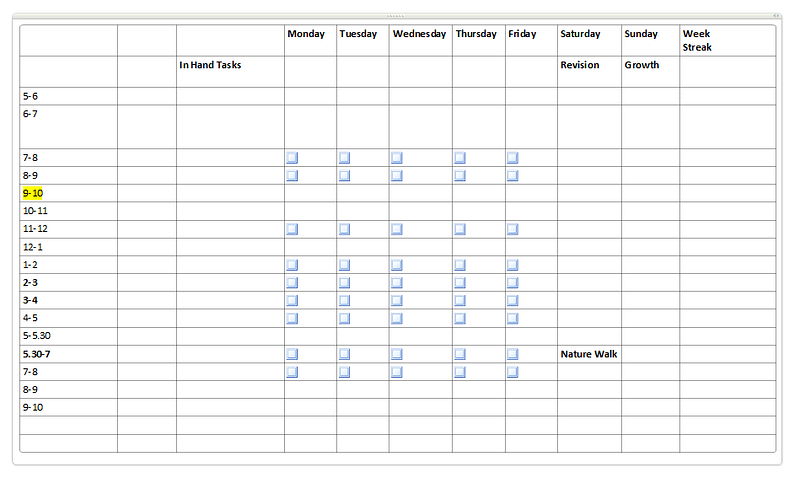
I keep weekends for revision and feedback.
You cannot sprint for straight 7 days. So, keep weekends for rest. It is necessary to move fast and slow when you are running a Marathon of life.
Habits build personality.
The above-mentioned procedures will help you build a routine.
A routine will help you to get in the flow state daily.
Once you achieve a flow state, you will start your journey of making-breaking.
Step 5- Shape Your Career Like You Shape Your Body
The muscle-building process is all about breaking the muscles with weight training and giving them time to rebuild. Repeated efforts help you chisel your body.
The process of reaching heights is analogous to muscle-building.
Step 6- Measure Your Growth
At the end of every week, measure what went right and where you went wrong. Improve on that area thereafter.
Personal Memoir
I started the habit of keeping a journal for a year and a half. Before that, I used bits of paper to keep myself updated. Since I started to write my thoughts and process in a journal, I became productive. I developed a learning attitude.
Journal also helped me penning down good and bad moments of my day. Now, when I look at a journal the next morning, I get a glimpse of the last day’s thoughts and activities. This helps me cherish my day and revise the lessons from the day.
Now, as I know what I want in life, I had no difficult time becoming productive in my routine. I would work on weekends and I can work straight for a day. In Nick Wignall’s words, I’ve traced the path to self-discovery.
I highly recommend this (Maintaining a journal) addictive positive habit to anyone who wishes to make the best use of time.
Step 7— Furthermore
Now you know how much you can produce within a day. You know what are your areas of improvement(SWOT). You will also know how much tentative time you will need to achieve your goals.
After you’ve found clarity in your action, which may take 1–6 months, you can scale up your efforts.
You’ll be ready with stats on how much time a task/activity takes. So, you can add members to your team! You can prepare Standard Operating Procedures(SOPs) for your routine tasks to make their work accountable.
This will scale up your effort to achieve wonders in life!
“If you want to walk fast, walk alone. But if you want to walk far, walk together.”
— Ratan Tata
Till you reach step 6, things will start making sense. Now, it will be up to you how far you want to go. Wish you all the best.
At last, you need to trust the process because —
- It is uncertain.
- It needs consistency.
- It requires discipline.
- It takes time.
Summary
- Envision your future
- Plan your life — Maintain a journal
- Start your work in the destined direction
- Set targets and measure them
- At times, you need to change trajectories that don’t go well
- More often, you need to add intermediate steps to reach milestones
- Trust the process. The process is foolproof, but not the journey.
- It may happen that you’ll need to start afresh. Failures are stepping stones and not hurdles.
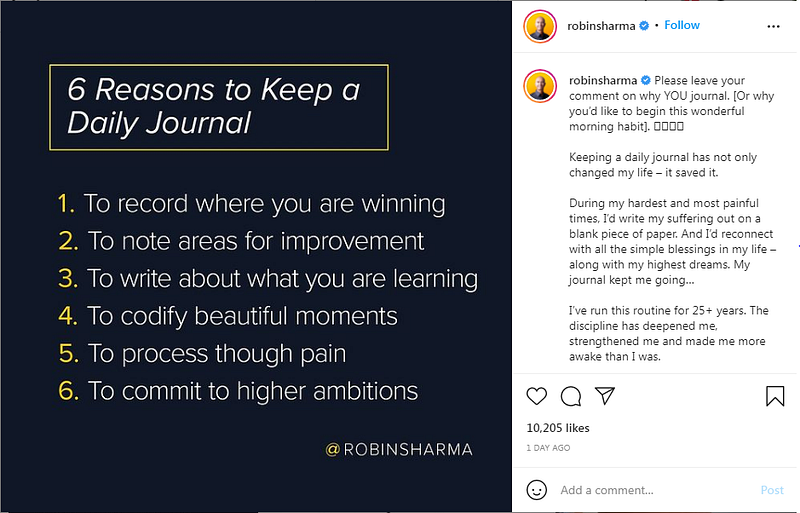
Here’s what Robin Sharma has to say about keeping a journal —
I help and coach how to stay happy, be purposeful, and live a balanced life!
P.S — Get the complete clarity toolkit for free!