avatarDaniele Quero, PhD

Free AI web copilot to create summaries, insights and extended knowledge, download it at here

2717

Abstract

8">Generally, familiar information considered true triggers cognitive ease: “the sky is blue” is true and feels good in our brain.</p><p id="2c62">The drawback of this mechanism is <b>that can be artificially induced</b>: novelties are not taken with ease, but if we are repeatedly exposed to them and they never harm us, we find may find ourselves comfortable with them in the end… and consider them true even if they are not.</p><p id="f7fb">That is why<b> fake news spread so easily</b> across social media. It is easy to have them repeated as often as required to make them appear true. But it’s not only about repetition:</p><ul><li>images with high contrast</li><li>crisp audio with no distortion</li><li>easily pronounced words, acronyms and names</li><li>sharp and clear legible text</li><li>things considered true by a large group of people</li></ul><p id="6375">are some examples of triggers of cognitive ease, these things just feel good.</p><p id="ed59">On the other hand, we have a sensation called cognitive strain. It is what we feel when our brain is <a href="https://www.nngroup.com/articles/navigation-cognitive-strain/#:~:text=System%202%20allocates%20attention%20to%20the%20effortful%20mental%20activities%20that%20demand%20it%2C%20including%20complex%20computations.%20The%20operations%20of%20System%202%20are%20often%20associated%20with%20the%20subjective%20experience%20of%20agency%2C%20choice%2C%20and%20concentration.">forced to think harder </a>(e.g. in performing calculations) or is put in a situation where nothing is familiar or triggers cognitive ease.</p><p id="b1c4" type="7">Like being outside our comfort zone.</p><p id="eb53">In these cases, we feel less comfortable and therefore <b>more suspicious</b>. We are <b>less intuitive</b>, creative and receptive but on the other hand, <b>less prone to be induced in error</b> by our intuition.</p><figure id="16fb"><img src="https://cdn-images-1.readmedium.com/v2/resize:fit:800/0*JwPuQYiywZ3Ou_kE"><figcaption>Foto from <a href="https://unsplash.com/photos/bmJAXAz6ads">unsplash.com</a> by <a href="https://unsplash.com/@elisa_ventur">Elisa Ventur</a></figcaption></figure><p id="8fcc">This state of vigilance, being more skeptical, takes more effort than “going with our guts” (cognitive ease) and may be related to <b>feelings of unhappiness</b>, which is not so rare among scientists and analytical thinkers.</p><p id="5c7f" type="7">Cognitive ease and strain are neither good nor bad, just two opposite mechanisms used by our brain.</p><p id="9e35">None of them has to be discarded: one allows us to <b>save effort and energy</b> in decision-making that is either minor or just familiar, the other allows us to <b>distinguish betwe

Options

en true and false</b> <b>with reasoning</b>, avoids intuition-induced errors (<i>counterintuitive</i> truths) at the cost of more effort and mental work.</p><p id="4394">The two mechanisms are the result of our evolution but need to be correctly used:</p><ul><li>answering intuitively a quantum physics test may result in an error</li><li>analytically thinking about what to wear today results in useless energy waste and unpleasant feelings of unhappiness, dissatisfaction or <a href="https://www.nngroup.com/articles/navigation-cognitive-strain/#:~:text=Negative%20Consequences">loss of confidence</a></li></ul><p id="f154">This stands even more <b>true </b>in a world where the instruments to artificially induce cognitive ease are so easily accessible.</p><p id="8441">If you liked the article, please clap to it and share it! Also, take a look at my games!</p><figure id="6051"><img src="https://cdn-images-1.readmedium.com/v2/resize:fit:800/1*OxQOMsD-vlGrfHyGJ7713w.jpeg"><figcaption></figcaption></figure><p id="ac2c"><b><i>Get access to my stories</i></b><i> and those of other Medium writers for just<a href="https://danio-quero.medium.com/membership"> $5 a month</a>. <b>With no additional cost to you</b>, I will receive half of your payments as a commission: it’s a great way to <b>support me</b>!</i></p><div id="52ca" class="link-block"> <a href="https://danio-quero.medium.com/membership"> <div> <div> <h2>Join Medium with my referral link — Daniele Quero, PhD</h2> <div><h3>As a Medium member, a portion of your membership fee goes to writers you read, and you get full access to every story…</h3></div> <div><p>danio-quero.medium.com</p></div> </div> <div> <div style="background-image: url(https://miro.readmedium.com/v2/resize:fit:320/0*QULnxfjIWW7AE6hO)"></div> </div> </div> </a> </div><p id="ba99"><i>Join my newsletter and receive<a href="https://danio-quero.medium.com/subscribe"> regular notifications</a> when I post.</i></p><div id="53c5" class="link-block"> <a href="https://danio-quero.medium.com/subscribe"> <div> <div> <h2>Get an email whenever I publish a new story!</h2> <div><h3>Get an email whenever I publish a new story! </h3></div> <div><p>danio-quero.medium.com</p></div> </div> <div> <div style="background-image: url(https://miro.readmedium.com/v2/resize:fit:320/0*lMyUFY9X05Q_Ye1L)"></div> </div> </div> </a> </div></article></body>

In and Out of the Comfort Zone: Cognitive Ease and Strain

Comfort Zone generally refers to an environment, real or figurative, in which a person feels comfortable and in control, safe in any way, from having a secure source of food to feeling loved and appreciated.

According to Bardwick, the comfort zone is characterized by low levels of stress and anxiety.

However, dwelling constantly in the comfort zone is not as good as it may appear.

New things, ones to discover or to learn are often beyond the zone and need a little dose of courage and effort to be reached.

White defines two more outer zones: while in the comfort zone a steady level of performance is ensured, outside there is the Optimal Performance Zone, in which performance may be enhanced by a controlled level of stress. An even higher level of stress leads to anxiety and makes the performance decrease rapidly: Danger Zone.
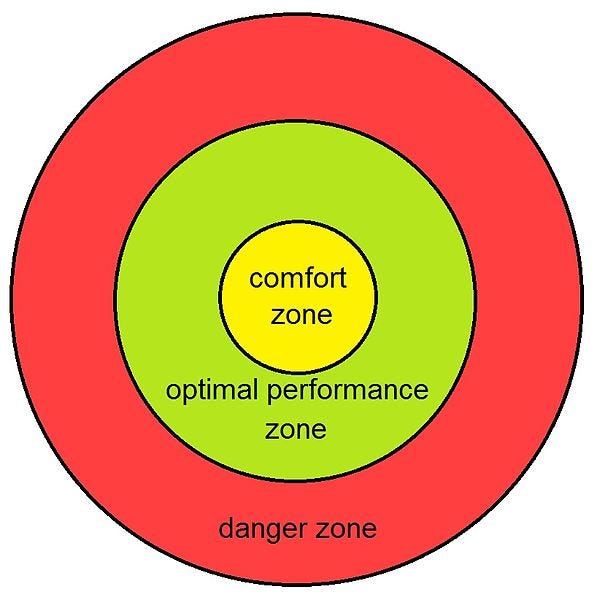
Diagram from Wikimedia Commons by Vkjzh45ls325dkf321vgl

The target should then be maximizing the time spent in the optimal zone or, equivalently, enlarge the two inner zones.

So, wherever you read something like “exit your comfort zone if you want to [insert your aim here]”, remember that is more advisable to enlarge it instead.

Cognitive Ease and Strain

A similar concept applies to a mechanism called cognitive ease.

It is a measure of how intensively our brain is working. We evolved with brains that favour cognitive ease to easily recognize threats. It allows us to recognize the truth with low effort, as in an energy-saving mode, quickly and involuntarily. It is called “ease” because it brings feelings of slight pleasure: when something is true and easily recognized so, it feels good.

Like being in our comfort zone.

Generally, familiar information considered true triggers cognitive ease: “the sky is blue” is true and feels good in our brain.

The drawback of this mechanism is that can be artificially induced: novelties are not taken with ease, but if we are repeatedly exposed to them and they never harm us, we find may find ourselves comfortable with them in the end… and consider them true even if they are not.

That is why fake news spread so easily across social media. It is easy to have them repeated as often as required to make them appear true. But it’s not only about repetition:

  • images with high contrast
  • crisp audio with no distortion
  • easily pronounced words, acronyms and names
  • sharp and clear legible text
  • things considered true by a large group of people

are some examples of triggers of cognitive ease, these things just feel good.

On the other hand, we have a sensation called cognitive strain. It is what we feel when our brain is forced to think harder (e.g. in performing calculations) or is put in a situation where nothing is familiar or triggers cognitive ease.

Like being outside our comfort zone.

In these cases, we feel less comfortable and therefore more suspicious. We are less intuitive, creative and receptive but on the other hand, less prone to be induced in error by our intuition.

Foto from unsplash.com by Elisa Ventur

This state of vigilance, being more skeptical, takes more effort than “going with our guts” (cognitive ease) and may be related to feelings of unhappiness, which is not so rare among scientists and analytical thinkers.

Cognitive ease and strain are neither good nor bad, just two opposite mechanisms used by our brain.

None of them has to be discarded: one allows us to save effort and energy in decision-making that is either minor or just familiar, the other allows us to distinguish between true and false with reasoning, avoids intuition-induced errors (counterintuitive truths) at the cost of more effort and mental work.

The two mechanisms are the result of our evolution but need to be correctly used:

  • answering intuitively a quantum physics test may result in an error
  • analytically thinking about what to wear today results in useless energy waste and unpleasant feelings of unhappiness, dissatisfaction or loss of confidence

This stands even more true in a world where the instruments to artificially induce cognitive ease are so easily accessible.

If you liked the article, please clap to it and share it! Also, take a look at my games!

Get access to my stories and those of other Medium writers for just $5 a month. With no additional cost to you, I will receive half of your payments as a commission: it’s a great way to support me!

Join my newsletter and receive regular notifications when I post.

Comfort Zone
Cognitive Ease
Cognitive Strain
Psychology
Recommended from ReadMedium