In Ancient Pompeii, Sex Was Power
Also, the Romans had no concept of heterosexual versus homosexual
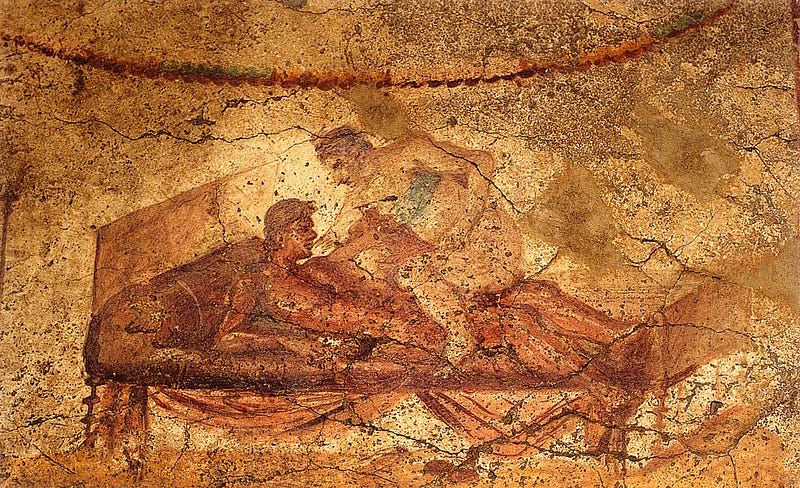
In Latin, the official language of the Roman Empire, a prostitute was called a lupa (she-wolf) and therefore, a lupānar (wolf’s den) was a brothel. Pompeii, like other major cities of the Roman Empire , had several thriving lupānāria (the plural of lupānar) and the largest one unearthed so far, also known as the Lupanare Grande, is unique for its well-preserved graffiti.
The writings on the wall, so to speak, range from declarations of (what else?) lust to personal stories of working class men and women trying to survive in a harsh world by any means necessary.
Pompeii and Vesuvius

In AD 79, Mount Vesuvius erupted, destroying Pompeii and several other nearby settlements. Ironically, the volcanic ash preserved the city, offering us a rare snapshot of Roman life. Human remains entombed in the ash decayed but left voids that archaeologists later filled with plaster to create accurate casts of the unfortunate residents at the precise moment of their city’s destruction.
One shocking detail — at least to 21st Century observers — is the amount of erotic and blatantly pornographic art all over the city. From frescoes in private houses depicting all kinds of sexual positions in lurid detail to naughty images on bathhouse walls to the fascina, the little amulets shaped like erect penises that were worn by children as protective talismans, erotic art was everywhere.
Pompeii’s Prostitutes and their Clients

The Lupanare Grande had 10 rooms and the beds were simple mattresses arranged on roughly carved stone blocks (see picture below). They were probably not too comfortable by 21st Century standards. This was also made worst by the cramped and windowless rooms.
The walls of the Lupanare Grande featured extremely explicit frescoes or paintings that served either to titillate and arouse the clients or to advertise the various services offered by the prostitutes there.
Most prostitutes in the lupānar were slaves, and free Roman citizens paid little attention to them in general. Many of them were of Greek origin and graffiti in both Greek and Latin were found side-by-side inscribed on the walls. Interestingly, many prostitutes in the Roman Empire were also men or teenage boys who served a male clientele.
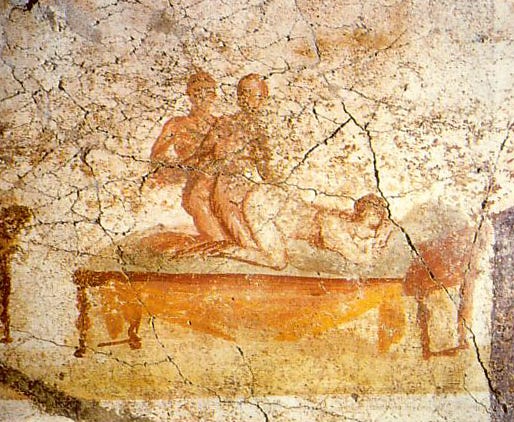
Prices for services at the lupānar were very low, one of the reasons being that these brothels were frequented by the lower levels of society (wealthy men had their own personal sex slaves and thus had no need for prostitutes) and many clients were either freed slaves or even slaves in bondage on a day off. On average the cost of a sexual service was just two assēs, the price of a loaf of bread.
Sex and Power among the Romans
The highly patriarchal culture of Rome is more glaringly obvious in sexual relationships than anywhere else: Roman women rarely had the power to choose whom they married, they were not permitted to have extramarital sex, as child brides (the age of consent for girls was 12!), they were expected to be virgins before their wedding night and the only men they were ever allowed to be intimate with were their husbands.
Meanwhile, Roman men had all the sexual freedom — wealthy Roman men had their sex slaves, of course, while their working-class compatriots regularly visited brothels. However, here’s the catch — it was illegal for a man to sleep with freeborn women or girls (except his own wife) and freeborn boys and men!
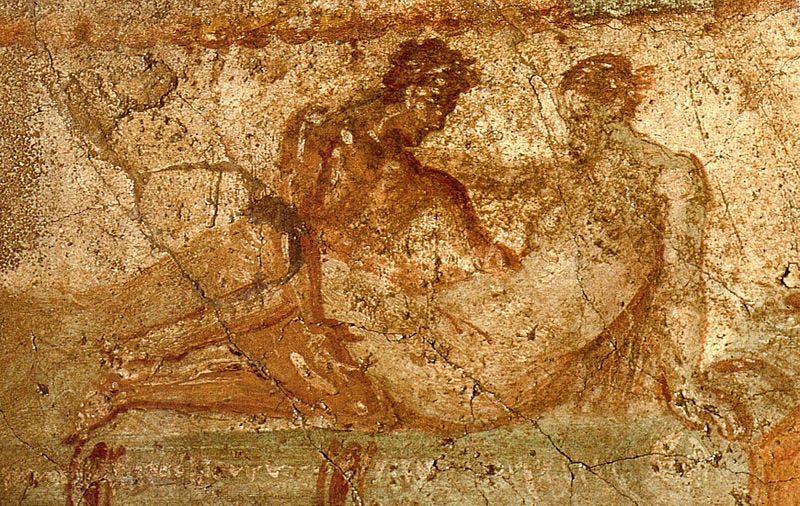
That’s right, in other words, a man was allowed to sleep with anyone, male or female, besides his wife so long as the person he was penetrating was a slave. And the Romans did not consider sex with slaves and prostitutes to be adultery!
Homosexual sex was perfectly acceptable so long as this protocol was followed — free Roman male citizens could not be sexually penetrated. In other words, the freeborn Roman client took on the active penetrative or dominant sexual role while the male slave-prostitutes took on the submissive, passive or “bottom” role.
As a matter of fact there were no words for “gay” or “homosexual” in ancient Latin. Roman men were expected to have both male and female sex partners! The Emperor Claudius was criticised by the historian Suetonius for being “libidinis in feminas profusissimae, marum omnino expers” or “of extreme lust in women, lacking in experience in males”! Romans were shocked that their Emperor Claudius had no taste in men and preferred to sleep exclusively with women!
The best way to describe sexual relations in ancient Rome was- those with power were always on top!
Women concealed, men revealed
While freeform men had all the freedoms in the world, freeborn women in Pompeii, like other areas in the Roman Empire, had one sole function — to bear as many male children as possible for their husbands.
Lesbian sex was therefore counterintuitive. But it did happen, and was regarded at best with disdain, at worst as a taboo.
While it was not unusual for older men, usually from well-off backgrounds, to openly consort with young male lovers (usually slaves or working class) women did not have that liberty and most of their affairs whether with men or with other women had be carried out in subterfuge for fear of being punished by their husbands and by the legal system of Rome.
If a married woman was caught with her lover, her father was entitled to kill both her and her lover. Otherwise, should he kill only one of them, he himself would be charged with murder. A freeborn man was allowed to kill his wife’s lover if said lover was a slave or a member of a specific lower class that included convicted criminals, prostitutes, pimps and gladiators. He was not permitted to kill his wife although he is expected to divorce her within three days and to have her charged with adultery the punishment of which varied throughout the history of the Roman Empire.
A society where freedom was relative
Ancient Roman cities like Pompeii were tapestries of contradictions. While being technologically advanced and equipped with public baths, plumbing, excellent roads and other sophisticated infrastructure, ordinary citizens often lived quiet unassuming and mundane lives. Slaves were bought by the wealthy like human livestock but they could also be freed, and freed slaves could even become Roman citizens. Freeborn men had much more political, economic, legal and sexual freedom then freeborn women. Homosexuality did not technically exist as something separate from heterosexuality yet freeborn men were only allowed to have anal sex with male slaves, never with other freeborns.
Life was both glorious and harsh, refined and squalid. Civilised and barbaric.
References:
Gamauf, Richard (2009). “Slaves Doing Business: The role of Roman Law in the Economy of a Roman Household”. European Review of History. 16 (3): 331–346.
Holy Sh*t: A Brief History of Swearing, by Melissa Mohr
Johns, C. “3: The Phallus and the Evil Eye”. Sex or Symbol? Erotic Images of Greece and Rome. British Museum.
Thomas A McGinn, The Economy of Prostitution in the Roman World (University of Michigan Press, 2004), p. 162.