In a World Run by Algorithms, Weirdness Is Our Best Weapon
How anomalous behavior defeats the systems of social control
The easiest way to break free of simulation is to recognize the charade and stop following the rules of the game.
No, cheating doesn’t count. Illegal insider trades and performance-enhancing drugs simply prove how far people are willing to go to win. If anything, cheating reinforces the stakes and reality of the game.
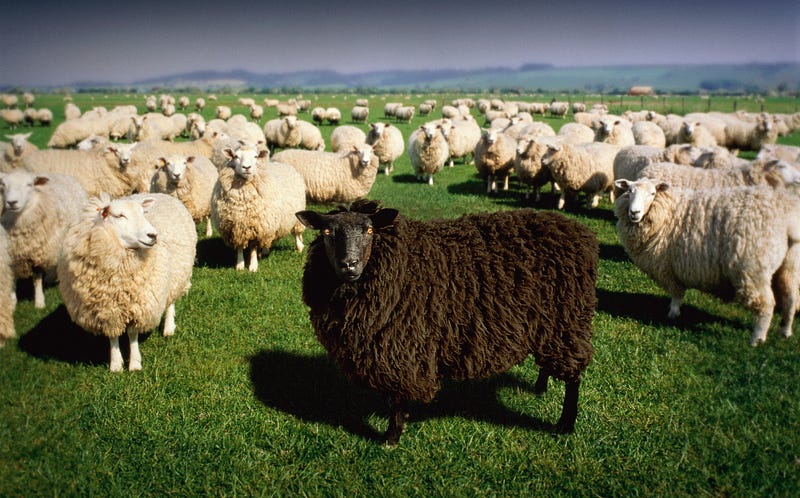
Transcending the game altogether means becoming a spoilsport — someone who refuses to acknowledge the playing field, the rules of engagement, or the value of winning. (Why win, anyway, if it’s only going to end the game?) In certain non-Western cultures, the spoilsport is the shaman, who lives apart from the tribe in order to see the larger patterns and connections. In a world where a person’s success is measured by career achievements, the spoilsport is the one willing to sacrifice commercial reward for social good. In a middle school where social media likes are the metric of popularity, the spoilsport is the kid who deletes the app or chooses not to own a phone at all. The spoilsport takes actions that make no sense within the logic of the game.
Such anomalous behavior challenges convention, breaks the conspiracy of conformity, and stumps the algorithms. A.I.s and other enforcers of social control can’t follow what they can’t categorize. Weirdness is power, dissolving false binaries and celebrating the full spectrum of possibility. Eccentricity opens the gray area where mutations develop and innovations are born.
We can assert our uniquely human sides through things like humor and pranks, music and magic — none of which can be appreciated or even understood by machines or markets. Comedy demands that we identify with someone else and recognize our plight in theirs. Music communicates through aesthetics, while art challenges our sense of self and our relationship to the outer world. Stage magic confounds our logical sensibilities, contrasting the way things appear with the way we know they should be, while spiritual magick explores the seemingly impossible relationship between our will and the workings of the universe.
Weirdness crashes boundaries, forcing us to see our complicity in reality creation: we break free of the imposed program and experiment with alternatives. None of our models are authoritative, but that’s the whole point. We each live within the confines of our own reality tunnels, seeing very limited pictures of the real world. That’s what we have in common. The best way to resolve the image is to bring more people and perspectives into play.
That’s why, most of all, being a spoilsport is a social signal. It is a way of calling out to the others who have unplugged from their programming and are seeking to reclaim their humanity. The weird may be what distinguishes us, but beware: unconventional behaviors are quickly identified, copied, and then sold back to us as commodified identities. That’s why being truly anomalous has to mean more than the adoption of a particular style or intersectional label. It’s about finding people with whom to connect more deeply and recognizing that the cues we use to identify one another are just means to that greater end.
This was section 64 of the new book Team Human by Douglas Rushkoff, which is being serialized weekly on Medium. Read the previous section here and the following section here.