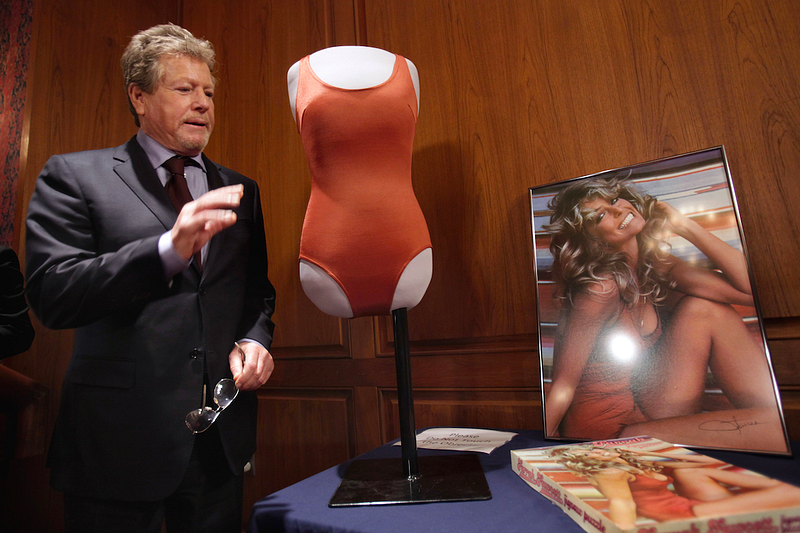
In 1976, Farrah Fawcett gave the world permission to masturbate
The story of an iconic bedroom poster
In 1976, a poster company in Ohio was looking to do a sexy bedroom poster. They had a model in mind—a woman best known from shampoo ads.
The deal was: a generation of teenage boys would masturbate to her image, and she’d get a 10% cut. Farrah Fawcett said yes.

The story of the poster is often told.
But one could read many articles about the poster and not learn some basic facts. Farrah Fawcett’s “Red Swimsuit,” as it’s often called, was was the first bedroom poster to be created as an erotic display of the female body.
Bedroom posters got big during the Vietnam War as a means of making anti-war statements. They expanded to Pop Culture fan memorabilia, from movies to music groups.
It became a teenage rite of passage to assemble the posters that evoked one’s dreams, ideas, interests. As I look at vintage photos of teenage boys’ bedrooms into the early 1970s, I don’t see women.

To sell soft-core porn to Middle America in 1976 was an interesting challenge.
The poster would have to be “dirty” enough to appeal to a boy’s erotic imagination, and prompt a purchase. It would also have to be “clean” enough for the boy’s parents to allow such a product into the house.
There were religious concerns. For two millennia, Christianity had warred against masturbation with strange fury, and the regulation on erotic display of women reflected that theology.
Anti-masturbation, actually, is the religion’s most fundamental teaching. As a Christian child, you’re taught that you are sexually controlled from the day of your birth.
It wasn’t just Christianity, of course. Many religions, Judaism, Islam, etc., banned it too. Every religious and political system, it seemed, was against masturbation. The communists in China and the Soviet Union tried to ban it just as vigorously as religion.
But the emerging fields of psychology and sexology had suggested masturbation wasn’t harmful.
It turned out that all the talk of the harmful effects of masturbation had been inaccurate, or really deceptive, since no one ever did go blind, etc.
The institutions did their best to keep the terror going. In late 1975, the Vatican released its Persona Humana report, which cracked down on homosexuality and masturbation (often framed as the same issue).

The story of the Farrah Fawcett poster, I realize, could be understood as an epic battle.
In one corner was Christianity, the Vatican, the Soviet Union, China, and most cultural authorities everywhere.
In the other corner was a shampoo model.
In the balance hung the sexual autonomy of boys everywhere.
Farrah Fawcett died in 2009. As I look over biographical sources for her life. I have to notice that she was a devout Catholic. She had grown up wanting to be a nun.
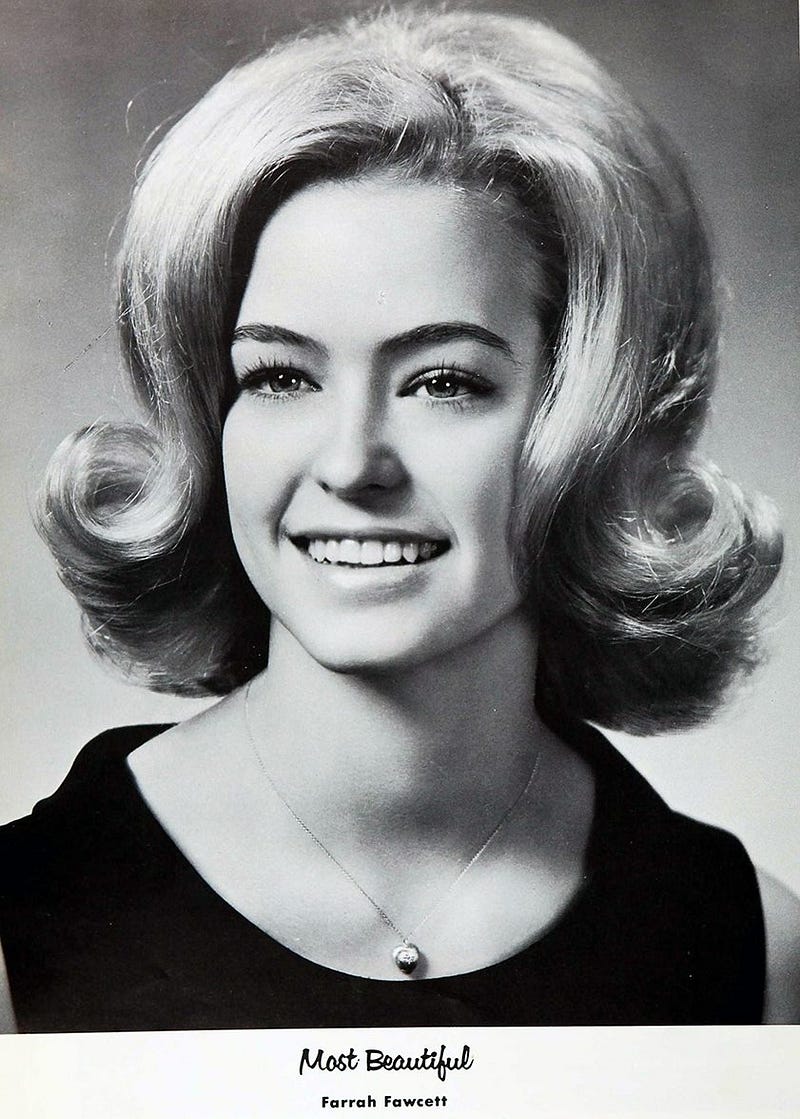
Her family was Catholic.
Her “saint name” assigned at baptism was ‘Mary’, and she seems to have absorbed the idea of being linked to the Virgin Mary. She collected pieta statues, and drew ‘Madonna and child’ images.
As a girl, Farrah’s mother was ill, and so from age two she was sent to the local Catholic school with her older sister. She was raised largely by nuns.
She seemed to have a special spiritual nature. Since a child, she was blonde and beautiful — so often called an ‘angel’.
She’d say in interviews that she’d wanted to be a nun. She didn’t say why she changed directions. The T.V. documentaries provide an answer.
One day when age seven, walking home from school by herself, a teenage male seized her and dragged her into a nearby cornfield. He was tearing at her clothes when she managed to escape.
An angel is a tempting victim?
It wasn’t just Farrah’s physicality, which was impressive enough. She carried within her some kind of light, some radiance, and men flocked to her. She refocused her existence to deal with this problem.
Every aspect of her famous personality and presence was a strategy to deal with obsessive male interest. She was often said to be extremely “nice”—and yet capable of lethal self-defense.
She became very athletic, and a skilled hunter. She was alert, and wary. At a slumber party once, the girls saw they had a peeping tom. Farrah alone ran after him, pulled him off the fence he was trying to scale, and held him down until police came.
She often downplayed her attractiveness.
She was noted throughout her college years to not wear make-up. Even so, men were said to line up just to see her, often falling in love with her—or that is how they described their interest.
At first she studied biology in college, then switched to art. Her artistic work, all her life, was almost entirely self-portraits.
Her work is often ‘dark’ — not attractive at all, and nothing like her exterior presentation. It seems that Farrah Fawcett experienced her inner self as troubled and inward, as wounded.

She took to sculpture.
Her key professor, Charles Umlauf, was a noted sculptor. He fell in love with her. But they worked together for years, as she did many studies of nude female figures—and he did studies of her.

She had many offers to come to Hollywood.
When she was in college it was a local joke when being around her, another man from Hollyood would be calling. She refused it, then decided she had no other choice.
She would discuss her rise to fame as a spiritual process. “I was led,” she would say in 1989. “I really gave no thought to my career.”
But she set to work shaping her image as an artist creating an artwork. This would be observed by her professor, Charles Umlauf. “Farrah has a sculptured look,” he noted in an interview.
Her hair became the most famous sculpture of the 1970s.
Flipped back on each side, the style was called “angel-winged.” Though I find her hair suggests a halo. In either reading, Farrah Fawcett’s hair was a Christian sculpture.
A range of hairdressers would be credited with the look, but I believe it was Farrah herself who designed it. She never disclosed that it was not all her own hair. She was an early adopter of hair extensions.
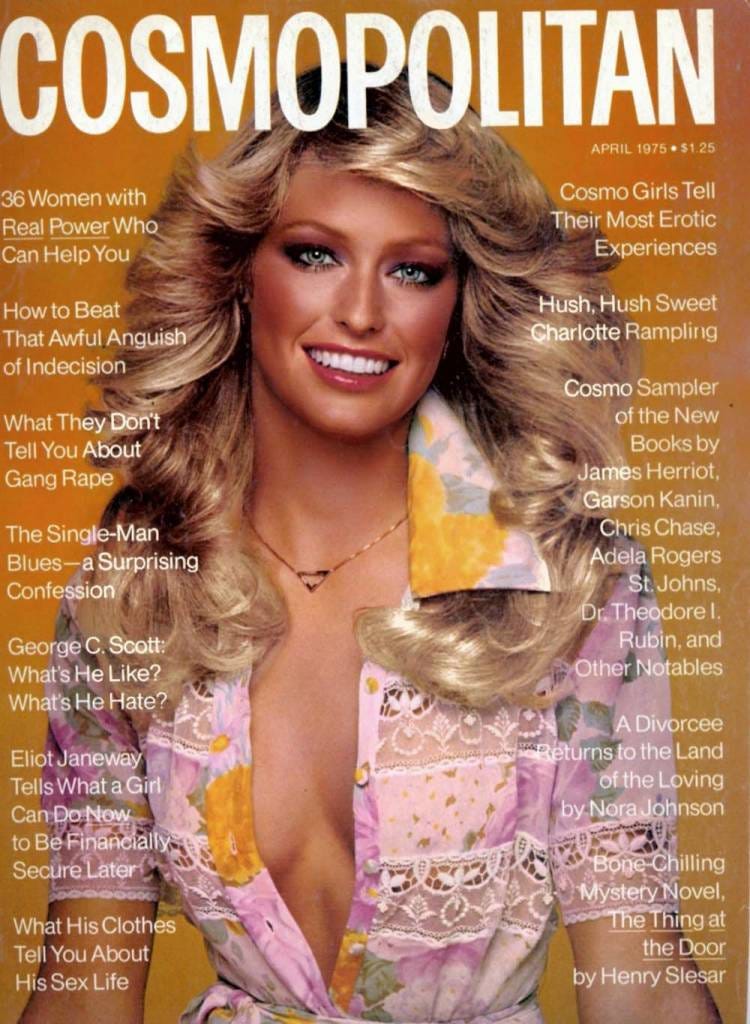
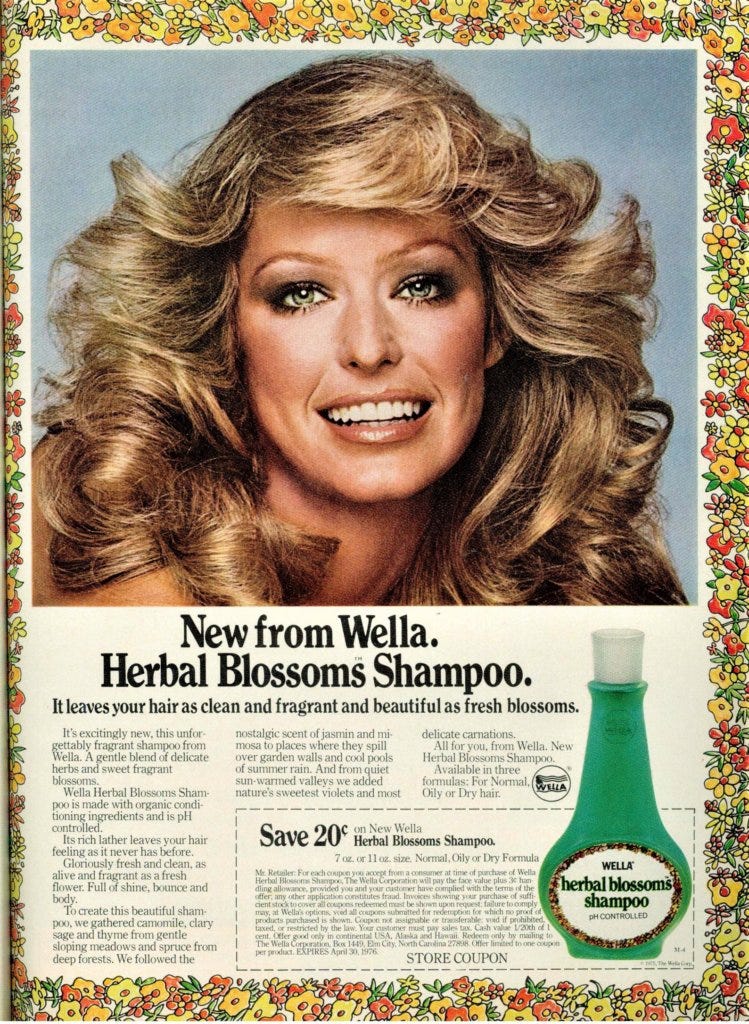
She was often said to appear ‘wholesome’.
The magic of a Farrah Fawcett appearance was that she was beautiful and sexy, and yet sweet, and not vulgar. In a culture where sex was charged with ‘sin’, darkness and insinuation, she was doing something new.
Many critics would comment on her explosive appearance on the cultural scene. Camille Paglia would recall: “There’s something about Farrah that was athletic, that was vibrant, that was smart, and yet nice. She was a kind of ray of sunshine into 1970s culture at the time.”
The scholar Chadwick Roberts writes: “Farrah epitomized the shift in our social perception of sex, she was both erotic and wholesome. She was the first mass visual symbol of post neurotic fresh-air sexuality.”
Farrah was old to be a ‘starlet’
That role was typically played when a woman was closer to 21. When photographed for the poster, she was 29, an age when women were expected to be married and mothers, i.e. “settled down.”
In appearing, at age 29, sexually viable, carefree, and flirty, Farrah was suggesting a different life cycle for modern women.
Her career was on the upswing. She was living with a man but reluctant to marry. Lee Majors was very taken by her, but she was less taken with him. He was an alcoholic. He was an ordinary man.
She’d been cast in a T.V. show, Charlie’s Angels. She’d was a new kind of woman: athletic, armed and dangerous, and able to deal with “bad guys.”

But her basic status as a traumatized person was always apparent.
Of all her life’s work, which is much occupied with women being harassed, stalked and assaulted, this theme is most apparent in the poster.
Farrah would say that the poster was unusually revealing of her. “It’s more me than any other photograph out there of me,” as she put it.
That wouldn’t be a reference to a display of her physical body. The poster was not very revealing. That was a surprise she sprung on them. When dicussing the poster, recalled, she’d been given the concept of “looking out from behind a tree, you know, acting seductive.”
The “tree” concept wasn’t explained, but I suspect she’d been asked to pose as Eve from the Bible’s Creation story. That would’ve been religious cover for her appearing less clothed.
She recalls thinking: “‘No, that’s not me.’ I wanted to be smiling. Happy.”
The poster was said to be created rather casually.
Farrah is often said to have done her own hair and makeup. All of this misunderstands her typical misdirection or deception, as she often underplayed the preparation she’d do for public appearances.
Her hair could be styled for hours, then she’d claim: “I just sort of toss it around up there, and that’s how it comes out.”
A 1977 newspaper article has celebrity hairdresser Kenneth commenting on the poster. He says: “That hair may look carefree, but it’s very hairdressed. You know there was a hairdresser there five minutes before the picture was taken.”
The photographer, Bruce McBroom, has been the main source for details about the shoot.
In many interviews he recalls arriving at Farrah’s home in L.A., thinking she’d be wearing a bikini. He recalled the instructions he’d been given: “drop-dead, sexy pictures.”
When Farrah came out in a one-piece bathing suit, McBroom didn’t know how to proceed. They began to shoot, and she seems to have been trying for a playful, “girl-next-door” to “angelic” effect.
But her eyes are darkly shaded. Despite the forced smiles, the impression I get is of a tragic idea of human sexuality.
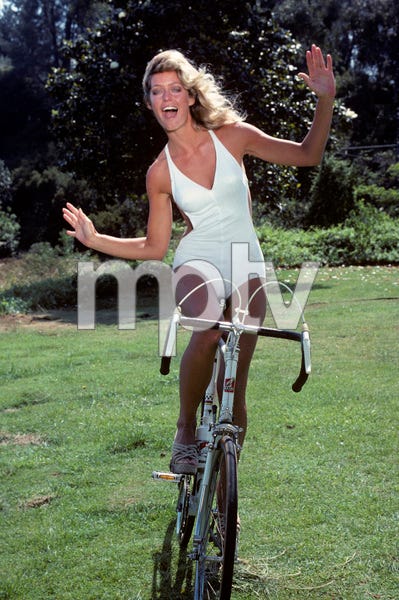
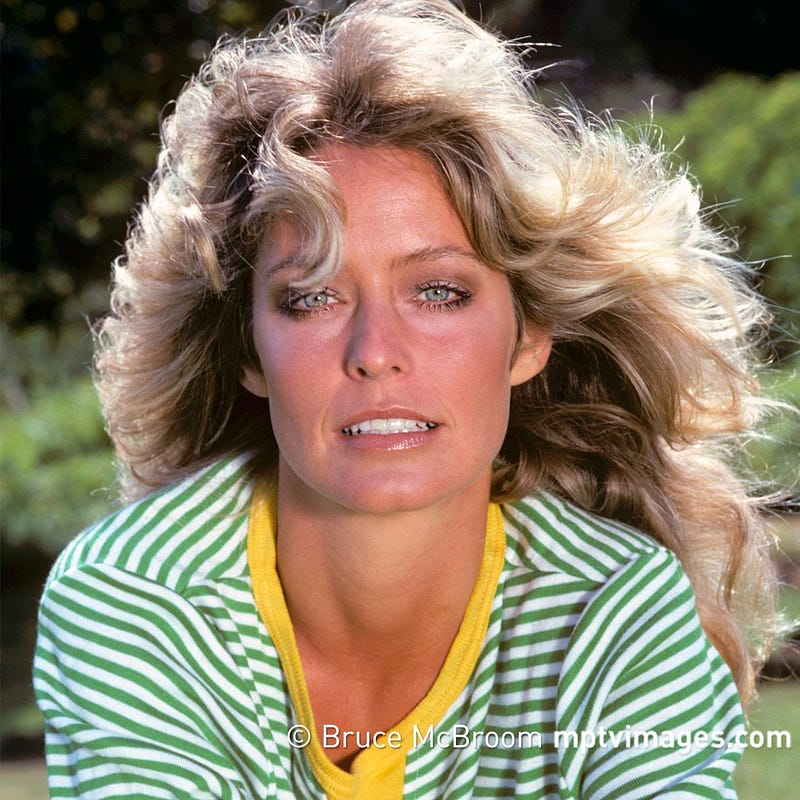
McBroom prompted her to try another outfit.
Farrah went to change, and came back in another full-body swimsuit. That it’s so often called ‘red’ is misleading, as it’s a burnt orange, the color of the robes of Tibetan monks.
As McBroom recalled in a 2009 interview, Farrah said in a Southern accent: “Well, is this anything?”
He looked at her, and said aloud: “Oh my God.”
They resumed shooting. But the poster was not yet happening.

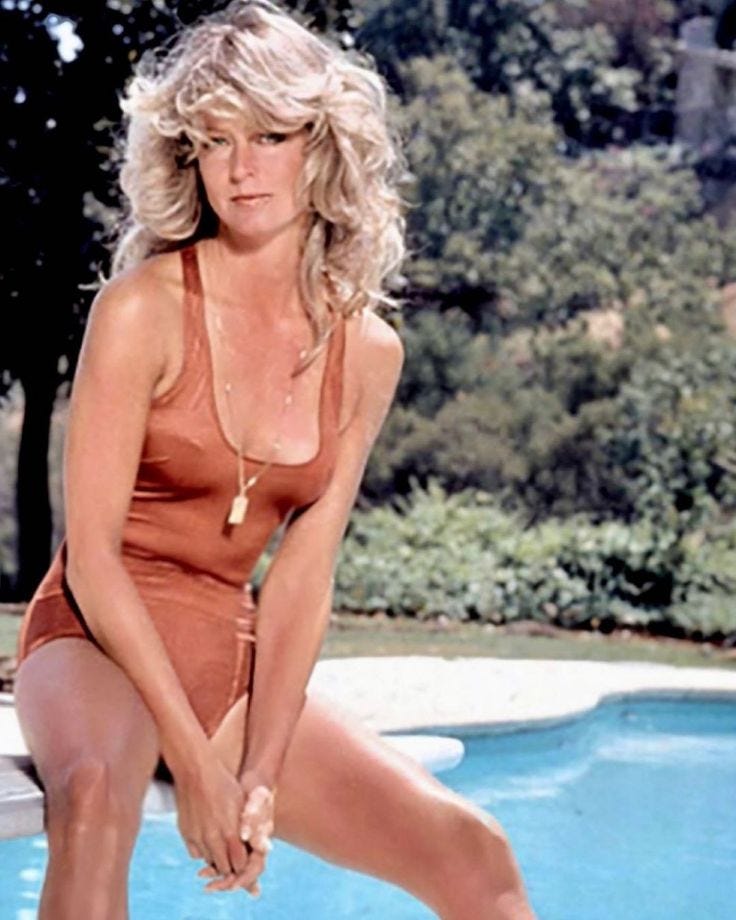
For all Farrah’s weird grins, she seems basically to find life threatening.
Left to herself, her posing just seems self-protective, closed off, and totally impervious to erotic ideas that men might bring to female bodies.
McBroom must’ve sensed failure in the air. He recalls he went to grab an ‘Indian blanket’ from Mexico that he says he used as a seat cover of his pick-up truck. They positioned it in a few ways, first as a blanket on the ground, as he seems to have been somehow positioned over her.
As Farrah lays on the blanket and poses, I see her continue to struggle to perform an eroticism she doesn’t feel.



The outtakes reveal an influence which was less apparent in the final result.
It seems they did not wish to say that the famous poster was actually a riff on a famous photo shoot done by Marilyn Monroe in 1949.
That shoot, of course, was the first centerfold of Playboy magazine in 1953, as launched pornography as a presence in American public life.
But I find myself moved. I am not sure how an artistic influence is different from a divine visitation. It seems to me that when Farrah was flailing and unable to generate an erotic force, Marilyn appeared to show humanity, once again, how to be sexual.
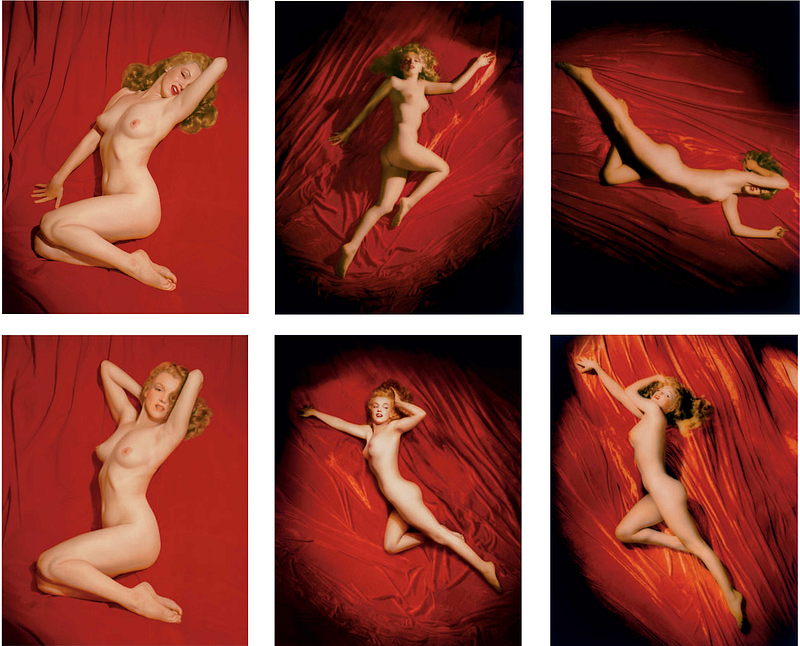
Farrah began working off Marilyn’s posings.
A new command and sense of direction began to appear—but not by mimicking Marilyn. She begins to revise the posing into her own.
I have wondered at a yogic influence. Farrah Fawcett was noted later to be a yoga pracitioner, and it seems to me she’s moving into Ardha Matsyendrasana, or seated spinal twist.
She’s focusing. There is now eroticism. The idea of a sexual engagement is even in the air. But there is distance and walls. She’s trying to project desire but it’s misfiring.


Farrah’s bent elbow seems to have its own story.
Years later, she posed for a sculpture of herself that mixed with imagery of the Virgin Mary, as the work was a pieta modeled on Michelangelo’s Rondanini Pietà.
She clearly had intended to evoke the “Red Swimsuit” poster, but the arm positioning was different, suggesting dreaminess, but also self-protection? This is a pose to shield oneself from being struck.
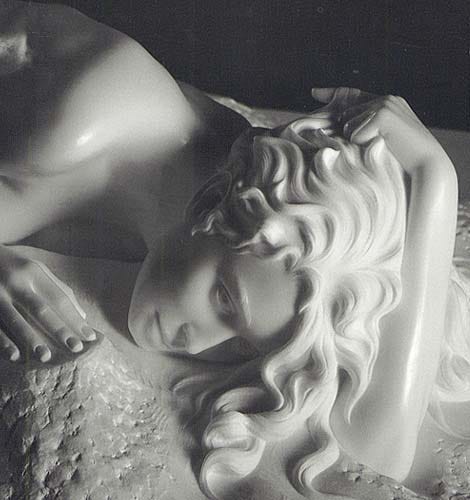

There would be a quirky belief that her hair had spelled out the word “sex.”
When I look at her hair, I’m seeing…a cornfield?
And I see a woman who is truly in inner distress.

But finally, that smile sold the image.
In one documentary of Farrah’s life, her tennis coach is interviewed. He says he had arrived as the photo shoot was ending. “She was as calm as a cucumber,” he says. “It was mesmerizing to watch because she didn’t sweat.”
He recalls that McBroom had prompted Farrah to do a final shot. She lifted her head, and there it was.
The tennis coach read the smile as flirtatious. As he said: “You’d like to think that she was smiling at you.”
The smile is quite strange.
As Leonardo’s Mona Lisa is often said to have a smile that changes as the viewer looks at it, to study the “Red Swimsuit” poster is to find Farrah’s expression changing very strangely.
I was hesitant to say that I read her face as anguished. But I noticed others saying much the same thing. A 1977 profile notes:
“Many viewers find the smile anything but natural and spontaneous — they term it artificial, strained, forced, even painful.”
In a 2019 blog post, the novelist Kim Magowan, amid some family memoir, has a startling reading:
“The most perplexing thing about the popularity of that poster is Farrah’s smile, which is not phony so much as tormented: the corners of her mouth extend as if she were a horse wearing a bit. Or perhaps this is not perplexing at all. Perhaps Farrah’s clear absence of pleasure is the key, not her nipple after all: her misery the turn-on to my creepy, misogynist brother David, and to all fucked up teenage boys.”
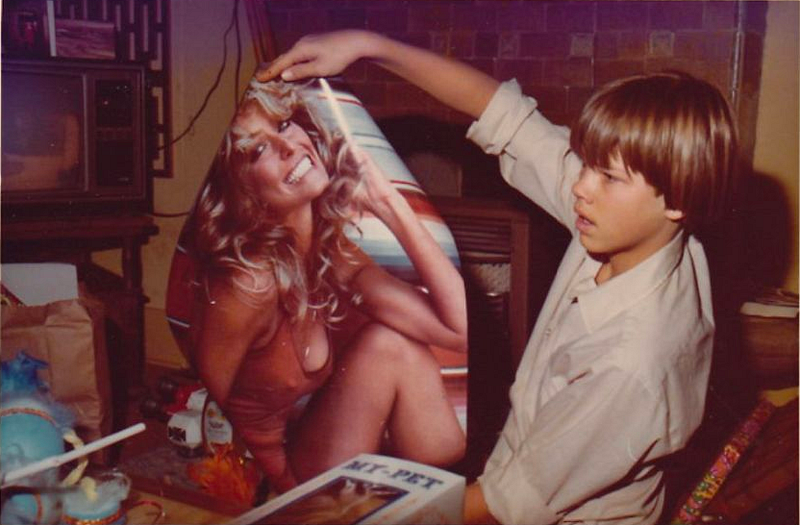
Ted Trikilis was said to be horrified by the image.
Bruce McBroom recalled: “He told me he wasn’t ever gonna pay me, because he hated the pictures.”
But Trikilis would note in his own interviews that he decided to accept her intuition about it. Farrah had said this was the one. One thing she seems to have liked is the lack of any overt pornographic suggestion.
“It’s not even sexy,” she’d say.
It was an explosive hit. Said to have sold over 12 million copies (though I can’t find a source for that), the “Red Swimsuit” entranced an era. It was tied into enthusiasm for Charlie’s Angels, which debuted months later. But the poster was more famous than the T.V. show.
The poster was a religious icon. There was something biblical about it.
“Farrah is a strange combination of the virginal girl-next-door and the vamp,” a scholar offers in a 1977 newspaper piece. “She’s a cross between Madonna and Delilah.”
But was it sexual?
The matter has been debated. In 1977, the newspaper columnist Mike Royko wrote a piece on not finding the poster sexy. When he looked at “sex symbol” images, he writes, “I knew what she had in mind” — or at least “what I immediately had in mind.”
With Farrah, he said, he wasn’t sure what she was thinking.
Many men have commented on the poster’s lack of erotic allure. One man offers: “She was attractive but that poster never did it for me.”
Another man said: “Every time I see this poster, I look at her eyes and smile, and think that she really didn’t want to be there.”
The poster’s appeal was basically “fap material.”
This is the most typical association. “She was the masturbator’s delight,” said Farrah’s publicist in a later memoir.
I look over reports over the years of the poster’s appeal for regular boys. Typically, it involves this theme. As one man put it: “Caused me to spill more DNA than a CSI lab tech with Parkinson’s.”
A man tweets: “I wonder if Farrah knew just how many ballbags were being emptied by teenage boys while staring at her poster.”
But there was a strange effect: boys didn’t think they weren’t really alone.
The idea of Farrah being imagined as a sex partner is a regular feature of commentary, though subtle. One man says: “Many a boy transformed into men with the aid of this poster.”
That’s the language used for sex, i.e. a man was said to become a man by having sex with a woman. But this also helped to minimize the religious problem of masturbation. It wasn’t perceived as solitary. You weren’t really alone. Farrah was there—and she was a ‘nice girl’.
She looks at you in a way that seems nervous, but kind. It seems to me she suggests: ‘You’re a good person, and I’m nervous, but let’s meet up.’
Teenage boys having the poster became routine.
Was having it a public declaration the boy masturbated? The scholar Lauren Rosewarne suggests that ownership of the poster “implies that a boy in possession of it was using it sexually.”
But somehow it was all right. The poster seems to have marked public acceptance of masturbation as an acceptable practice.
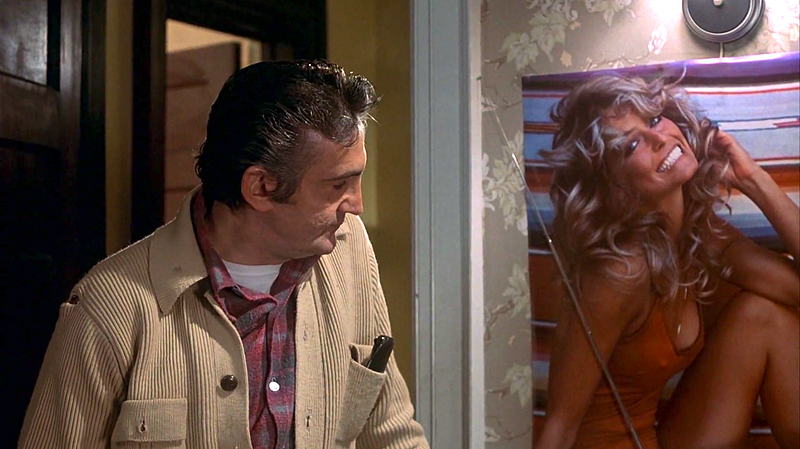
Two movies in 1977 featured the poster—in scenes with adult men.
There it is in Saturday Night Fever, where an adult man seems to be getting ideas for his event’s entertainment. In Close Encounters of the Third Kind, the poster is layered a suggestive image of a man’s hand.
Was the poster just perceived as a focus for teenage boys?

It addressed sexual anxieties across the board.
One man recalls: “My dad bought that poster for me when I was 10. I’m sure now he did it to make sure I didn’t grow up ‘gay’.”
Another man recalls his mother bought him the poster, though he wasn’t sure why: “Maybe she just thought it was in fashion, or was worried I might not know what a girl was.”
One man writes of being a secretly gay boy told about masturbation by another boy, and facing Farrah Fawcett’s poster as a daunting heterosexual obligation: “Farrah Fawcett’s smile seemed to mock me.”
Young women sometimes had the poster too. One woman recalls: “I had it on my wall on 7th grade and my mom said people would think I’m a lesbian. As if that’s a bad thing.”
She became a global superstar.
A 2009 obituary of Farrah by Tunku Varadarajan discusses his growing up with it in India, where the poster seemed to represent the idea of life being, he writes, “fundamentally good and full of promise…”
He wants to suggest the poster represented America, but perhaps better it represented Farrah, and a new idea that was not a dangerous, dark force, but somehow on the side of light, hope, possibility.
Year after year, the “Red Swimsuit” image continued to be felt. The iconic T.V. show Baywatch, which ran from 1989 to 1999 (with spin-offs and a movie) was clearly a revival of its strange magic.
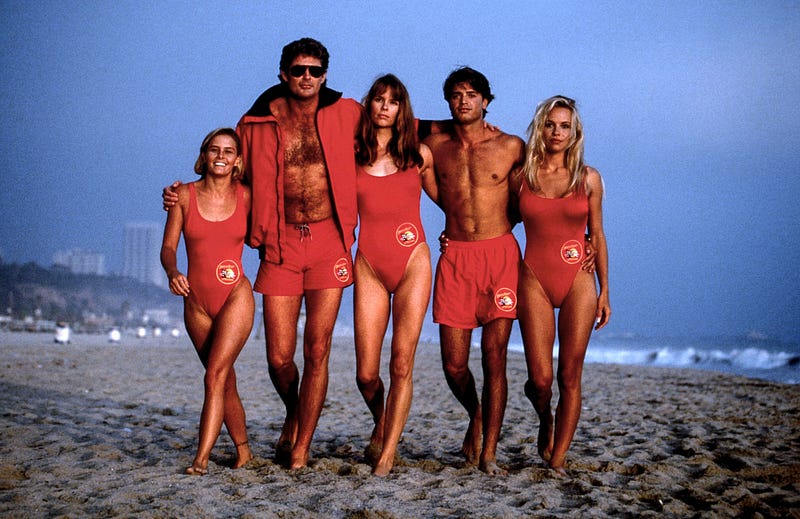
The show’s signature star was Pamela Anderson, the Playboy cover girl, who would re-enact the “Red Swimsuit” poster into a more conventional sexual appeal.
I’m left wondering if this re-enactment would’ve had the same impact as the original. There was just something about Farrah Fawcett.

She lived the rest of her life in the poster’s shadow.
Her fame was a kind of prison. She’d get phone calls at all hours of day and night, picking up the phone to hear boys say: “I love you. You’re the most beautiful person in the world!”
She generated hysteria when appearing in public. In a 1980 interview, she says: “I see people who just stop reacting to me in a normal way. They act so silly. I go to Mass every Sunday just to learn patience around these people.”
Unless she was all made up, fans would be disappointed or shocked, and she became less interested in being seen. “I am so sick of looking perfect,” she’d say.
She kept acting, and her work was often “dark.”
The public wanted to think of Farrah Fawcett as a blonde sunburst of sexy, cheerful blonde glamour. But, unexpectedly, the story she seemed to want to tell was about a woman locked in a struggle with a man intent on her destruction.
I remember watching her 1986 movie Extremities once on late-night T.V. and thinking it nearly occult, like a real and terrible battle with the forces of evil, though it was just a man.

Everything she’d do seemed to pale to the poster, which followed her like a second self.
Her later husband, Ryan O’Neal, writes: “Imagine the pressure of loving someone whom millions of men fantasize about and desire? Imagine trying to be that woman and having to live up to your own poster.”
The ‘real’ Farrah, as she aged, seemed to her fans less a woman than a betrayal of the teenage fantasy. The fun of teenage masturbation led to the reality of relationships and conflict, sickness and dying.


Did the poster, in the end, kill her?
When she was diagnosed with anal cancer, she declined the medical treatment for that condition. Ryan O’Neill explained: “They wanted to cut her open and take everything out — that was the cure — but a bathing beauty with a colostomy bag? That would have been a test.”
I try to assess the story of the poster. It gave the world permission to masturbate? It wasn’t just that. From her conflicted self, Farrah Fawcett smuggled into the minds of millions of boys a new idea.
A woman has feelings. 🔶