
In 1724, a Young Woman was Hanged for Concealing her Pregnancy
Miraculously, she survived her hanging, earning her the nickname “Half-Hangit Maggie”
On a bustling street in Edinburgh, Scotland, is a cozy pub named Maggie Dickson’s, where patrons can enjoy traditional Scottish delicacies while listening to live music.
Most people don’t know, however, that the pub’s name pays homage to a real woman who was the subject of one of Scotland’s most notorious crime stories.
Women in the 1700s were expected to be submissive, quiet, and chaste. Maggie was none of these things.
Margaret “Maggie” Dickson was born in Musselburgh, Scotland, in the early 1700s. In a time when women were expected to marry young, submit to their husbands, and pop out babies, Maggie could think of no worse fate.
After all, she saw how miserable her own parents’ marriage was. Her father was an abusive, alcoholic philanderer, and her mother had resigned herself to playing the role of the long-suffering wife.
But such was life in a bleak, Scottish coastal town. The men were hardened by the rough weather and grueling physical work of fishing. The women were equally tough and resourceful, struggling to keep their children alive on a meager subsistence.
Maggie eventually married a fisherman and bore him two children. But her free spirit could not be tamed. Like her mother, she was trapped in a loveless marriage to an alcoholic. Worse, her husband couldn’t even support her and her children financially.
Maggie unleashes her passion and gives in to her wild side.
Faced with starvation while her husband was off at sea, Maggie had no choice but to find another source of income. With her good looks and charming personality, she discovered how shockingly easy it was to seduce young, handsome men in nearby Edinburgh (where she often went to sell fish) — and make money while doing it.
It became clear that monogamy and motherhood weren’t Maggie’s thing, and the ability to support herself in this scandalous manner was too intoxicating a prospect. Suddenly unleashed in Maggie was a desire to start a new life of pleasure and sensuality.
When her husband was enlisted in the Navy, she saw her chance. She abandoned her children with a friend and decided to journey to Newcastle, England, where she had relatives. It was there that she decided she would find a new husband. Maybe this time, she thought, she could marry for love.
Maggie would never make it to Newcastle.
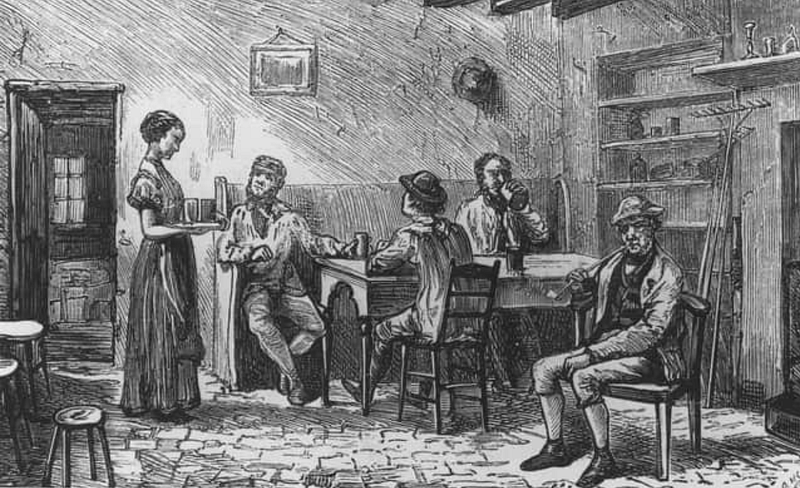
The journey from Musselburgh to Newcastle was treacherous and plagued with freezing weather. To escape the severe cold, Maggie ended up at a tavern, where the landlady offered her a job as a tavern wench in exchange for room and board.
All was going well for Maggie until she fell madly in love with the innkeeper’s son, William Bell. The dashing young man was equally smitten but knew that Maggie was off-limits as she was technically still a married woman.
That didn’t stop the two from eventually consummating their relationship, and Maggie became pregnant with William’s child.
Panicked, Maggie tried to hide her condition before secretly delivering her baby prematurely. She claimed that her baby was born dead, but what she did next would seal her fate.
A local fisherman finds the baby’s body by the river Tweed.
Maggie tried to dispose of her baby’s body on a riverbank when she was spotted by a fisherman. Maggie was immediately arrested and sent to Edinburgh to await trial, languishing in deplorable prison conditions.
Some say she was charged under the Concealment of Birth Act, while others contend she murdered her baby. It didn’t really matter. Concealing her pregnancy was enough to warrant the death penalty (it was basically a way to criminalize abortion). Never mind the guy who knocked the girl up to begin with.
After a sensational trial, Maggie was found guilty and sentenced to death. Maggie was taken to the Grassmarket — where her namesake pub stands today — and hanged.
The hanging goes horribly wrong.
When “criminals” are hanged, the body is usually donated to the local medical school. But Maggie’s friends and family were able to claim her body and place her in a coffin to be taken back to Musselburgh for burial.
Supposedly, a loud knocking suddenly came from inside the coffin on the journey. To everyone’s shock, when the coffin was opened, Maggie sat up, very much alive, with barely a scratch on her.
Whether the court determined that trying her again would be double jeopardy (after all, she technically had been hanged) or that her miraculous survival was a sign from God, the court decided to set Maggie free.
Legend has it that Maggie returned to Musselburgh, reunited with her husband, and had more children. This time, however, Maggie entered the relationship on her own terms. Unrepentant and shameless as ever, she ran an alehouse and lived for another 50 years.
Conclusion
Maggie was flawed, for sure. But it’s hard for me to see her in too negative a light. I think it’s because the legend is so old and the details so embellished that it’s difficult to separate fact from fiction.
Also, I can’t help but take away from the tale how painfully limited a woman’s choices were back then. Marriage was required for women to have standing, stability, and an identity. What were your options if you were trapped in a loveless or abusive relationship and deeply unhappy?
Maggie was independent, feisty, and impulsive. Yes, she was promiscuous. Yes, she got pregnant out of wedlock. But the world in the 1700s was (and still is) hard for single, pregnant, working-class women. Maggie made certain choices, and she paid dearly for them. She was hanged, after all!
The fascination around the headstrong “Half-Hangit Maggie Dickson” clearly continues to the present day, where you can debate the merits of this bizarre case over a pint or two at Maggie Dickson’s Pub.

Sources: