
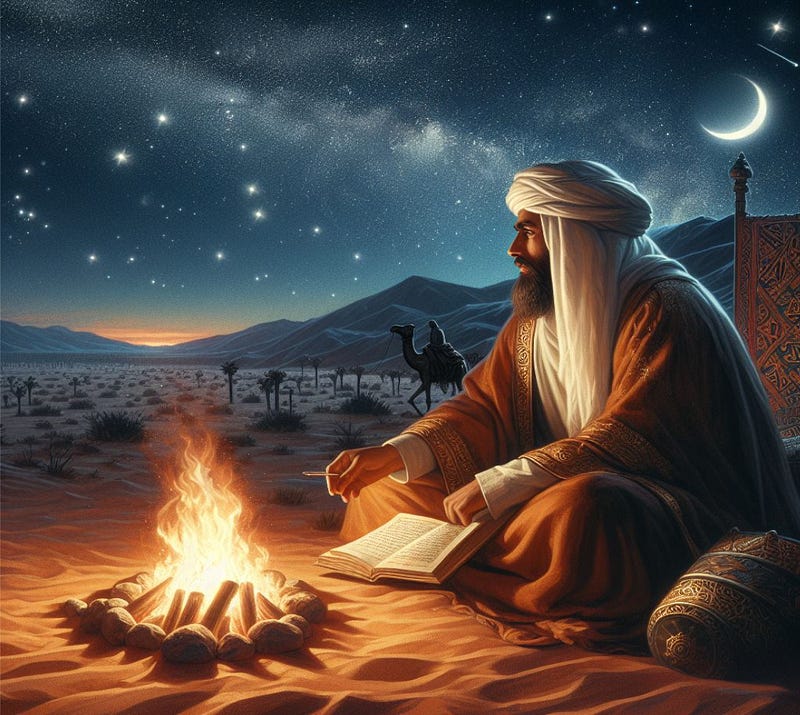
Imru’ al-Qays, King of the Arabs
Maulana Jalaleddin Muhammad Balkhi, known as Rumi (The Book of Love)
For more insights about Rumi and his poems:
Rumi’s impulse feels earthward in its transformation, going down instead of up in the way one might aspire to the angelic. There is no down or up in love. Still, if one had to say whether Rumi’s poetry goes more with the pure transcenders or more with the grief-gardeners, one would say he’s a ground-hugger and not so much a high-flyer, more Jamal (feminine, receptive) than Jalal (masculine, commanding). But as Rumi himself says hundreds of times, there is little one can say about love. It has to be lived, and it’s always in motion. When Rainer Maria Rilke, the great mystical poet of the twentieth century, saw the *Mevlevi dervishes in Cairo in 1910, he said, “With Rumi, the scale is shifted, for this is the mystery of the deeply kneeling man. In following the peculiar weight and strength in his knees, he belongs to that world in which height is depth. This is the night of radiant depth unfolded.” He referred to the night of December 17, when Rumi died in 1273. It is celebrated as his union with the divine.
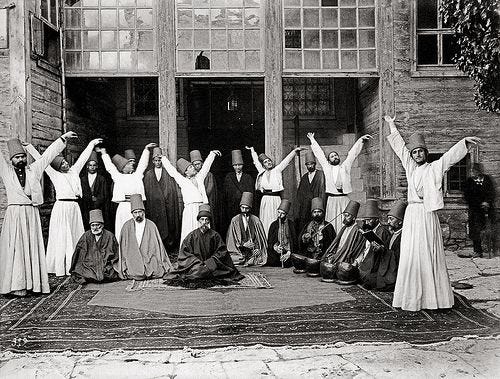
*Mevlevi dervishes: Dervishes, sometimes called Sufis, are members of Islamic religious communities who seek a direct and personal experience of God through asceticism, remembrance of God (dhikr), music, dance, and spiritual ceremonies. Dervishes and Sufis are often recognized for their relatively lesser attachment to worldly appearances and their focus on personal spiritual development. They may practice various approaches and exercises, but their main goals include purifying the heart, surrendering to the divine will, and loving God and His creation.

Imra’u ‘l-Qays, king of the Arabs, was very handsome and a poet full of love songs.
Women loved him desperately. Everyone loved him, but there came one night an experience that changed him completely.
He left his kingdom and his family. He put on dervish robes and wandered from one weather, one landscape, to another.
Love dissolved his king-self and led him to Tabuk, where he worked for a time making bricks.
Someone told the king of Tabuk about Imra’u ‘l-Qays, and that king came to visit him at night.
“King of the Arabs, handsome Joseph of this age, ruler of two empires, one composed of territories, and the other of the beauty of women,
if you would consent to stay with me, I would be honored. You abandon kingdoms, because you want more than kingdoms.”
The king of Tabuk went on like this, praising Imra’u ‘l-Qays and talking theology and philosophy.
Imra’u ‘l-Qays kept silent. Then suddenly he leaned and whispered something in the second king’s ear, and that second King became a wild wanderer too.
They walked out of town hand in hand, no royal belts, no thrones.
This is what love does and continues to do. It tastes like honey to adults and milk to children.
Love is the last thirty-pound bale. When you load it on, the boat tips over.
So they wandered around China like birds pecking at bits of grain. They rarely spoke because of the dangerous seriousness of the secret they knew.
That love-secret spoken pleasantly, or irritation, severs a hundred thousand heads in one swing.
A love-lion grazes in the soul’s pasture, while the scimitar of this secret approaches. It’s a killing better than any living.
All that world-power wants, really, is this weakness.
So these kings talk in low tones, and carefully. Only God knows what they say.
They use unsayable words. Bird language. But some people have imitated them, learned a few birdcalls, and gotten prestigious.
Recommended and related topics:
To support me through my investigations you can buy me a book📖 and also For more interesting and engaging facts, subscribe and follow now.


