
5 grammar rules you can break to sound more relatable
Rebels unite! Break out of grammar prison today.
This is a post about English grammar.
Warning! Could cause drowsiness. Do not read it while operating machinery or cooking on an open fire.
Top 5 rules to break
English Rule #1: “End each sentence with a preposition.”
When you were at school, you were probably forced to sound like the late Queen by uttering,
“With whom are you going to the cinema?”
Your English teacher probably clutched her pearls and gasped if you dared to say,
“Mrs Richardson, who are you going to the cinema with?”
However, if you usually say, “I know where you’re coming from” rather than “I know from where you are coming,” write it how you’d say it.
Use contractions and let that “from” dangle at the end.
Moral of the story: Make your writing sound like a conversation with a friend instead of a formal exchange with royalty.
English Rule #2: “Use Sentence Fragments”
We all speak in sentence fragments. It’s normal!
They sound natural and relatable — exactly how you want your copy to sound.
Before you shout, “But sentence fragments tend to represent incomplete thoughts,” at your screen, let’s take a look at some good advertising examples:
“You’ll be glad you bought a group ticket. And so will your friends.”
“Come find us. Or we’ll find you.”
“Why? Because you’re the bomb, that’s why.”
It’s all about creating rhythm.
And breaking patterns.
Think about it!
Text is monotonous when each sentence is perfect or the same length.
Your scroll-sleeping reader, will switch off even more.
The moral of the story: Wake up! Break patterns. Chop up sentences.

English Rule #3: “Don’t Use Slang”
You don’t have to swear like a sailor to use slang.
You don’t have to drop F-bombs or use the S-word (unless you want to shock or surprise people).
Use colloquial, informal, everyday language to sound natural and conversational.
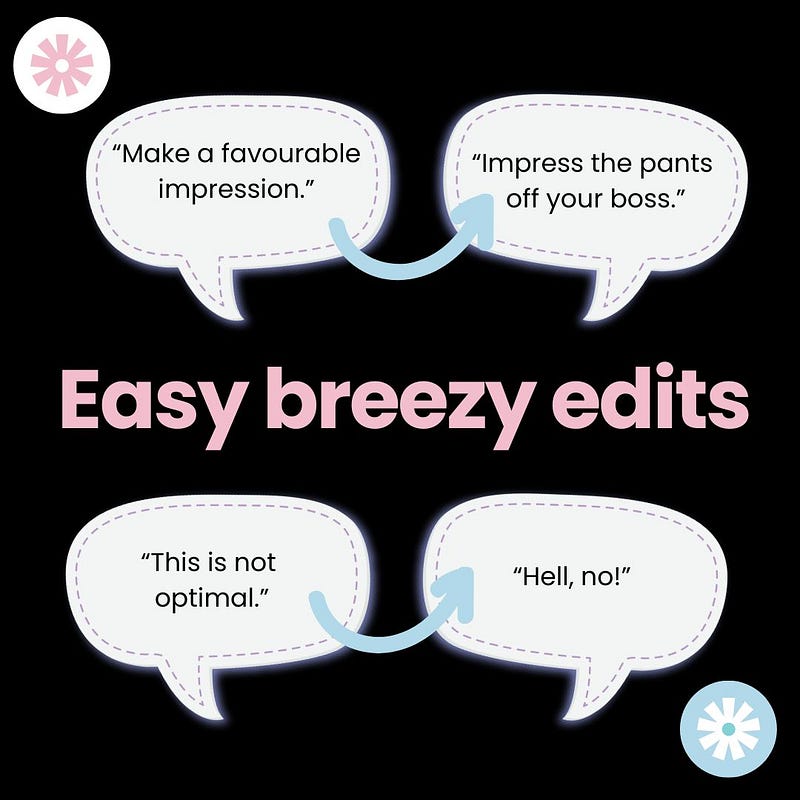
Moral of the story: Use your common sense (read the room, darling!), but it’s okay to sound informal and human when you write.
English Rule #4: Write prose with flowery language
From this day forward…
… You have permission to cut the crap (sorry, prose) to “cure stiff and stilted copy disease.” — Marie Forleo.
Your copy will have less impact if it sounds like you swallowed a dictionary.
And, like me, you were taught to write prose at school.
I once believed you had to use bombastic, ostentatious language with many filler words to sound professional.
Big words are perfect for anyone trying to impress their reader with an extensive vocabulary and a wall of text like the Harvard Review.
But there’s a better way to communicate.

Thank heavens I found a cure.
Marie Forleo’s prescription for Lame Copy Disease:
“The cause: Too many loooong words in all the wrong places makes your copy bloated and sluggish (and hard to digest).
The cure: Remove ALL the redundant, useless, and ‘filler’ words.”
In other words, get rid of any words you can cut without losing the meaning of that sentence.
Filler words to eliminate:
- A little
- A bit
- Fairly
- Kind of
- More or less
- Somewhat
- Really
- Sort of
- Somewhat
- Quite
Want to know how to edit filler words?
Original version
“I firmly believe that everyone is fully capable of writing their own copy and developing their own truly unique voice, as long as they have the necessary knowledge of how to implement certain techniques, which I am about to share.”
Edited version
“Everyone can write. Everyone can develop a voice. All it takes are these simple techniques.”
I don’t know about you, but I feel like I’ve shed those unwanted Christmas pounds.
English Rule #5: Use the Passive Voice
“Staying active; it’s good for your grandma and great for your copy.” — Marie Forleo
Forget the passive voice.
Start using the active voice to encourage your readers to stay awake or take action now.
What do I mean by the active voice?
- Verbs are your best friend regarding the active voice and passive voice.
- The active voice is stronger and uses fewer words (bingo!).
- The active voice is direct, confident, clear, and has more punch (like Rocky Balboa).
- The passive voice is weaker, less direct, and a bit of a coward (like Scooby-Doo). While it’s not incorrect, it can slow down your message.
Final thoughts
You don’t have to have a product to sell to use these techniques.
It’s fun to play with words. Don’t be afraid to snub conventional grammatical conventions to make your writing more effective.

“If you want people to buy into your ideas, you gotta sell ‘em!” — Ellie Kingswell
And the best way to do that is to make your words clear, concise, and compelling.
Join the club.
Join the underground movement of rebels with a typewriter. 😉
In other words, follow my party of one for more writing tips and tricks.
👏 Clap the article to show your appreciation
🌟 Share the story on social media
🔔 Follow me on Medium