
Improve Your Note-Taking Skills with a Powerful 6-Step System
What are Cornell Notes, and how can you use the Cornell note-taking system in your daily work life?
I have used many different methods and systems to take notes during the past 45+ years.
As a student at the university, I developed the skill of transcribing lectures to paper almost subconsciously. I filled many notebooks over the years, and despite my horrible handwriting, other students wanted to copy my lecture notes to study for the test.
In my corporate career, my note-taking system has evolved. I started as an engineer, but after a few years, I got more demanding roles, and the breadth and scope of my jobs kept increasing.
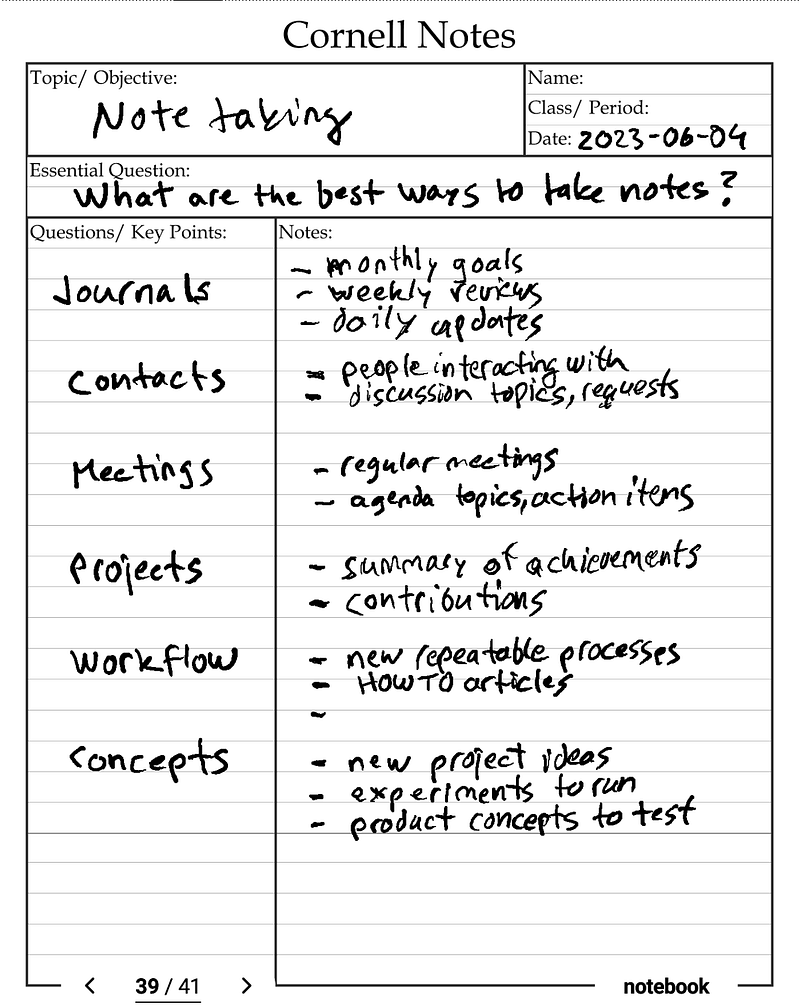
I came up with the following 6-step system:
Journals
Initially, my notebooks were just simple dated journals in which I scribbled my thoughts, actions, and what my boss was asking me to work on next. I summarized my achievements for our weekly review and wrote down the monthly goals.
Meetings
I added a meetings section as my boss asked me to keep minutes for our regular weekly meetings. I captured participants, agenda topics, action items, and other discussions in my notes.
Contacts
When I became a manager, I added a section for contacts. I had a section for each person reporting to me and a section for my boss, colleagues, and other managers. Every time I met each person, I kept dated notes on what was discussed and any new requests.
My one-on-one meetings went much better as I reviewed my notes from the previous meeting. My boss appreciated that I could complete his requests, and he didn’t need to remind me.
Projects
By doing great work, I was rewarded with even more work. I was initially responsible for one, but soon for multiple projects. So I added a projects section in my notebooks.
I filled pages and pages of notes, tracking goals and achievements in order to give my boss a succinct project summary in our one-to-one meeting.
Workflows
When I was promoted to director, I realized that good workflows and documented processes in a company matter greatly. Troubleshooting cross-functional process problems and designing new workflows required another notebook section.
Concepts
The responsibilities and expectations kept growing, and I got more involved with product design, planning, and budgeting for new projects.
A new notebook section for Concepts was needed. New product concepts to test and project ideas filled the pages in this section.
What are Cornell Notes?
I recently discovered Cornell Notes. Cornell education professor Walter Pauk initially developed the Cornell Note-Taking System in 2010. Prof. Pauk outlined this effective note-taking method in his book, How to Study in College (1)
I wish I had found this system earlier. Compared to my bit of unstructured note-taking system, Cornell Notes is designed to capture notes, write the cues or questions, and summarize the learnings after the class.
Using the Cornell Notes template in my Supernote E-book, I scribbled the page above and another below in preparation for writing this article. I love organizing my notes digitally, searching by keywords and tags, and using various templates like the one I used.

Why Note-Taking Matters?
I was reflecting on the past 45+ years and thinking about the purpose of note-taking.
Looking at my note-taking habits from multiple perspectives, I can identify many benefits.
I have learned many new skills by working on projects and running retrospectives. Writing down “lessons learned” tends to hurt, especially when I have screwed up, but it also helps retain the learnings.
Most companies I have worked for have an annual or semi-annual Human Resources led ritual for performance reviews. Having a detailed record of my achievements, deliverables, and factual assessment of my goals for the performance reviews has helped me to progress in my career.
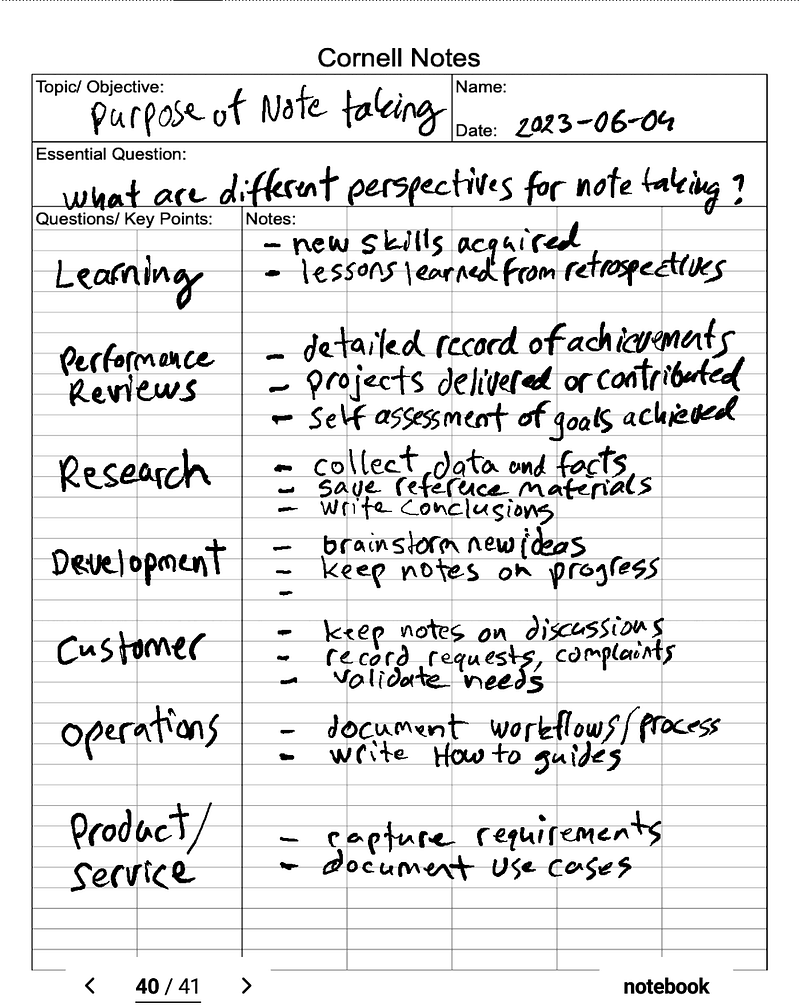
In Research and Development (R&D), where I have spent almost 40% of my career, capturing data, facts, progress, and details is very important. Multi-million dollar budgets for new projects are decided based on this kind of data. Keeping accurate notes is not optional.
Keeping detailed notes on customer meetings, feedback, complaints, and requests has helped validate product design decisions, influence roadmaps, and build better products.
On the business operations side, documenting cross-functional processes, designing new workflows, and having proper “How To” guides is another area that has helped a lot in ISO-9001 certifications and various kinds of security and compliance audits in which I have participated.
Conclusions
Note-taking is a very useful skill to learn and practice. I can run a meeting and take detailed notes on what was discussed simultaneously. With enough practice, it becomes an automatic, almost subconscious activity.
Finding an effective way to organize the information depends on your work and the kind of information you are dealing with daily.
The 6-step system (Contacts, Meetings, Journals, Projects, Workflows, and Concepts) I describe in this article is quite generic and has served me well over the last 20+ years. Your mileage may vary.
Reviewing your notes and preparing summaries is essential.
The Cornell Notes adds a new twitch to note-taking, enabling you to use critical thinking and summarize the information for improved learning.
These new E-ink devices designed explicitly for note-taking have reached the state where I have moved from paper notebooks to all digital notes.
What is your ideal note-taking system? Please leave comments or ask questions.
References
(1) Pauk, Walter; Owens, Ross J. Q. (2010). How to Study in College (10 ed.). Boston, MA: Wadsworth. ISBN 978–1–4390–8446–5. Chapter 10: “The Cornell System: Take Effective Notes”, pp. 235–277


