
Imperfection
Learning to Celebrate Our Flaws
Much of my life, I have tried to be perfect: the perfect son, the perfect student, the perfect husband, the perfect father, the perfect writer, the perfect speaker and the perfect employee. But I failed every time. I have never been able to live up to the image I had of myself or that others had of me.
And most people can not live up to the images that other people have of them. I am sure that you have favorite writers or artists whose work you love. Yet, if you ever read a biography of the person, you realized that he was not as good in his personal life as you imagined him to be. All our heroes have clay feet.
For creative leaders, perfection creates paralysis and immobility. Painters who seek perfection stay with the tried and true because they don’t want to risk failure. Writers won’t step outside their comfort zone because of the fear of failure. We are a society driven to be perfect and we don’t tolerate mistakes. Yet, without failure there is no success. Failure provides the flavor to life.
I read a story once of a Japanese haiku poet, who in his lifetime had written thousands of haiku. When he was dying, he destroyed all but three of his haiku. He felt the others were not good enough — were not perfect.
I have spent a lifetime struggling against the false god of perfection. I know I will never be perfect, but a part of me still seeks to reach it. The lesson I keep relearning is that it is okay to fail — to make mistakes, to be human. Failure is part of the human state.
It has taken me years, but I have made progress. I worry less today about being perfect. In fact, I have learned to celebrate my failures. And to enjoy making mistakes. It is okay to be human.
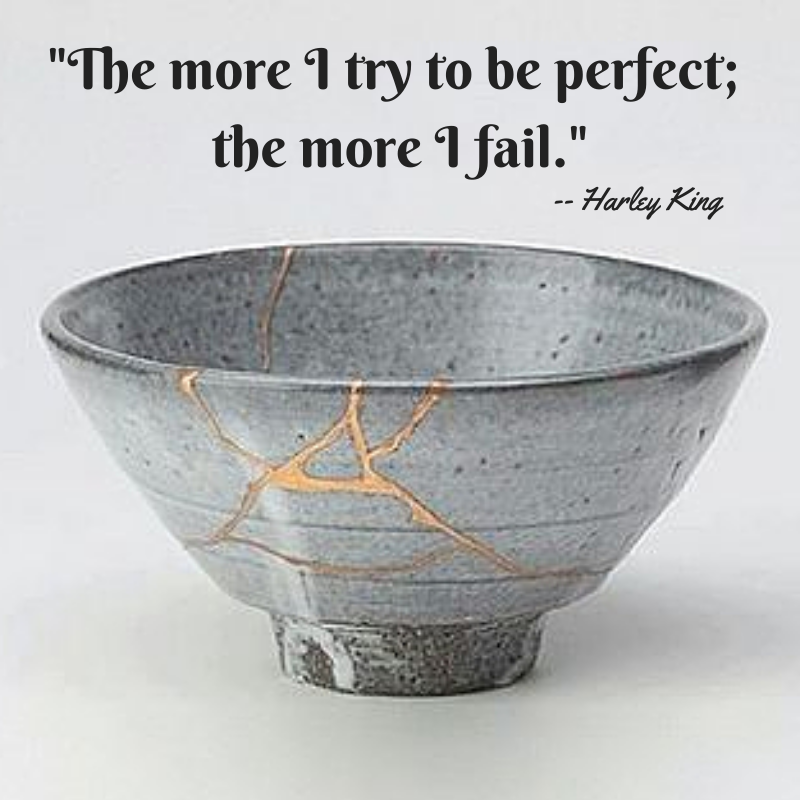
In Japan, some craftsmen practice the 500-year-old art of Kintsugi which involves repairing broken ceramic pieces with a lacquer that is mixed with gold, silver or platinum. We should not simply throw things away because they are broken or imperfect. We need to find the beauty in the imperfection. We need to celebrate imperfection. Our imperfections are what make us unique and special. Without our imperfections, we would not be who we are.
So, the next time that you want to wad up your creative work and toss it into the waste basket, don’t. Put it aside and come back to it on another day. Learn to find the good within your creative work. Learn to celebrate the imperfections. Honor your mistakes.
Action Steps
Here are five actions you can take to help you overcome perfectionism.
- Select a mistake you made and identify the lessons that you learned from making that mistake.
- Select a mistake you made recently and celebrate it. Acknowledge your mistake to yourself and to others. Reward yourself for making the mistake.
- Observe nature, particularly trees. Are they identical? Are they perfect? What are the imperfections?
- Take something that is broken and find the beauty within the object. How can you remake the item into something useful?
- Read about the art of Kintsugi. Apply the principles of Kintsugi to your life and work.
© 2020 by Harley King
About Harley King
Harley King has been writing and publishing poetry for over 50 years. He spent 7 years writing only haiku. His poems have appeared in over 30 publications including Modern Haiku, Dragonfly and Outch. He has published 12 books of poetry and 2 works of non-fiction. Harley is patiently waiting for the big publisher in the sky to turn his books into best-sellers and his poetry into classical literature.
Harley is a certified Zentangle teacher and creates abstract drawings.
Connect with Harley on:
Goodreads: https://www.goodreads.com/author/show/2876863.Harley_King
LinkedIn: https://www.linkedin.com/in/harleyking/?trk=nav_responsive_tab_profile_pic
Facebook: https://www.facebook.com/harley.king.37


