
Impact of White Privilege on Muslim College Students
By Alina Popatia and Dr. Benjamin Drury
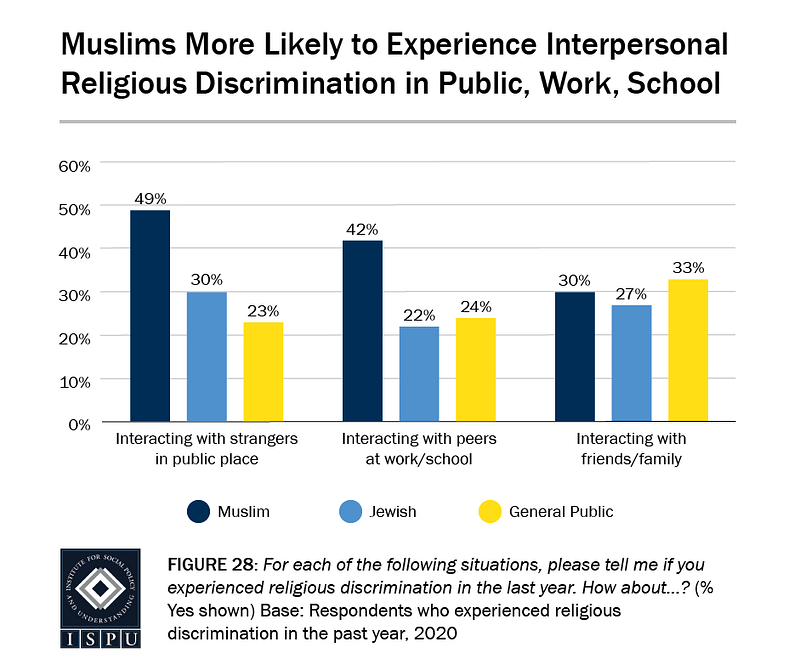
white privilege is a phenomenon that has been extensively discussed and analyzed in recent years. It refers to the set of advantages that white people, particularly those of European descent, enjoy over people of color in various areas of life, including education, employment, and social status. In higher education, white privilege can create obstacles and barriers for students of color, particularly Muslim students, who face systemic discrimination and bias. For Muslim students they may face additional barriers due to the prevailing stereotypes and misconceptions about their religion and culture. As Edward Said once noted, “In the modern world, Muslims are cast as the ‘other,’ a group that is seen as fundamentally different and often threatening to the dominant Western culture.” This “othering” can lead to a variety of discriminatory practices, from the stereotyping of Muslim students as terrorists or extremists to the targeting of Muslim students for surveillance and monitoring. It can also contribute to a general lack of understanding and appreciation for the unique contributions and perspectives that Muslim students bring to the university community.
One of the ways in which white privilege manifests itself in higher education is through the indirect and subtle teaching of racist and exclusionary beliefs in the classroom. Students are often taught to value individualism and to view success as the result of hard work and merit, without acknowledging the role that race and privilege play in shaping opportunities and outcomes. This creates an environment in which students of color, particularly Muslim students, are expected to conform to white cultural norms and values, rather than being encouraged to embrace and celebrate their own cultural heritage.
What is most curious and often insidious is how the concept of privilege itself is often not addressed in the classroom, leaving students unaware of the advantages they may have due to their race, gender, or other factors. This lack of awareness can lead to a perpetuation of systemic inequalities, as students are not equipped with the knowledge and tools needed to challenge and dismantle these inequalities. In addition to the subtle ways in which white privilege is perpetuated in the classroom, there are also more overt manifestations of racial bias that Muslim students may face in higher education. For example, Muslim students may be subjected to racial profiling and discrimination by campus security or law enforcement, leading to feelings of insecurity and a lack of belonging on campus. This can result in decreased academic performance and a decreased likelihood of graduating from college, which in turn limits their opportunities for upward social mobility.
Another way in which white privilege affects Muslim students in higher education is through the lack of representation and inclusivity in the curriculum and faculty. Many academic disciplines, such as history and political science, have traditionally been dominated by white scholars and perspectives, leading to a lack of diversity and representation in the curriculum. This can result in a limited understanding of the experiences and contributions of people of color, including Muslim students, and perpetuate a sense of otherness and marginalization.
A historical and present lack of diversity among faculty can limit the opportunities for mentorship and support for Muslim students, who may struggle to find faculty members who share their cultural and religious background. This can result in a lack of guidance and mentorship, which is essential for academic success and career advancement. To address the obstacles and barriers that Muslim students face in higher education due to white privilege and racial bias, it is essential to acknowledge and address these issues both within and outside of the classroom. This includes creating a more inclusive and diverse curriculum that represents a variety of perspectives and experiences, as well as increasing the representation of people of color, including Muslims, among faculty and staff.
It also includes actively working to challenge and dismantle systemic inequalities and biases, both at the institutional level and within society. This can include engaging in advocacy and activism efforts to promote diversity and inclusivity in higher education, as well as addressing the systemic issues that contribute to racial and ethnic disparities in education and employment opportunities. Ultimately, addressing white privilege in higher education and creating a more inclusive and equitable environment for Muslim students requires a collective effort from educators, administrators, students, and society. By acknowledging and challenging these systemic inequalities, we can work towards a more just and equitable society in which all individuals can succeed and thrive, regardless of their race, ethnicity, or cultural background.