
Immune Cells of the Brain Continue to Define Alzheimer’s Disease
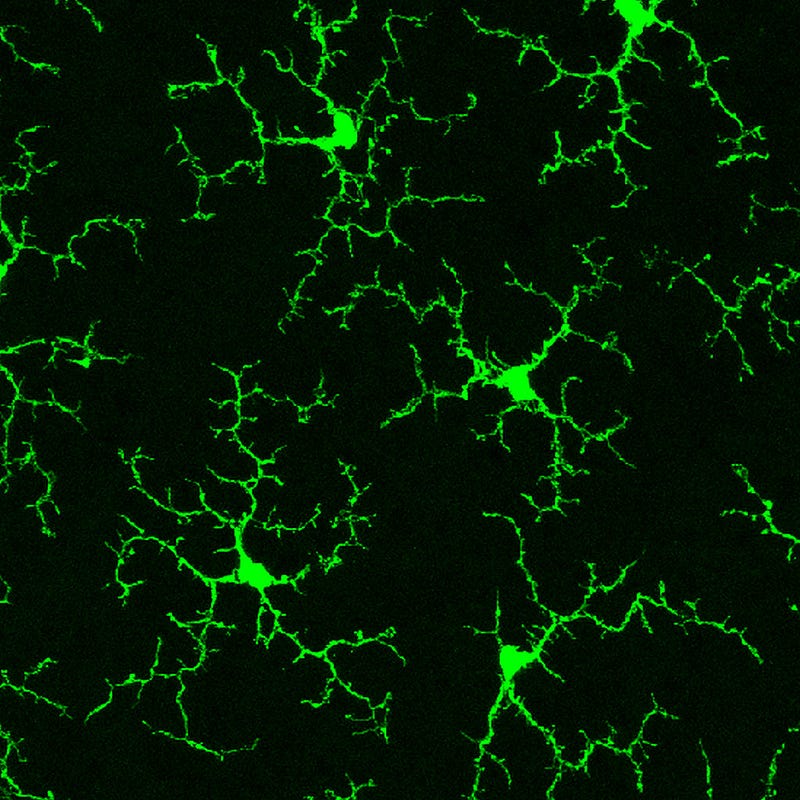
Back in 2015, while doing my postdoctoral fellowship at the National Institutes of Health, I wrote a quick blurb for the website Brain Blogger in response to the increasing buzz of the big neuroscience projects. My point in writing that was to draw some attention away from the neuron and towards the cells that make up the majority of the brain: glia. In the last few years the amount of data on the role glia in brain function and disease has skyrocketed. I can’t take credit for it, but the coincidence is nice.
I started studying microglia (literally small glia) as a graduate student in the context of Alzheimer’s disease. I can not recall why I found them so interesting, but what stands out is that they seemed to be involved in nearly every neurological process, on the spectrum from development to dysfunction. Recent work has made huge strides in understanding how and to some extent why they do what they do in the brain. A new study in Nature Communications continues this progress into understanding their role in Alzheimer’s disease pathogenesis.
Until recently, it has been a mystery as to what the role of microglia was with respect to the etiology of Alzheimer’s disease. Are they helpful garbage collectors, engulfing amyloid-beta plaques to protect neurons? Or are they careless policemen, firing off neuroinflammatory molecules indiscriminately into the neuronal milieu? For a while, they were thought to be both. My impression of microglia function and dysfunction has always been in the context of their longevity. They eagerly enter the brain early in gestation, before the blood brain barrier even closes. Once in place throughout the brain, they initiate a program of synaptic pruning to clean up extraneous neuronal connections. The brain, interestingly, begins life with far too many connections between its neurons — an issue that if not resolved can result in neurodevelopmental disorders such as autism. Once the official connectome is established, microglia (the same ones that entered the brain during gestation) spend the rest of the organism’s lifespan maintaining these connections and cleaning up neuronal or exogenous debris, including infectious organisms. However, as the organism ages, so do their microglia. As one might expect, an aging microglia becomes a less effective microglia. So what determines whose microglia will continue doing their job into old age? Well, it is probably the genes.
In the new study cited above, the authors looked at microglia in several stages of activation. The importance here was that they used morphology (how the microglia look) as opposed to their molecular profile (what proteins microglia express or secrete). There has been a debate in the field on which method is better. Personally, I subscribe to the former as the expression profiles seem to overlap between what we think are activated versus non-activated microglia. The caveat being that microglia are always active — they are one of the most dynamic cells in the body. Check out our published video below of a microglial cell in the mouse retina with laser scanning microscopy.
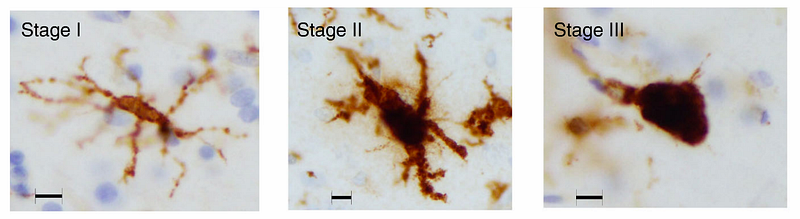
Morphologically activated microglia (Stage III), which appear plump and rounded compared to their steady-state brethren (Stage I), were highly associated with Alzheimer’s disease pathology — and only Alzheimer’s pathology — in regions of the brain known to be affected. There was no association between Stage III microglia and brain regions known not to be as affected by the disease process. I was pleasantly surprised to see that Stage III microglia were not associated with vascular amyloid pathology (a phenomenon known as cerebral amyloid angiopathy, where amyloid deposits in the wall of the cerebral blood vessels). When I was a graduate student, we showed that the equivalent to Stage I microglia were highly associated with Alzheimer’s disease concomitant with amyloid angiopathy, but that Stage III microglia were present more in Alzheimer’s disease patients without vascular amyloid deposition. This seems to fit the paradigm described in the current study.
So what factors push microglia towards Stage III, where they presumably become inefficient at maintaining brain homeostasis or become downright detrimental? The authors found that some people have a genetic makeup that may influence how microglia age and how they respond to external stimuli. Like most non-dominantly inherited diseases, Alzheimer’s disease seems to exist at a precarious tipping point influenced by the weight of a myriad of genetic risk and protective factors — each pushing the brain towards either cognitive decline or continued cognitive health. One can appreciate this at the molecular level where genetic variants make the organism (humans in this case) more or less resilient to the everyday environmental challenges inflicted on the brain.
The authors found two genetic variants, known as a single nucleotide polymorphisms or SNPs, in their genome wide association study, one of which was rare and the other of which was found in a third of the population. The more common genetic variant was additionally found to be significantly associated with activated microglia based on brain imaging with a radiotracer in living humans. At this point, these data don’t offer us much because it is not clear what these genes do, except that new and exciting research into the genetics of Alzheimer’s disease is promised in the future. What is exciting though, is once the authors incorporated about thirty other less significant genes into their analysis of genetic risk for Alzheimer’s disease, they were able to create a polygenic risk score of microglial activation. The majority of genes found to increase microglial activation were also found to be genetic risk factors for Alzheimer’s disease. In other words, having microglia that are more easily activated may tip the homeostatic balance towards Alzheimer’s disease.
It should be clear that the clinical utility of polygenic risk scores remains unclear, but you do see them popping up for a number of other diseases such coronary artery disease and diabetes. As we become better at reconciling our genetic makeup and disease risk, I think these genetic risk scores will gain traction, at least initially for determining groups in clinical trials. Either way, the genetics of Alzheimer’s disease is a hot topic right now and microglia are at the forefront of this movement. At last, we are starting to look outside the simplified parameters of the amyloid cascade hypothesis. Instead of fixating on amyloid aggregation as the initiating event, researchers are looking into what factors tip the balance toward starting that cascade. Parsing out how the genetics of microglia influence the brain will also help us understand their role in the development of neuronal connections throughout life and how they may influence memory and cognition. It seems clear that the big brain initiatives need to understand the role of all cells in the nervous system, not just the neuron.