avatarNicholas Fournie

Free AI web copilot to create summaries, insights and extended knowledge, download it at here

4900

Abstract

s of the old world with brutality, and Porter wondered if China’s hermits managed to survive a full decade of assault. Were these ancient mountain dwellers truly timeless?</p> <figure id="f4c1"> <div> <div> <img class="ratio" src="http://placehold.it/16x9"> <iframe class="" src="https://cdn.embedly.com/widgets/media.html?src=https%3A%2F%2Fwww.youtube.com%2Fembed%2FR6miAPuNYj8%3Ffeature%3Doembed&amp;display_name=YouTube&amp;url=https%3A%2F%2Fwww.youtube.com%2Fwatch%3Fv%3DR6miAPuNYj8&amp;image=https%3A%2F%2Fi.ytimg.com%2Fvi%2FR6miAPuNYj8%2Fhqdefault.jpg&amp;key=a19fcc184b9711e1b4764040d3dc5c07&amp;type=text%2Fhtml&amp;schema=youtube" allowfullscreen="" frameborder="0" height="480" width="640"> </div> </div> </figure></iframe></div></div></figure><p id="4958">By 1989 the revolution had ceased and Porter was finally able to organize an expedition through the notorious <a href="https://goo.gl/maps/r5gbmn86GNKNUhJj8">Zhongnan Mountains</a> with the intention of encountering and documenting hermits. Just south of the ancient imperial city of <a href="https://en.wikipedia.org/wiki/Xi%27an">Xi’an</a>, Zhongnan’s peaks and valleys have acted as a refuge for China’s most notorious sages including Lao-Tzu, the father of philosophical Taoism. Porter’s findings were monumental, and his book “<a href="https://www.counterpointpress.com/dd-product/road-to-heaven/">Road to Heaven, Encounters with Chinese Hermits</a>” has reignited the tradition of mountain contemplation after years of political strife.</p><h2 id="d1d0">The Immortals of the Tao</h2><p id="9c00">Lao Tzu, a legendary sage from the 6th century BC is said to have reached immortality while practicing Tao in the Zhongnan mountains. There is a unique history of alchemy in China, and the pursuit of elixirs that provide eternal life was a common practice at this time. Lao-Tzu’s immortality, however, most likely refers to a spiritual concept similar to Buddhist enlightenment, or the attainment of a heavenly afterlife. To this day, the xian of the Zhongnan mountains are commonly referred to as the immortals.</p><p id="00b8">While the most common understanding of Taoist philosophy is accredited to is his prophetic work the <a href="https://www.amazon.com/Tao-Te-Ching-Lao-Tzu/dp/1690029994/ref=sr_1_7?crid=13GCJYWJJTAOY&amp;keywords=tao+te+ching&amp;qid=1651116874&amp;s=books&amp;sprefix=tao+te+ching%2Cstripbooks%2C149&amp;sr=1-7">Tao Te Ching</a>, it is clear that Lao-Tzu’s knowledge was derived from China’s existing philosophical tradition. This work best encapsulates the ancient worldview and spiritual ambitions of Zhongnan’s xian. <i>(see quote below)</i></p><figure id="eb1e"><img src="https://cdn-images-1.readmedium.com/v2/resize:fit:800/1*ZZPyCPtk8WE02jiovZV5Vg.jpeg"><figcaption>“Daoist Immortal Zhang Guolao” by Shanghai Museum, Public domain, via <a href="https://commons.wikimedia.org/wiki/File:Album_of_18_Daoist_Paintings_-_17.jpg">Wikimedia Commons</a></figcaption></figure><blockquote id="7b93"><p>“The Tao that can be described</p></blockquote><blockquote id="0c1f"><p>is not the eternal Tao.</p></blockquote><blockquote id="57ef"><p>The name that can be spoken</p></blockquote><blockquote id="feb5"><p>is not the eternal Name.</p></blockquote><blockquote id="a5c8"><p>The nameless is the boundary of Heaven and Earth.</p></blockquote><blockquote id="d39a"><p>The named is the mother of creation.</p></blockquote><blockquote id="7506"><p>Freed from desire, you can see the hidden mystery.</p></blockquote><blockquote id="14b7"><p>By having desire, you can only see what is visibly real.</p></blockquote><blockquote id="6559"><p>Yet mystery and reality emerge from the same source.</p></blockquote><blockquote id="19be"><p>This source is called darkness.</p></blockquote><blockquote id="f09d"><p>Darkness born from darkness.</p></blockquote><blockquote id="ade8"><p>The beginning of all understanding.”</p></blockquote><blockquote id="8680"><p>— Chapter 1 “Tao Te Ching,” Translated by <a href="https://www.unl.edu/prodmgr/NRT/Tao%20Te%20Ching%20-%20trans.%20by%20J.H..%20McDonald.pdf">J.H. Mcdonald 1996</a></p></blockquote><h2 id="64c8">China’s Contemplative Traditions</h2><p id="3ab6">As Buddhism spread throughout the mountains starting in the 6th century CE it was infused with Taoism’s uniquely Chinese flavor. Today, China’s mountain sages are often described interchangeably as “Taoist and Buddhist” hermits. To an outsider, the subtle differences in their practices are nearly impossible to observe, as their philosophies and methods result in very similar lifestyles and practices.</p><p id="9edc">Taoism is known for its teaching “Wu Wei” (“non-doing” or “doing-nothing”). By moving out of the cities and monasteries and into the mountains, the xian embody “non-doing” regardless of their re

Options

ligious tradition.</p><figure id="bc04"><img src="https://cdn-images-1.readmedium.com/v2/resize:fit:800/1*OrFnQTM_rQ5uvpwp-GbskQ.jpeg"><figcaption>“Taoist Priests in White Cloud Temple” by Unknown author, Public domain, via <a href="https://commons.wikimedia.org/wiki/File:Taoist_Priests_in_White_Cloud_Temple_Beijing_Qing_Dynasty.jpg">Wikimedia Commons</a></figcaption></figure><p id="b5d3">The origin of Zen Buddhism, known as “Chan” in China, is also found in these mountains. The Indian sage “Bodhidharma” brought his teachings to the mountains and taught amongst the xian. As such, the philosophy of “Wu Wei” is clearly reflected in Zen’s unique style of lengthy silent meditations. In the mountains, truth is illuminated through the clarity gained in “non-doing”.</p><h2 id="6e75">The Reclusive Revival</h2><p id="5912">The esteem of the mountain hermits has never been the same since the devastation of the cultural revolution. While the number of xian found in the Zhongnan Mountains greatly reduced, they managed to maintain their tradition in the face of adversity. Throughout the interviews in Porter’s “Road to Heaven,” hermits often mention the hardships of the cultural revolution and the continued impositions of China’s government upon their religious life.</p> <figure id="9bd9"> <div> <div> <img class="ratio" src="http://placehold.it/16x9"> <iframe class="" src="https://cdn.embedly.com/widgets/media.html?src=https%3A%2F%2Fwww.youtube.com%2Fembed%2F3R0h3dvL73w%3Ffeature%3Doembed&amp;display_name=YouTube&amp;url=https%3A%2F%2Fwww.youtube.com%2Fwatch%3Fv%3D3R0h3dvL73w&amp;image=https%3A%2F%2Fi.ytimg.com%2Fvi%2F3R0h3dvL73w%2Fhqdefault.jpg&amp;key=a19fcc184b9711e1b4764040d3dc5c07&amp;type=text%2Fhtml&amp;schema=youtube" allowfullscreen="" frameborder="0" height="480" width="854"> </div> </div> </figure></iframe></div></div></figure><p id="0f80">Porter’s work, which has been most influential in China, inspired a new generation of Hermits in China’s holy mountains. In 2014, Bill Porter returned to Zhongnan to find that the tradition has experienced a flourishing revival as a result of his book <i>(documentary above)</i>. While visiting the caves of several young practitioners, he was recognized and revered for his illuminating work that inspired their retreat.</p><p id="e968">Similarly, the short film “Summoning the Recluse” (linked below) shows a slightly more modern face of the reclusive mountain hermits.</p><div id="ad3a" class="link-block"> <a href="https://psyche.co/films/chinas-young-people-who-trade-parties-for-peace-at-a-mountainside-hermitage"> <div> <div> <h2>Summoning the recluse | Psyche Films</h2> <div><h3>undefined</h3></div> <div><p>undefined</p></div> </div> <div> <div style="background-image: url(https://miro.readmedium.com/v2/resize:fit:320/0*oWjdoTlMG_yFpgKV)"></div> </div> </div> </a> </div><p id="c092">Every year, more media and information surfaces regarding the hermits of China. While the sensation of media attention threatens the authenticity of their earnest way of life, it has (for now) reinstated the immortals to their former esteem.</p><h2 id="a80c">Further Reading and Sources Used</h2><p id="6fcd">Hanshan, et al. <i>The Collected Songs of Cold Mountain</i>. Copper Canyon Press, 2020.</p><p id="510d">Hays, Jeffrey. “Taoist Sages, Hermits, Immortals and Deities.” <i>Facts and Details</i>, <a href="https://factsanddetails.com/china/cat3/sub10/entry-5579.html#:~:text=Taoist%20mountain%20hermits%20are%20called,refers%20to%20those%20who,%20%22when.">https://factsanddetails.com/china/cat3/sub10/entry-5579.html#:~:text=Taoist%20mountain%20hermits%20are%20called,refers%20to%20those%20who,%20%22when.</a></p><p id="4215">Philips, Tom. “The Cultural Revolution: All You Need to Know about China’s Political Convulsion.” <i>The Guardian</i>, Guardian News and Media, 11 May 2016, <a href="https://www.theguardian.com/world/2016/may/11/the-cultural-revolution-50-years-on-all-you-need-to-know-about-chinas-political-convulsion.">https://www.theguardian.com/world/2016/may/11/the-cultural-revolution-50-years-on-all-you-need-to-know-about-chinas-political-convulsion.</a></p><p id="0a0e">Porter, Bill, and Steven R. Johnson. <i>Road to Heaven: Encounters with Chinese Hermits</i>. Counterpoint, 2009.</p><p id="eb60">“Tao Te Ching — University of Nebraska–Lincoln.” Translated by J.H. Mcdonald, <i>University of Nebraska Lincoln</i>, 1996, <a href="https://www.unl.edu/prodmgr/NRT/Tao%20Te%20Ching%20-%20trans.%20by%20J.H..%20McDonald.pdf.">https://www.unl.edu/prodmgr/NRT/Tao%20Te%20Ching%20-%20trans.%20by%20J.H..%20McDonald.pdf.</a></p></article></body>

Immortal Songs of the Mountain

Bill Porter and the Secret Lives of Chinese Hermits
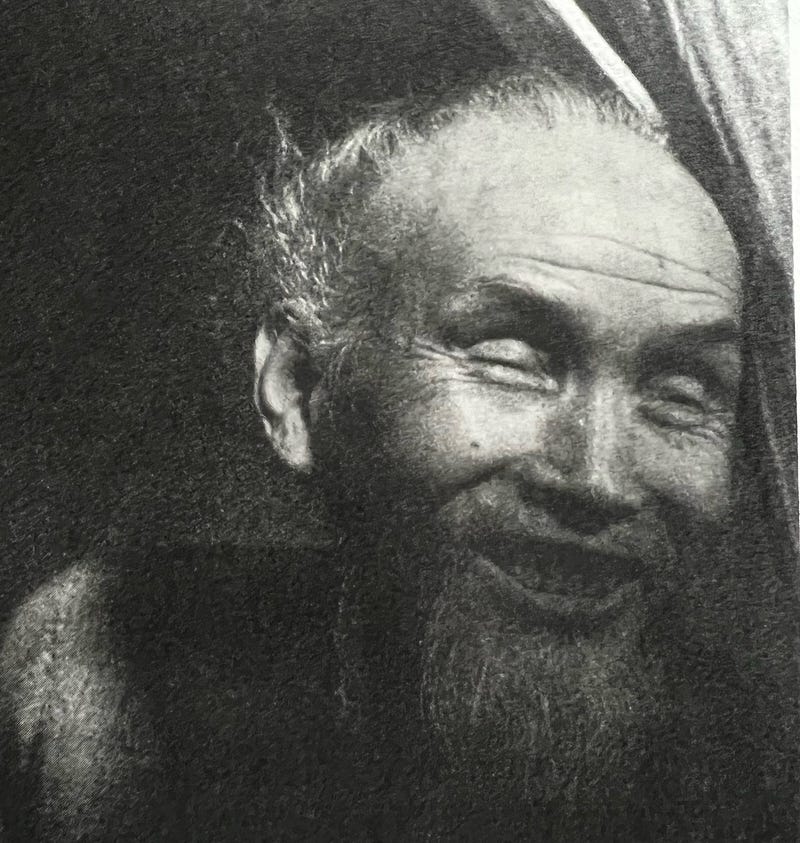
“Master Yang, The Blind Taoist” (Pg. 217) in “Road to Heaven: Encounters with Chinese Hermits” by Bill Porter

For thousands of years, China has venerated the *Xian, reclusive spiritualists that occupy remote regions of their land in order to pursue the “Tao.” Living in solitude, beyond the furthest reaches of civilized life, these hermits have seldom been encountered. Yet, their virtuous calling to live a life of hardship in the name of metaphysical discovery has always granted them an honored position in Chinese society.

*Taoist mountain hermits are called “xian.” According to the Encyclopedia of Religion: Usually written using the characters for “man” and for “mountain,” the character for xian is said originally to have been composed of those for “man” and for “ascend.” An early dictionary explains that it refers to those who, “when they grow old, do not die.” Xian means “to move into the mountains.”

Facts and Details

As far back as 5000 years, the Xian are believed to have bestowed wisdom upon the imperial courts of the early empires. In the beginning, these sages were lunar-worshipping shamans, and “the Tao” was a pursuit of immortality through out-of-body encounters with the moon. While the mountain hermits of today vary in tradition, the Tao has come to represent the culmination of China’s esoteric understanding and as such, it unites their spiritual pursuits.

Meeting the Immortals

Bill Porter, is a renowned translator who moved to Taiwan and lived in a Buddhist monastery in the 1970s. As a gift to the monks, he decided to translate a couple of texts from the monastery’s library into English. Before long, he came across the poetry of one of China’s most beloved mountain hermits, Han Shan (poem below). Han Shan (or “Cold Mountain” in English) revealed China’s secret world of reclusive wisdom through his simple verse. Porter began to translate these poems, self-publishing his results under the pen name “Red Pine.”

China has an unparalleled emphasis on poetry in its culture. Being one of its highest art forms, poetic verse has an exclusive reputation and a rich history in the imperial courts. While hermit poetry may not be considered refined or prestigious amongst China’s elite, its raw simplicity has gained notoriety in circles that appreciate the Tao. Red Pine has tapped into this unique tradition, and his translations have shared immortal teachings with the world through the verses they left behind.

Eventually starting a family of his own in Taiwan, Red Pine spent his free time becoming an expert translator of China’s poetic sages.
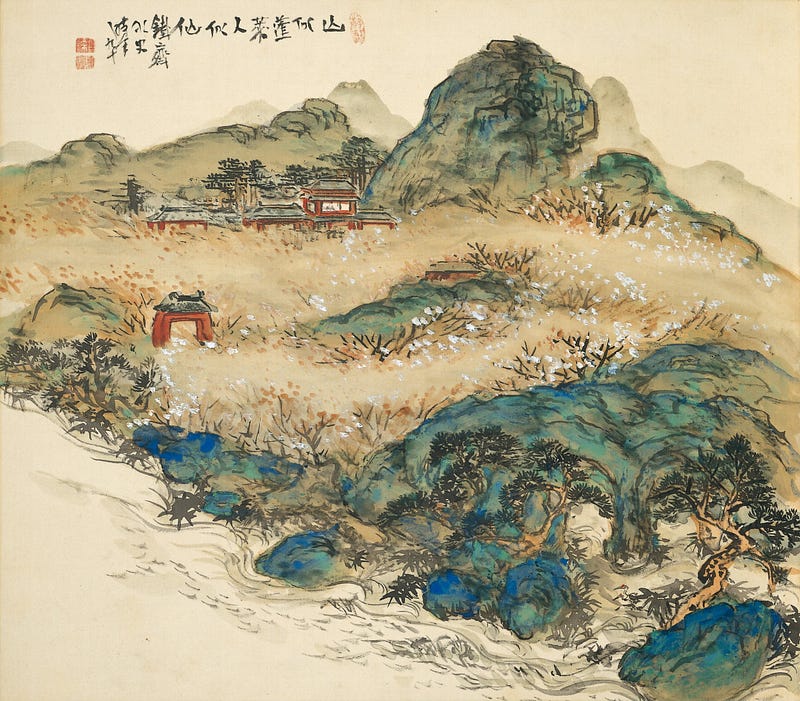
“Mountain of the Immortals” by Tomioka Tessai (1924), Public domain, via Wikimedia Commons

“Towering cliffs were the home I chose,

bird trails beyond human tracks

what does my yard contain

white clouds clinging to dark rocks

every year I’ve lived here

I’ve seen the seasons change

all you owners of tripods and bells

what good are empty names”

— Poem 1, “The Collected Songs of Cold Mountain” translated by Red Pine

When Red Pine first started translating hermitic poetry in Taiwan, the People’s Republic of China was nearing the end of a decade-long cultural revolution. Their goal was to put an end to the four “olds” that were inhibiting economic progress: old ideas, old customs, old habits, and old culture. The revolution met symbols of the old world with brutality, and Porter wondered if China’s hermits managed to survive a full decade of assault. Were these ancient mountain dwellers truly timeless?

By 1989 the revolution had ceased and Porter was finally able to organize an expedition through the notorious Zhongnan Mountains with the intention of encountering and documenting hermits. Just south of the ancient imperial city of Xi’an, Zhongnan’s peaks and valleys have acted as a refuge for China’s most notorious sages including Lao-Tzu, the father of philosophical Taoism. Porter’s findings were monumental, and his book “Road to Heaven, Encounters with Chinese Hermits” has reignited the tradition of mountain contemplation after years of political strife.

The Immortals of the Tao

Lao Tzu, a legendary sage from the 6th century BC is said to have reached immortality while practicing Tao in the Zhongnan mountains. There is a unique history of alchemy in China, and the pursuit of elixirs that provide eternal life was a common practice at this time. Lao-Tzu’s immortality, however, most likely refers to a spiritual concept similar to Buddhist enlightenment, or the attainment of a heavenly afterlife. To this day, the xian of the Zhongnan mountains are commonly referred to as the immortals.

While the most common understanding of Taoist philosophy is accredited to is his prophetic work the Tao Te Ching, it is clear that Lao-Tzu’s knowledge was derived from China’s existing philosophical tradition. This work best encapsulates the ancient worldview and spiritual ambitions of Zhongnan’s xian. (see quote below)
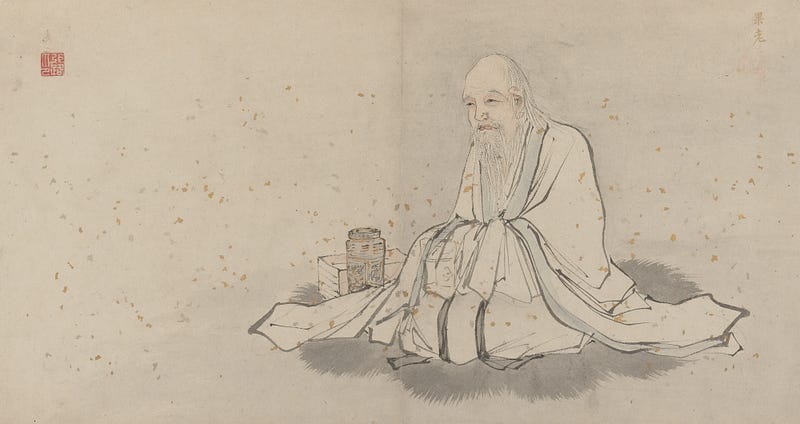
“Daoist Immortal Zhang Guolao” by Shanghai Museum, Public domain, via Wikimedia Commons

“The Tao that can be described

is not the eternal Tao.

The name that can be spoken

is not the eternal Name.

The nameless is the boundary of Heaven and Earth.

The named is the mother of creation.

Freed from desire, you can see the hidden mystery.

By having desire, you can only see what is visibly real.

Yet mystery and reality emerge from the same source.

This source is called darkness.

Darkness born from darkness.

The beginning of all understanding.”

— Chapter 1 “Tao Te Ching,” Translated by J.H. Mcdonald 1996

China’s Contemplative Traditions

As Buddhism spread throughout the mountains starting in the 6th century CE it was infused with Taoism’s uniquely Chinese flavor. Today, China’s mountain sages are often described interchangeably as “Taoist and Buddhist” hermits. To an outsider, the subtle differences in their practices are nearly impossible to observe, as their philosophies and methods result in very similar lifestyles and practices.

Taoism is known for its teaching “Wu Wei” (“non-doing” or “doing-nothing”). By moving out of the cities and monasteries and into the mountains, the xian embody “non-doing” regardless of their religious tradition.
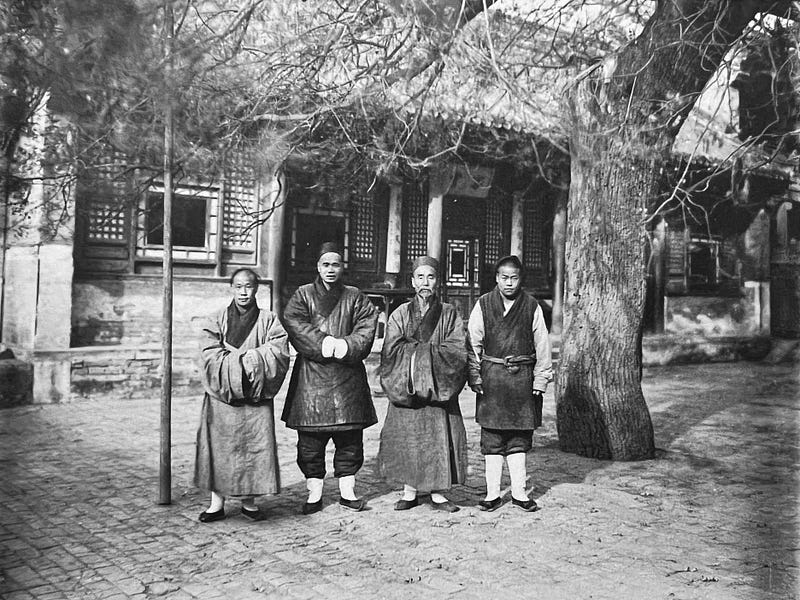
“Taoist Priests in White Cloud Temple” by Unknown author, Public domain, via Wikimedia Commons

The origin of Zen Buddhism, known as “Chan” in China, is also found in these mountains. The Indian sage “Bodhidharma” brought his teachings to the mountains and taught amongst the xian. As such, the philosophy of “Wu Wei” is clearly reflected in Zen’s unique style of lengthy silent meditations. In the mountains, truth is illuminated through the clarity gained in “non-doing”.

The Reclusive Revival

The esteem of the mountain hermits has never been the same since the devastation of the cultural revolution. While the number of xian found in the Zhongnan Mountains greatly reduced, they managed to maintain their tradition in the face of adversity. Throughout the interviews in Porter’s “Road to Heaven,” hermits often mention the hardships of the cultural revolution and the continued impositions of China’s government upon their religious life.

Porter’s work, which has been most influential in China, inspired a new generation of Hermits in China’s holy mountains. In 2014, Bill Porter returned to Zhongnan to find that the tradition has experienced a flourishing revival as a result of his book (documentary above). While visiting the caves of several young practitioners, he was recognized and revered for his illuminating work that inspired their retreat.

Similarly, the short film “Summoning the Recluse” (linked below) shows a slightly more modern face of the reclusive mountain hermits.

Every year, more media and information surfaces regarding the hermits of China. While the sensation of media attention threatens the authenticity of their earnest way of life, it has (for now) reinstated the immortals to their former esteem.

Further Reading and Sources Used

Hanshan, et al. The Collected Songs of Cold Mountain. Copper Canyon Press, 2020.

Hays, Jeffrey. “Taoist Sages, Hermits, Immortals and Deities.” Facts and Details, https://factsanddetails.com/china/cat3/sub10/entry-5579.html#:~:text=Taoist%20mountain%20hermits%20are%20called,refers%20to%20those%20who,%20%22when.

Philips, Tom. “The Cultural Revolution: All You Need to Know about China’s Political Convulsion.” The Guardian, Guardian News and Media, 11 May 2016, https://www.theguardian.com/world/2016/may/11/the-cultural-revolution-50-years-on-all-you-need-to-know-about-chinas-political-convulsion.

Porter, Bill, and Steven R. Johnson. Road to Heaven: Encounters with Chinese Hermits. Counterpoint, 2009.

“Tao Te Ching — University of Nebraska–Lincoln.” Translated by J.H. Mcdonald, University of Nebraska Lincoln, 1996, https://www.unl.edu/prodmgr/NRT/Tao%20Te%20Ching%20-%20trans.%20by%20J.H..%20McDonald.pdf.

Buddhism
Spirituality
Eastern Religion
History
Taoism
Recommended from ReadMedium