
Imanishi Kinji and the World of Living Things
The birth of modern ecology
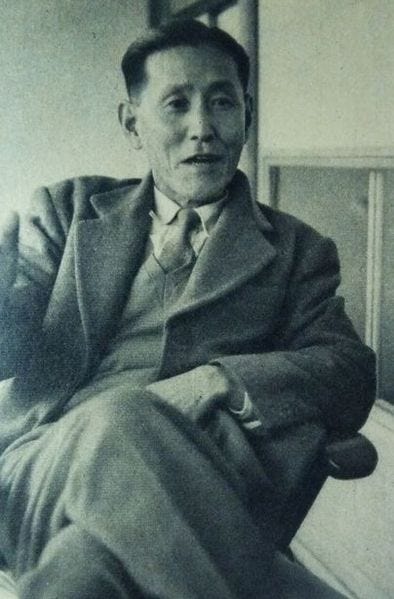

Have you ever heard of Imanishi Kinji 今西錦司 (1902–1992)? He is considered one of the founders of the renowned Japanese school of primatology, which has influenced research in the field worldwide.
He was one of the first to see the lives of animals and insects as structured by society and culture. According to primatologist Franz de Waal, Imanishi’s ideas have silently invaded contemporary science.
Yet few scientists have heard his name.
Born in Kyoto in 1902, he studied agriculture at Kyoto University and hiked extensively in the mountains of Japan and abroad. He is notably known as the founder of the Academic Alpine Club of Kyoto.
Specialized in entomology, his first papers, written between 1930 and 1940, were based on his studies of the ecology and taxonomy of mayflies.
Based on these papers he received a Ph.D. from the Faculty of Science at Kyoto University in 1939.
He wrote his most important book entitled The World of Living Things (Seibutsu no sekai 生物の世界) in a hurry and completed it in 1940. It was published in 1941.

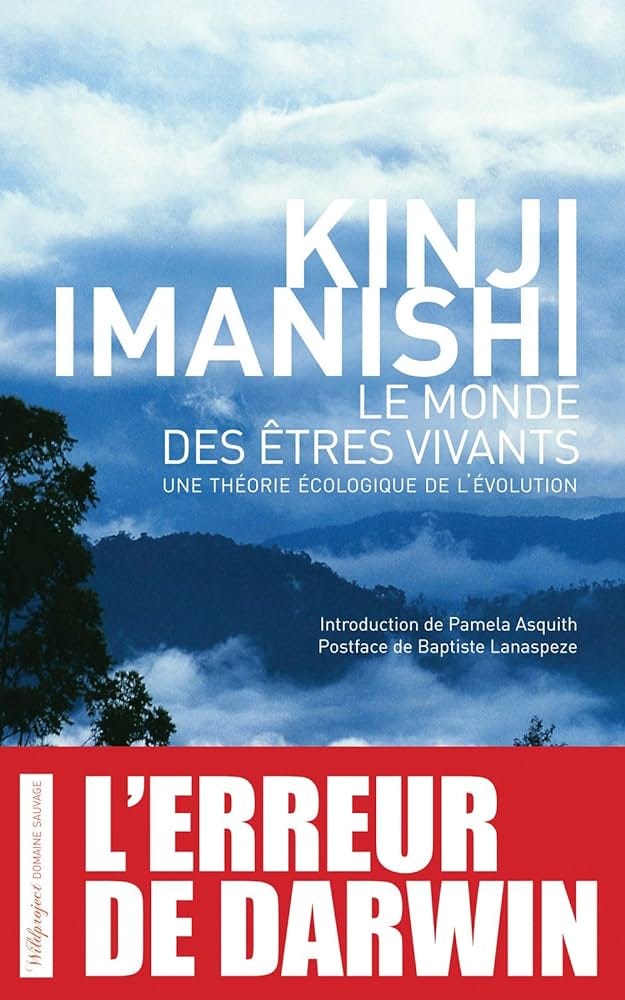
Why was he in a hurry? Because Japan, like many other countries, was at war. In the first pages of his book, he explains that if he were to die during the war, his purpose in writing this book was to leave a trace of his activities as a biologist.
He didn’t die in the war, and what he published in 1941 was nothing less than an innovative way of understanding what he called “the world of living things.”
In this world, living things have a culture. They are organized socially. Different species also form higher-level societies. The relationships between species are influenced by these societies; not at the individual level, but at the species level.
Imanishi claims that there exists a global social gathering all species that can ultimately influence, to a certain extant, individuals. Furthermore, individuals are also able to influence the global society.
At the level of the biosphere (which he defines as a large society), we find the most important aspect of the relationship between societies of living things for him.
But if Imanishi’s ideas have infiltrated contemporary science, as primatologist Franz de Waal explained, why is he not well known?
First of all, he was a Japanese scientist who became famous mostly after Japan’s defeat in World War 2. Japan’s reputation was not at it’s best during that time.
Second, he was known for his personal relationship with Nishida Kitarō, the founder of the Kyoto School of Philosophy; a philosophical movement that was considered to have philosophically supported Japanese ultra-nationalism.
In addition, he also doubted important elements of Darwin’s theory of evolution and was severely criticized for this.
In several posts, I plan to present some of his key ideas, all based on a simple idea: living things have their own “acting subjectivity” (shutaisei 主体性).
I hope you will join me on this exploratory journey.
Thank you for reading. If you enjoyed it and would like to support me, there are several ways, all of which I would greatly appreciate.
- Engage with this article by clapping, commenting, highlighting it.
- Subscribe to my Medium stories.
- Buy me a coffee!