
Imaginary World Of Salvador Dali!
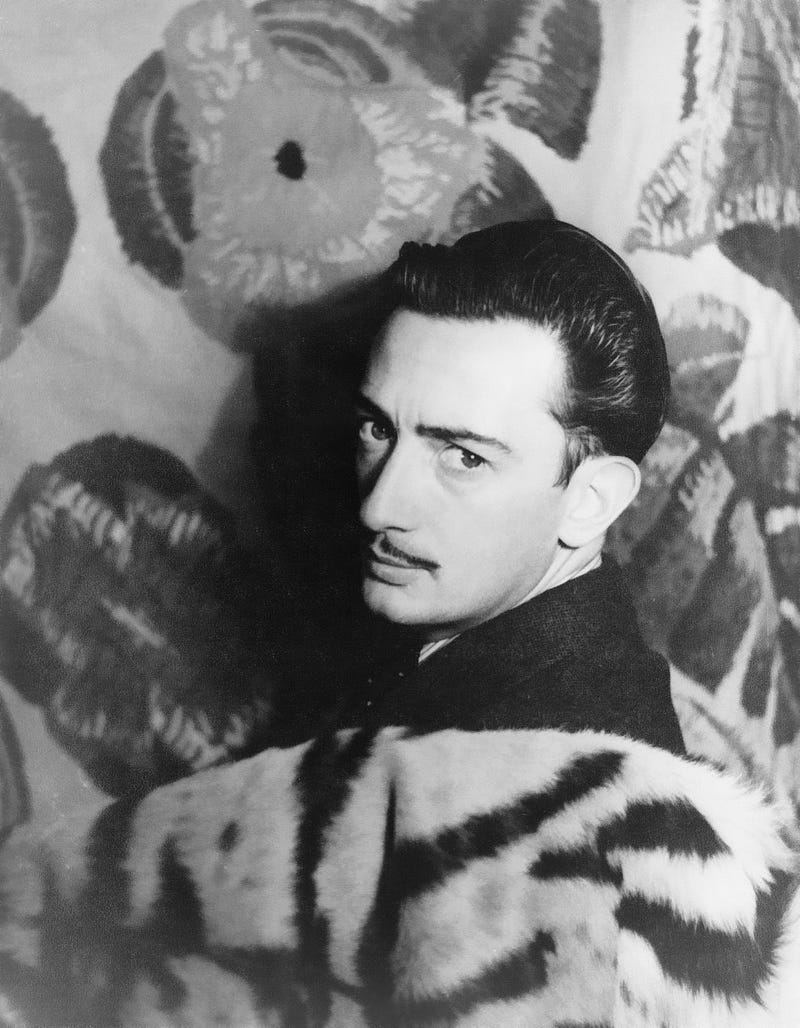
Salvador Dalí was a prominent Spanish surrealist artist known for his eccentric and imaginative works. His full name was Salvador Domingo Felipe Jacinto Dalí i Domènech, 1st Marquess of Dalí de Púbo l. He was born on May 11, 1904, in Figueres, Catalonia, Spain, and died on January 23, 1989, in the same town. Dalí’s art is characterized by its dreamlike, fantastical, and often bizarre imagery. Dalí used sleep as a catalyst for his creativity, inducing hypnagogic hallucinations that resulted in his whimsical and frequently unsettling artwork.
Dali knowledge of religious mystics and his exposure to contemporary science, especially the advancements in nuclear physics, led him down a unique creative and spiritual path that blends the two. Dalí identified as a Catholic in 1950, although he was an unfaithful Catholic.
Dalí’s parents were Salvador Dalí i Cusí and Felipa Domènech Ferrés. His father, Salvador Dalí i Cusí, was a lawyer, and his mother, Felipa Domènech Ferrés, was a homemaker. Dali had one sibling, a younger sister named Ana Maria Dalí. She was born in 1908. Ana Maria Dalí was not as well-known as her brother, but she did appear in some of Dali artworks, such as Portrait of My Sister and Young Virgin Auto-Sodomized by Her Own Chastity.
Dalí displayed artistic talent from a young age. His parents recognized his potential and provided him with the necessary tools and resources to nurture his artistic skills. At the age of 17, Dalí enrolled at the Royal Academy of Fine Arts of San Fernando in Madrid. While there, he developed his distinctive style and was exposed to various artistic movements and techniques.
During his time in Madrid, Dalí was exposed to Impressionism and Cubism, which had a profound influence on his early works. He experimented with different styles and began to develop his surrealistic approach. In the 1920s, Dalí moved to Paris, the epicenter of the art world at the time. There, he met influential artists such as Pablo Picasso and Joan Miró, who further shaped his artistic development.
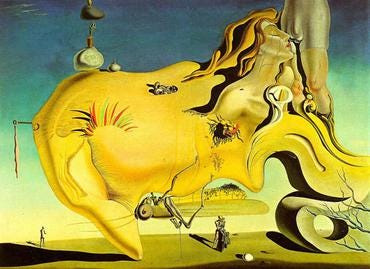
Dalí’s exploration of surrealism began in the 1920s. His early works, influenced by Sigmund Freud’s theories and dream imagery, often featured bizarre and dreamlike elements. In 1929, Dalí met Elena Ivanovna Diakonova, known as Gala, who would become his muse, model, and eventually his wife. She had a significant influence on his life and work.
Throughout his life, Dalí cultivated an eccentric and flamboyant persona, often characterized by his distinctive mustache, outlandish clothing, and theatrical behavior. This eccentricity became an integral part of his public image. Dalí continued to paint and create art throughout his life. He worked in various media, including painting, sculpture, and film. He also collaborated with other artists and filmmakers, such as Luis Buñuel.
Dalí is considered one of the most important figures in the Surrealist art movement. His contributions to art and his unique approach to creativity continue to influence artists and captivate art enthusiasts around the world.
Dalí’s upbringing, exposure to various artistic influences, and personal experiences played a pivotal role in shaping his artistic journey and the creation of his iconic, surreal artworks. Dalí produced over 1,500 paintings over the course of his career.
The most expensive Dali artwork ever sold was Portrait De Paul Eluard, which sold for $21,671,110 on February 10, 2011, at auction London. In 1929, while visiting Paris, Dali got to know Eluard, a surrealist poet.
Robert and Nicolas Descharnes claim that Salvador and Gala Dalí kept the Portrait De Paul Eluard painting in their personal collection for many years. The piece was handed to Cécile Eluard, the daughter of Gala and Eluard, following Gala’s death in 1982. The auction winner of the Portrait De Paul Eluard has kept anonymous.
Dali melting clock painting current value is estimated to be $150 million, it was only sold for $250 during its 1932 debut exhibition at the Julien Levy Gallery in New York. A few years later, the artwork was anonymously given to the Museum of Modern Art MoMA in New York City, where it is still housed today.
Dali contributions to the art world continue to be celebrated for their innovative and avant-garde nature.