
Connecting With Others Through Creativity
An Experiential Process
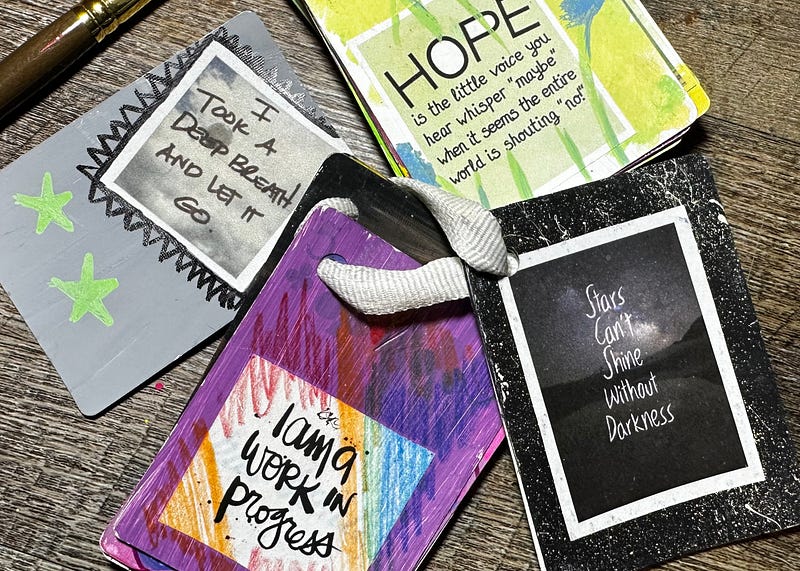
The activity introduced here combines images and words that not only helps us journey inward, but also helps us connect with others. The four steps on this creative journey are:
Preparing, Searching, Engaging, and Processing.
The therapeutic process of making art and the images created within this process, can become the needed catalyst for insight and change.
The color, medium, size of the image, the thickness of the line, and, most importantly, the story behind the creation, all play an integral part in the creative process.
Art, music, storytelling, poetry, and movement provide a bridge for communication when words cannot be spoken.
Expressive Arts
I use a multimodal approach as an expressive arts therapist, combining several creative modalities within each session.
Art, music, storytelling, poetry, and movement provide a bridge for communication when words cannot be spoken.
Within a therapeutic environment, people find that they have control (autonomy) over what they share and when and how it is shared, processing only that with which they are comfortable and feel safe processing at that time.
The use of image-making, independently or in therapy, has many benefits.
Benefits
Art-making fosters improved self-esteem, aids in expressing feelings, helps clients gain insight, and elicits a sense of connectedness with others (Gladding, 2011; Sutherland et al., 2010).
In addition, when done in a therapeutic setting with a therapist, it can address and benefit those with a myriad of concerns, such as chronic illness (Beebe et al., 2010), trauma (Lyshak-Stelzer et al., 2007; Pifalo, 2006), as well as those with social and emotional difficulties (Freilich & Shechtman, 2010).
The artwork created becomes a guide as to how we view ourselves, others, and the world; helping us connect more fully to our thoughts and emotions
Art making can redirect harmful behavior and sublimate unacceptable urges into socially acceptable art forms (Gladding, 2011).
Anger can be sublimated into clay, or the depressed client who often cuts can paint the pain that otherwise would turn into self-harm.
Another advantage of the expressive arts is the brief/time-limited or solution-focused effectiveness of techniques (Riley, 1999; Spier, 2010).
Clinicians who are constricted by schedules that do not lend time for lengthy sessions, or school counselors racing against the ringing of the school bell, can gain quick momentum within their sessions when using the expressive arts.
Experiential: Encouragement Cards
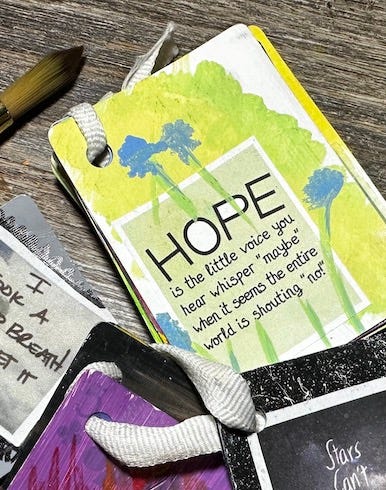
The following arts-based experiential, Encouragement Cards, provides a vehicle for connection, self-awareness, and enhancing of one’s self-esteem.
It can be done independently for self-care, in individual therapy, or within a group setting.
The artwork created becomes a guide as to how we view ourselves, others, and the world, helping us connect more fully to our thoughts and emotions.
The personal images we create often reflect our unique style of life (Watts, 2003).
We use these images to interpret our environment and give meaning to the events in our lives.
Images often reach beyond our reality and suggest or relate to a deeper meaning than we had initially thought them to have.
The following activity uses images, symbols, and therapeutic quotes to help elicit insight.
Step 1: Preparing a Blank Canvas
There are several steps to prepare for this activity. However the preparation can lead to many more creative ideas.
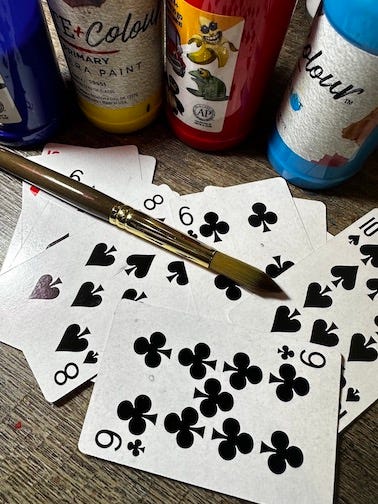
The first step is to paint the number side of a few cards from a deck of cards. I find them for really cheap at the dollar store. No need to ruin an excellent expensive deck of cards!
Painting cards in different colors allow for more choices and creative opportunities. Allow time for the cards to dry or pre-paint them.
Depending on the paint, you may need to add more than one layer. Once the cards are dry, they provide a blank canvas to create images and add your words/quotes.
Step 2: Searching for the right Words
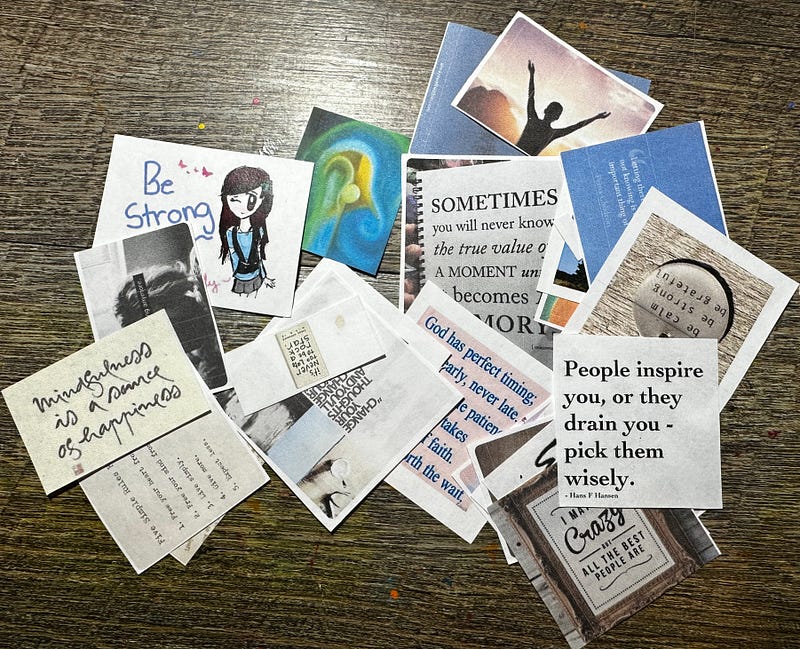
The second step is to search for encouraging quotes/words/poems.
Find quotes or poetry that resonate with you. Quotes that are already formatted work best and are fun to use.
There are several sites where quotes can be found, but my favorite site to search is Pinterest. Searching for encouraging quotes on this site will generate hundreds of quotes that can print with just one click.
Choosing quotes can take time because you can get lost in reading encouraging words. They are good for the soul! If time allows, having more than two cards ready and various quotes to choose from works best. You will want to create more than two!
Images often reach beyond our reality and suggest or relate to a deeper meaning than we had initially thought them to have.
Step 3: Engaging in the Creative Process
Put your painted cards and quotes in front of you. Choose at least one quote you identify with and one that you would like to give to someone else.
After you choose your quotes, glue them onto the painted cards. Once the quotes are glued onto the cards, you can use the art materials to finish decorating each card.
The end goal is to keep one card and give one away to someone else.
Have silence (or soft music) during your creation process. Silence is a powerful tool to allow deep thoughts and feelings to emerge.
Choosing a quote to represent oneself is a very personal and emotional experience. In addition, allowing time to be self-reflective can be cathartic and produce insight.
Once the quotes are glued onto the cards, decorate the cards. Simple lines and designs can be drawn onto the cards to decorate them.
I like to use permanent markers for this step. Whatever you create will be unique and special.
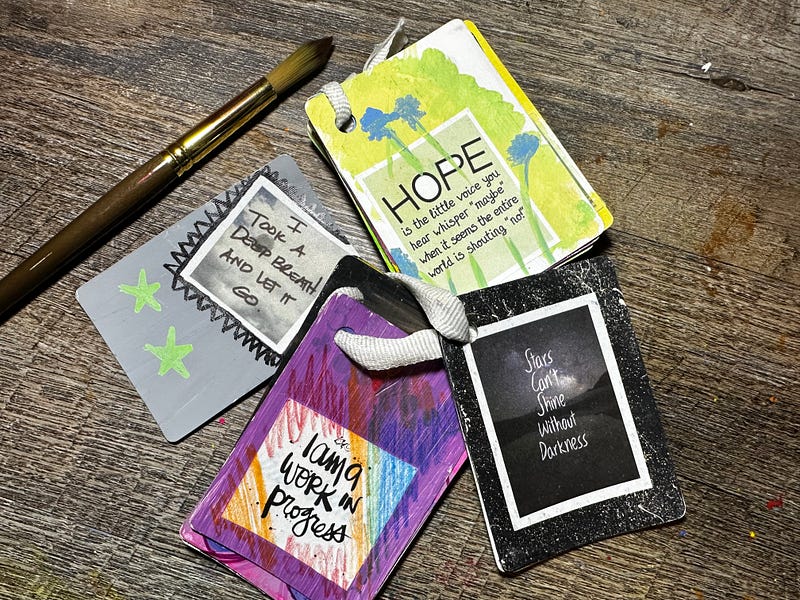
When I’m done I sometimes hole punch my cards and string them together like the image below.
Step 4: Processing the Activity
You can process this activity by yourself or with a client.
Explore the words and images. If working with a client you can start by asking, “I am curious about the quotes you chose for each one of your cards. Can you explain how you chose these over the other quotes you read?”
These quotes will be very powerful. They reflect how they view themselves, others, and the world around them.
Now explore the images created on each card. You can say, “I am wondering about the images you created. Can you tell me about them?”
You can also explore the feelings associated with each card by saying, “If you were to choose a feeling to associate with each of these cards, what might that feeling be?”
Allowing time to identify and explore these feelings is essential when processing this activity.
Just allowing time to identify the feeling can be a therapeutic breakthrough.
Exploring the feelings with your client will be a therapeutic decision based on how far your client is willing to go within the session.
The act of sharing a card with someone else promotes connection. Is this person someone in your life who needs a little encouragement or to hear something positive?
Giving away a card you created with words and images creates a powerful sense of connection and the good feeling of giving.
Summary:
The act of sharing promotes social interest, connection, and a sense of belonging. When used in therapy, the cards can be taken out during follow-up sessions and viewed again, enhancing healing, development, and growth as new discoveries and insights are continually being made.
This activity can be used at any point, independently or during a therapeutic relationship.
It is beneficial for assessment purposes, to build rapport, help clients (or yourself) become unstuck, or to help move a client from the initial stages of therapy toward gaining additional insight.
This is also true when done independently for self-care. The activity consists of making two cards, one for yourself and one for someone else.
Making a card for someone else fosters connectedness with others. The cards serve as a bridge between the creator and the action of building relationships.
Using images in therapy sessions can be a powerful tool that can elicit strong emotions; therefore, like any activity, it is a good idea to do the activity personally before asking a client to do it.
Finally, establishing a safe and therapeutic environment to create and process art is essential for successful treatment and for self care.
References
Beebe, A., Gelfand, E. W., & Bender, B. (2010). A randomized trial to test the effectiveness of art therapy for children with asthma. Journal of Allergy and Clinical Immunology, 126(2), 263–266.
Freilich, R., & Shechtman, Z. (2010). The contribution of art therapy to the social, emotional, and academic adjustment of children with learning disabilities. The Arts in Psychotherapy, 37(1), 8–12.
Gladding, S.T. (2011). The creative arts in counseling. Alexandria, VA: American Counseling Association.
Klorer, P. G. (2000). Expressive therapy with troubled children. Northvale, NJ: Jason Aronson.
Lyshak-Stelzer, F., Singer, P., St. John, P., & Chemtob, C. M. (2007). Art therapy for adolescents with Posttraumatic Stress Disorder symptoms: A pilot study. Art Therapy: Journal of the American Art Therapy Association, 24(4), 163–169.
Pifalo, T. (2006). Art therapy with sexually abused children and adolescents: Extended research study. Art Therapy: Journal of the American Art Therapy Association, 23(4), 181–185.
Riley, S. (1999). Contemporary art therapy with adolescents. London, England: Jessica Kingsley Publishers.
Spier, E. (2010). Group art therapy with eighth-grade students transitioning to high school. Art Therapy: Journal of the American Art Therapy Association, 27(2), 75–83.
Sutherland, J., Waldman, G., & Collins, C. (2010). Art Therapy Connection: Encouraging Troubled Youth to Stay in School and Succeed. Art Therapy: Journal of the American Art Therapy Association, 27(2), 69–74.
Watts, R. (2003). Adlerian therapy as a relational constructivist approach. The Family Journal: Counseling and Therapy for Couples and Families, 11(2), 139–147.