
Image Classification Using CNN

There are a wide variety of growing applications in image datasets. Image classification is a hot area that is explored by many researchers nowadays. The most popular algorithm that is applied in this field is Convolution Neural Network (CNN). Researchers found that the human brain recognizes images in different layers. And CNN is designed with the same perspective and that’s the reason it’s creating a strong impact in the field of image processing and pattern recognition. CNN is designed to solve the questions like what is an object? where is the object? and also in some cases what the value corresponds to images.
In this blog, we will understand the working of convolution neural networks and their practical demonstration on the CIFAR dataset.
Convolution Neural Network
In Layman's terms, The input image goes to a bunch of layers by applying the set of filters and predicts the output. The CNN process in the following steps
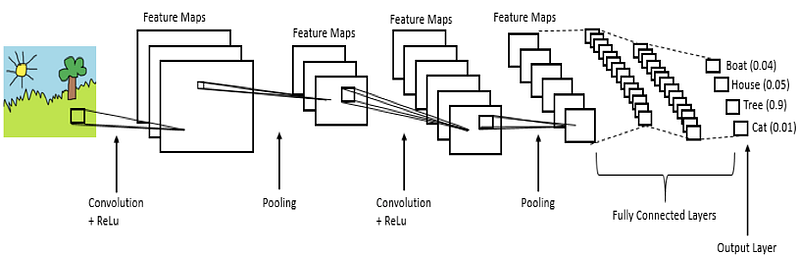
Step 1. Input image.
Step 2: Convolution +Relu Layer: In this layer, along with the convolution operation, the set filters are applied. A convolution is a linear operation that involves an input weight multiplication, similar to a traditional neural network. Because the technique has been developed to provide a 2-dimensional input, a double-dimensional weight array, a filter, or a kernel, is multiplied between input data arrays.
Step 3: Pooling layer: It is a kind of non-linear or downsampling layer that reduces the size of high-dimensional images to low-dimensional ones. This makes it further easy for computing and also reduces the high computing cost.
Step 4: Fully Connected layer: In this layer, every node is connected to every next node in the layer. It is followed with the layer of softmax or an SVM for a probability distribution. The highest probability distribution will be considered at the output layer.
Step5: In the output layer: The top 5 probabilities will be considered and given as output.
Let’s see the practical demonstration of CNN on the CIFAR dataset. GitHub repo.
Enjoy working with CNN.