
I’m Trying… And You Should Too
The rarely talked about impact of just trying.
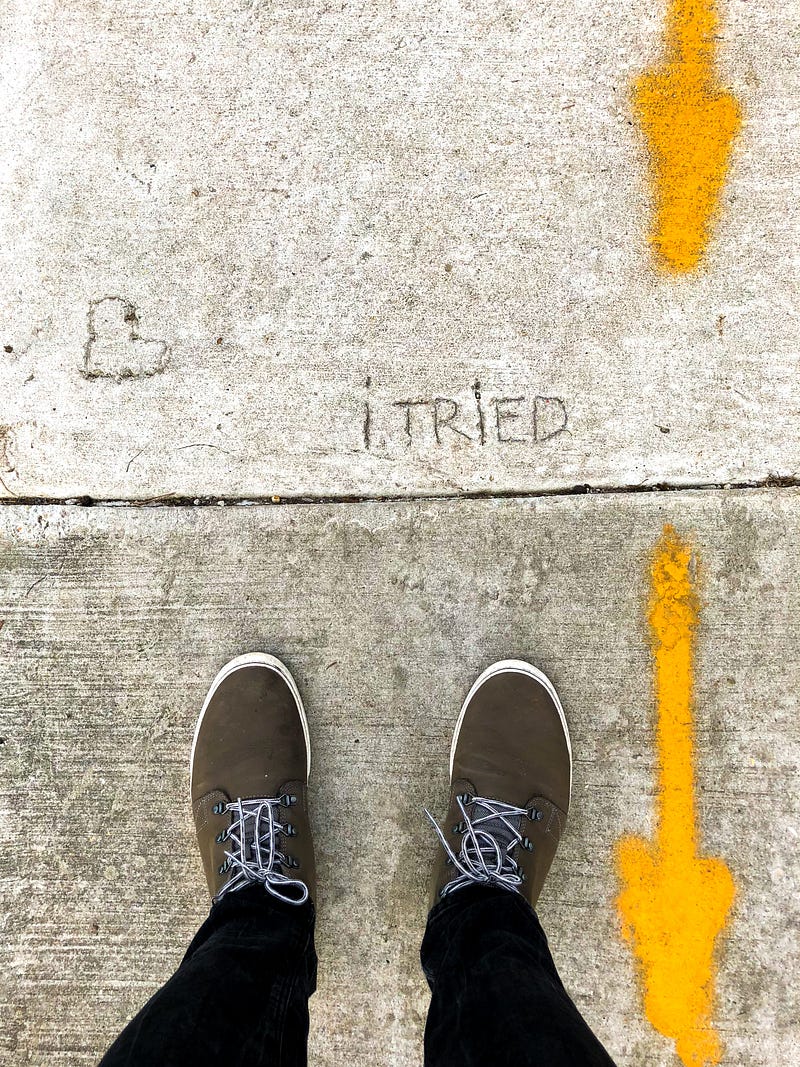
Have you heard these comments before?
“Don’t bother trying, it’s not worth it.”
“If something is worth doing, it’s worth doing well.”
“Why try when you will just end up regretting it?”
It is commonplace in modern society to believe in the all-or-nothing attitude. We all know someone like this, they are completely apathetic towards an activity or so all-in it's hard to keep up.
From the outside looking in, it might appear that these people have their priorities straight — they know what they want. But I would like to suggest otherwise, because how can these individuals be so sure when they aren't willing to venture out and try the things unknown to them.
Why do I bring this up? Because I believe re-establishing the definition of trying holds a lot of value to both the individual and society.
Yes, I know my last article was about nihilism, it makes sense if you have read it. I swear! So if you haven’t, I guess that means you should:
What do I mean by trying?
There are two versions of the word ‘try’ I believe exist: trying something new and trying something you have previously failed. We will talk about both, but the latter is where the juicy stuff is.
Something New
Trying something new is the most obvious definition, but also the one most avoided. Unknown activities can be especially daunting, and this feeling can be further aggravated by the notion that it's not worth trying unless you put in some elbow grease — who knows, you may be disappointed or get hurt.
There are of course situations where a high level of caution and effort must be used, however for almost anything new, the risk is limited at embarrassment.
As a personal anecdote, I always thought lucid dreaming was ridiculous; then on Christmas eve of 2017, I decided why not? Turned out, I was a natural! I put little energy in the beginning because of my lack of interest, but that didn't matter, it became a successful venture, anyway.
This became the catalyst for my realization that trying to stuff you believe you might not like is a great way to expand your horizons. You don’t have to put in much effort and yet, if you enjoy it, you can keep going. If I had just left it at a thought, I would have never found out I actually really enjoyed it.
Dipping your toes into foreign waters even if it is scary, especially when you feel you won’t enjoy it is not only a great way to grow as a person but an effective way to find new activities that you find fun.
Something you have previously failed
Now, this is the real meat of what I want to talk about. I’m sure you have all tried to do well in something and failed; gave it your all and still came up short. This section is for the people who think they can’t do it because you can and it's called ‘desirable difficulty’. I am bending the definition of the concept a little, but it fits so well!
Our minds are powerful and designed to adapt to the environment around us, but only slowly and through repetition. Estimates put the optimal range for learning just above your current capability. This does not sound promising, but with some compounding, it really builds fast.
As a hypothetical example: if you attempt an activity and put in 5% more effort than last time, 15x and you have more than doubled your effort from your first attempt.
It is okay to fail, it just means you successfully tried. This is the power of ‘desirable difficulty’; a level of difficulty in an activity that promotes learning by being difficult enough to be engaging but not so difficult the lessons cannot be absorbed, allowing such an activity to be repeated at various difficulties for long-term success.
This mentality can be applied to everything in your life, from relationships and work ethic to dieting and exercise. EVERYTHING! The key is to start small; you don’t have to do a lot. If something you are doing gets too hard, STOP. Don’t keep going if you don’t want to. Once you feel okay, go again; you will thank me for it.
My Achievements Using This
You may think if is so easy, what have YOU done with this method? I shall tell you! I started this journey about three and a half years ago at the beginning of 2018 after graduating high school.
The three biggest impacts this theory of mine had on me were through cooking, meditation, and lastly work ethic. We will go through them in order.
Cooking
Cooking started off completely foreign to me; I just wanted to learn so I could have good-tasting cheap food. Starting with easy dishes like fried rice, quiche, and spaghetti bolognese, I tried myself at culinary mastery. I Failed some of them and others came out not tasting the best, but none of them required much effort.
This was the key, it was easy to keep trying and wasn’t a struggle; it was just difficult enough to be engaging. Slowly, over time, I got better and better. I am far from a great cook, but this method made tackling a new skill like cooking easier to follow through with.
Meditation
Meditation was a concept I completely ignored and even ridiculed throughout my adolescence, but started putting effort into it just after high school. Unlike cooking, it was never easy and while you can’t fail at meditation, anyone who says you can’t improve at it is missing the point. Initially, I would meditate for about 3mins; constantly wondering when it was going to end. Each time I felt meditation was getting tedious, I would take a break.
This way it never felt drawn out or too uncomfortable — as long as I got back into it once I was feeling better, the cycle of improvement would never be broken. Nowadays I meditate for at least 10mins a day, and when I am stressed, I do a full 2-hour session to reset. Without those initial attempts and my effort to avoid the bitterness, I would not have been able to reach this point.
Work Ethic
Now for what you have waited for. Work ethic while something almost ethereal and seen as a skill you do or don’t have, I can say with certainty that you can improve it. I was smart enough in high school to breeze through with minimal effort — this was a true detriment to my future self.
I ended up struggling to do any over 2 hrs a day for a week before I burnt out. After high school, I realized the world didn’t care if you were smart, so I knew I had to do something about it.
2018 began with me and an abysmal work ethic. Then came my attempts; I would do those two hours each day for a week then stop for a few days. Again, and again, and again I would do this, slowly improving. Would I say I failed? Most definitely, and that was the difference, I didn’t push too hard. I knew if I kept trying, improvement would come as I became accustomed to each new level of work.
A lot has changed for me since the beginning of 2018, but this method has not — I use it to this day. Consistency beats brute force every time, and you don’t need to push yourself hard to be consistent.
There will be some of you who didn’t even realize you were implementing this method. For those of you out there, I would like to hear from you. Comment or respond with a skill, activity, or life concept you have mastered by this method.
And for those who are learning the power of this for the first time, try it, future you will thank you.