
I’m Kenough: A Nonbinary Transmasculine Perspective on BarbieI’m Kenough: A Nonbinary Transmasculine Perspective on Barbie
I felt something I definitely did not expect: I felt seen
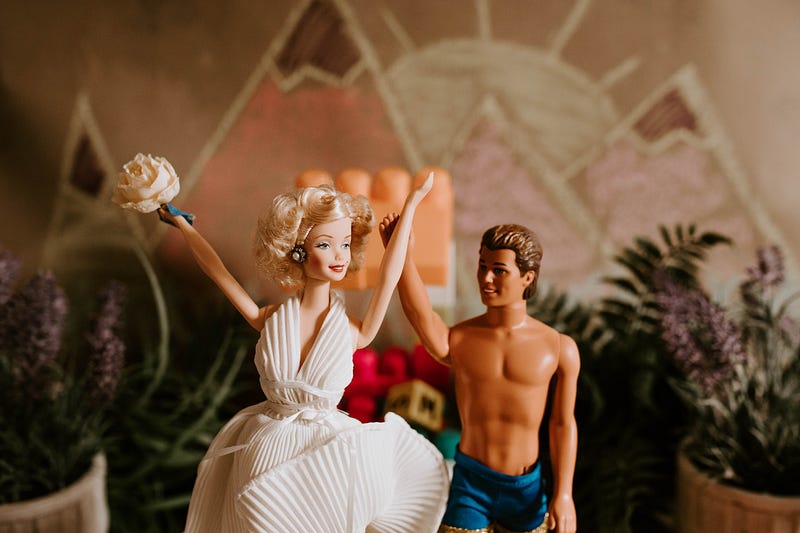
This article contains spoilers.
My partner and I planned to watch Oppenheimer the other night, but showed up late to the theater and opted for Barbie instead.
I never was a huge Barbie fan. Hot pink gives me a headache, and I remember being annoyed by my Dreamhouse’s painted-on furniture, and feeling insecure because my four-year-old waist wasn’t smaller than my head, like hers.
Neither of us really understood the Barbie appeal, but the good reviews convinced us to give it a chance.
From the moment at the beginning when Barbie steps out of her high-heeled sandals and her feet remain in tiptoe shape, we knew we were going to enjoy it in spite of ourselves.
The combination of goofiness, clever satire, and heartfelt emotion felt fresh and vibrant. It invited the viewer to laugh at the absurdity of the subject matter, without losing the nostalgic glow that also belongs to a movie about a children’s toy, and delivered more food for thought than many movies that present themselves as serious.
I’m nonbinary and AFAB. I certainly watched Barbie from a feminine perspective: tearing up at America Ferrera’s monologue about the impossibility of being a woman, and dissolving in cathartic giggles at the idea of “full body cellulite Barbie.” I groaned at the Kens’ on-the-nose Matchbox Twenty serenade (“I want to push you around …”).
But from my perspective as a detransitioned transmasculine person, other scenes stood out.
In their journeys between the matriarchal bizarro-world that is Barbieland and real-world LA, Barbie and Ken each experience a sudden change in social roles, and go through opposite, but parallel, identity crises. While not explicitly dealing with trans characters or transition, these themes link it to the trans experience in a way that’s more inclusive, and deeper, than the relentless focus on the physical that pervades so many trans portrayals in the media. After all, as the dolls themselves point out, neither of them has genitals. Their genders are social constructs in the most obvious way, but carry great personal and social significance.
As a member of the trans community I felt something I definitely did not expect: I felt seen.
Something about Ken’s reaction to the real world, as ridiculous as it was, got to me. When a stranger asks him for the time, he responds with awe and wonder. “You *respect* me?” He looks from men in business suits to pictures of male presidents with growing delight: the first time he’s seen someone who looks like him in a position of power. Like Elsa singing “Let it Go,” it’s a villain’s origin built around a wholesome core: a yearning to be accepted as one is.
Kens in Barbieland are second class citizens, expected to center their lives on hetero-romantic relationships, lacking male role models and representation. It’s not so much the world feminists want as it is the one men fear: a flipping of the existing hierarchy. Ken is a doll, representing a man, experiencing something like a woman’s role in society.
Upon arriving in the real world, he finds validation, but it’s contingent on embracing the patriarchy: keeping the hierarchy, but becoming the oppressor. Unable to imagine equality, he becomes a villain even though what he really seems to want is harmless: self-respect, the respect of others, and maybe a horse.
It reminded me of how it felt to transition from female to male.
I like to think I didn’t go on a rampage like Ken, swaggering into businesses demanding to be hired without qualifications, rallying his fellow Kens to oppress the Barbies. But something about his gleeful, unapologetically tacky self-expression, his goofy “mojo dojo casa house” and mink coat, spoke to me. It reminded me of the silly fashion statements I and a lot of other transmascs embrace — of the delight of being oneself, being playful and free in one’s presentation instead of carefully designing it to meet the expectations of others (sexy enough, but not too sexy. Up-to-date, but age-appropriate. Polished, but not unapproachable).
The joyful burst of solidarity between the fist-bumping Kens reminded me of the nods from men on the street, and this, along with cooperation by which the Barbies ultimately free themselves, left me wistful for the kind of empowering sibling-hood that’s hard to find as an older nonbinary person. Part of me was rooting for Ken — not to oppress the Barbies, of course — but to be his goofy self, and to find happiness in his male friendships, his horse motifs, and brewski-beers.
When I first started passing as male, people stopped calling me “hysterical” and “irrational” in arguments, and started letting me finish my sentences in conversations. The change was so sudden and stark I found myself actually needing to learn how to finish a sentence. In 30+ years of being seen as a woman, I’d developed an unconscious habit of condensing my thoughts to a Cliff’s Notes version, preempting the inevitable interruptions. It was so difficult to get the people around me to hear my ideas, I counted it as a victory when they stole them.
After transition, things changed. I’d reach the end of my prepared half-sentence and trail off into silence, waiting for an interruption that never came. Men and women alike would listen with polite interest, waiting for me to finish and explicitly hand off the conversational ball.
The liberation of early transition didn’t last — it was replaced by a need to navigate a new set of gendered expectations. Was my silly hat too silly? Was I nodding correctly — down for a stranger, up for a friend? Was I inadvertently intimidating women? Did smiling at a child seem creepy? I couldn’t easily talk about certain past experiences, like pregnancy or misogynistic discrimination, anymore. People assumed I’d gone through life with a privileged obliviousness I’d never actually known, and the genuine, honest camaraderie, the brotherhood or sisterhood I’d always yearned for, still felt out of reach.
I didn’t want to be on the top or bottom of a hierarchy, but to be myself in a world free of hierarchy.
Barbie ends with Barbieland’s original inequality restored, the Kens only beginning to make strides, as the narrator points out, toward the status women have in the real world. The film doesn’t depict or even promise a perfect society, just points out its absence. It seems to say to the viewer, “What, you don’t like that ending? You’d rather see equality? How would a better world look?”
The first step toward any change is imagining it, and, as Barbie’s gentle satire points out, our society is lousy at imagining equality. Like the movie’s dolls (Kens and Barbies alike), we can find empowerment in self-acceptance, solidarity, and strong platonic friendships, but it’s not enough to confront the hierarchies in the external world.
To build a better world, we need to deal with the way these hierarchies have warped our self-images, our relationships, and even our imaginations.
Pink Hair & Pronouns — come write for us!
Pink Hair & Pronouns is a brand-new Medium publication, a space for parents and caregivers of gender non-conforming kids. Please follow us, and if you have a story to tell, consider becoming a writer! Thanks!