I’m in a Toxic Relationship With the Restaurant Industry. Help.
Are you still in school? Or is this, like, your dream job?
I once had a woman ask me, as if these were the only two possible options:“So what’s your deal? Are you still in school, or is this, like, your dream job?”
“Neither,” I told her.
I’ve spent a third of my life in the restaurant industry. The other two thirds, I was too young to work. I’m twenty-four, and the most developed skill I have acquired is a finely tuned ability to smile while you yell at me about not getting enough sauce.
My mother tried her best, God bless her (I’m agnostic), to keep me away from restaurants. She’s an “industry vet” herself, having worked in restaurants for the better part of twenty-odd years. Having a kid at 20 puts some plans on hold, I suppose. Every time I struggle to pull myself away only to fall back into another “How’s everything tasting?” I blame myself for my family’s financial problems.
I remember, when I was sixteen, I had a friend who worked in a local fine-dining restaurant. He offered to get me a job there. “The money was good,” he’d said. My mother absolutely refused. Instead, I got a job at an old folks’ retirement village… as a server in the restaurant. Like I said, she tried her best. I was a good kid, too. I never drank or smoked, never really went to parties. I babysat my younger sister often and kept quietly to myself.
In college, I lived a block away from a Ruth’s Chris which was frequented by my then-girlfriend’s mother. I didn’t have a car and, well, the money was good. I worked there as a busser for three years, during which I began drinking heavily (underage), staying out late, and neglecting my studies.
I left Ruth’s during renovations, when I was a senior in college, and jumped ship to a smaller, local restaurant in Pittsburgh’s Market Square. I started serving at Diamond Market in October of 2017 and continued to do so until July 2018, when the restaurant suddenly closed because the owner’s sold the building to Bank of America. I still refuse to set up an account with them.
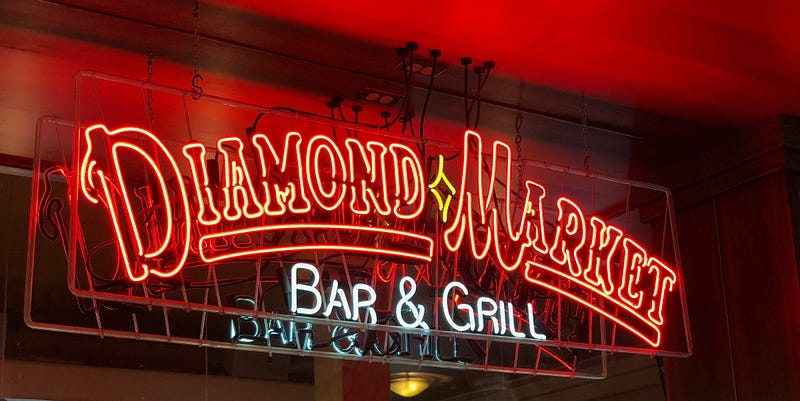
Diamond is where this toxic love affair truly began. I never really enjoyed my time at Ruth’s — as it turns out, fine dining isn’t my jam— but Diamond Market, like the food we sold, was comforting.
I graduated from college in 2018 with a degree in screenwriting, which meant I wasn’t going to find any jobs in Pittsburgh. The “plan” was to move out to LA one day when I’d saved up enough money. The issue was the “saving up” part.
Diamond Market allotted to me a sense of freedom and stability. I could work through busy lunches and easily make $150–200 a day, even more if I stayed through dinner. Being in the center of downtown Pittsburgh meant business was always, well, busy.
The money was good. The people were good.
Then life hit like an oversized SUV forgetting to yield at a highway merge, crashing into the rear of a 2003 Mercury Sable full speed, brakes screeching too late to make a difference. If that sounds like a hyper-specific metaphor, that’s because it isn’t a metaphor.
The accident came the same week Diamond was supposed to close, the same week my mother was hospitalized for 72 hours, and the same week I turned twenty-two. Happy birthday!
I found myself broke, jobless, and without a form of transportation. Fortunately, the issue of the job was handled with relative ease when I started with my current employer, which I’ll refer to as [REDACTED] for legal reasons. Less fortunately, at the time, the money wasn’t good, which still left the other two issues. Eventually, I maxed out two credit cards to fix the car.
For two years, I’ve been telling myself “one of these days.” One of these days I’ll get a writing job. One of these days I’ll move somewhere else. One of these days I’ll feel fulfilled. One of these days I won’t be broke.

When the clock struck twelve on January 1, 2020 I was in a bar with three of my closest friends playing JENGA, enjoying a Guinness. While 2019 had been a personally rough year, I was optimistic about the future. I planned to work harder at my personal projects, fix my financial situation, and finally get out of [REDACTED].
Obviously, that didn’t happen.
I don’t need to recap the events of the past seven months to you. Nor do I want to talk about the US response to the virus. For my thoughts on that, you can read this:
The one thing I will say is this: When the PA lockdown happened in March and the first waves of increased unemployment pay and stimulus checks rolled out, I was making more money than I ever had before.
I made more money shut up in my apartment than I did working 50-hour work weeks.
I want to be clear that this isn’t a criticism of [REDACTED], but rather a criticism of the restaurant industry as a whole. Restaurant employees are not required to receive minimum wage, so long as the tips they claim cover that difference in pay. Restaurant employees rarely receive benefits of any sort. No paid vacation, no dental/health/vision, no 401k. In most scenarios, if you have to take time off, you’re simply losing out on money.
This poses a great threat in the current climate. Restaurant workers, like many other essential employees, are in a high-risk low-reward situation. Have customers been kinder? Have tips been more generous? The short answer is no, they haven’t.
I worked Mother’s Day this year, during which we were still in the “Red Phase” of lockdown. It was a nightmare. Ticket times were nearly two hours. As the crowd outside grew more and more frustrated, they became less and less understanding. We were cussed out, screamed at, and threatened. Many people cancelled their orders. It was the first time I’d ever seen our kitchen managers simply have no clue what to do. Somehow, we managed it. Just down the street from us, Red Lobster had no choice but to send customers home without food.
I was disgusted by how little empathy people possessed.
According to Forbes, at the beginning of 2019 78% of Americans were living paycheck to paycheck. I remembered a conversation I had with my manger back in March, where he said “servers aren’t living paycheck to paycheck. They’re living day to day.”
He perfectly articulated why it’s so difficult for restaurant employees to break away from this line of work. You never know how much money you’re going to make. If you don’t think you’ll have enough for rent, you pick up an extra shift. It’s hard to think about not leaving work with cash at the end of the day.
I’ve never had to make a budget. Not really, anyway. I’ve never had the experience of receiving two weeks worth of pay and having to make a plan for it to last me two more weeks. I go into work, and sometimes I leave with $100, other times with $30. You just never know.
Most times, the money is good enough or simply “too good” to justify going to another retail job, even if it might make you happier in the end. For a while, I considered quitting and working at a local bookstore, only to realize that $11 an hour wouldn’t pay my bills. The money, however, is never so good that there isn’t always something better lurking just around the corner. It’s just a matter of reaching out and taking it, if you’re willing to suffer through the adjustment period and take an initial financial hit.

Just like any toxic love affair, though, it isn’t all bad. That’s sort of where the difficulty in leaving truly stems from. At the end of the day, if you like your coworkers, working in a restaurant can be downright fun. I have dozens upon dozens of positive memories associated with coworkers, and maybe one day I’ll share them.
If you like the people you’re working with, they can make it all seem worthwhile. The late nights after work sitting around, having a beer, and talking just to unwind can create some of the fondest memories. But there’s a negative side to this, as well.
Restaurant culture breeds toxicity even in its friendliest forms. Sure, having one beer after work seems harmless, but when that turns into three or four or five every night because you need to unwind? It isn’t healthy. There’s always the option to simply go home, shower, and go to bed but it becomes isolating and anti-social, lonely in an environment that is entirely reliant on hospitality and socialization.
It draws you in with a “We’re one big family!” mantra that is never supported by the person who hands you your W-2 each year. It sucks the life out of you day by day when you’re forced to remain stoic as an old man yells “Fuck you!” when you charge him for an item he ordered but didn’t expect to actually pay for. Year by year, it turns you from an innocent, good-natured kid to a cynical, functioning alcoholic watching the years pass by in a haze of hungover dissatisfaction as you slowly slip away from yourself, piece by piece.
I’m no longer in love with the restaurant industry, but it won’t let me leave.