
I’m Growing a Monster in My Belly
No, it’s not a baby, it’s a tumor.
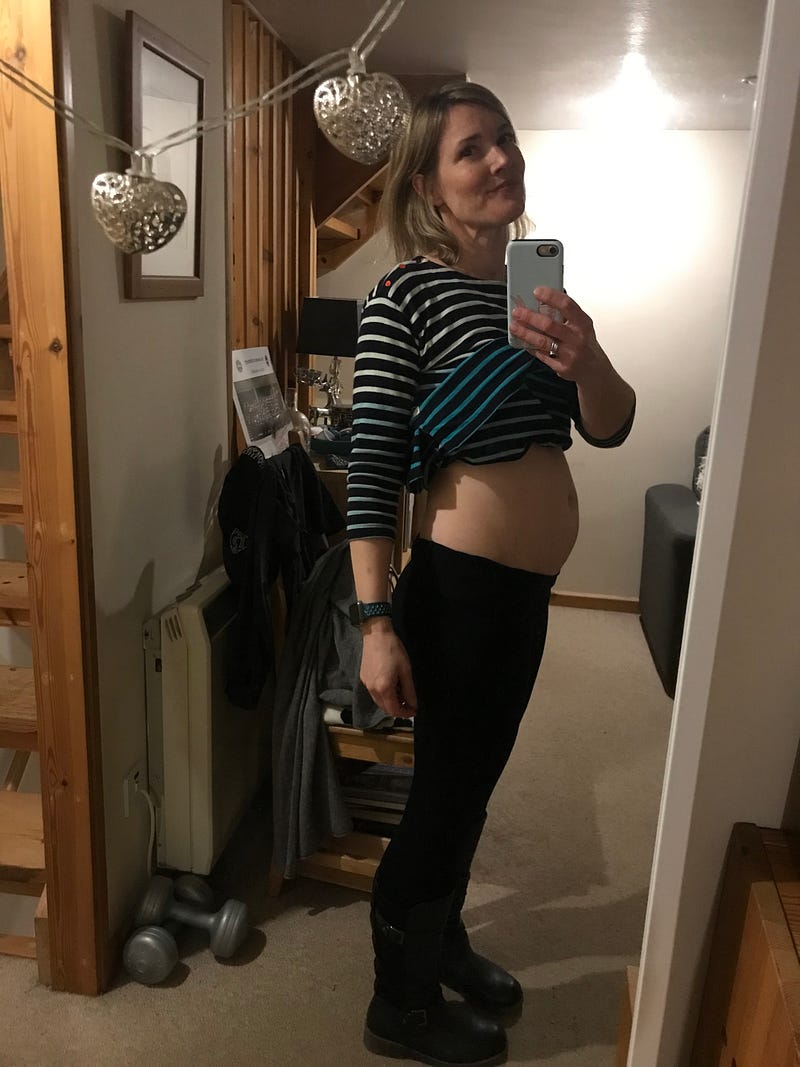
Looking down at the swollen mound spilling over my stretchy pants, I run my hands over my flesh, trying to love this changing body.
I can’t fit into my jeans anymore. I’ve resorted to wearing maternity clothes again to fit over my sore, distended stomach. I pop painkillers like sweeties, but nothing helps.
The pain in my body is relentless, gnawing, pervasive. I feel drained of energy, a husk of my former self, while outwardly I’m expanding.
I can’t sit down to write without constant pain, I can’t walk far, and I can barely think straight on a really bad day. I need to pee all the time.
I haven’t been doing much for a few months — apart from growing an alien in my abdominal cavity.
No, it’s not a baby, it’s a tumor.
A fibroid to be more precise. If you or someone you know has a uterus, this is stuff you should know about.
Maybe that ‘food baby’ is really a fibroid?
Sudden weight gain can be a sign of fibroids growing in your body. If you’re not pregnant and there is no other reason your belly is starting to swell, consider asking your doctor for tests to check for fibroids.
Up to 80% of women will have these benign tumors on their reproductive organs at some point in their lives, at any age from their 30s onwards. Many will not even know the muscular space invaders are there at all. For an unfortunate percentage, however, a fibroid can grow to a size that causes pressure on other internal organs.
Fibroids don’t go away on their own
Like a cuckoo in the nest, as it grows it pushes everything else out of its way, compressing your bladder and bowel, causing obstructions to your urethra, and in rare cases leading to kidney failure, and breathing problems.
There are treatment options for fibroids. You can have UFE (Uterine Fibroid Embolization) to try to shrink them. This involves injections into the arteries to shut down their blood supply. They won’t disappear completely but should shrink by up to 50%.
Myomectomy is the surgical removal of part or all of the fibroid, but there is a high risk of regrowth. It can be the best option for women who still want to start a family.
The only 100% certainty of removal is hysterectomy, where the uterus and attached fibroids are completely removed.
Fibroids only affect women
If men had multiple growths the size of grapefruits and lemons all over their reproductive organs, you can bet something would be done about it.
But women have been gaslighted about their health for centuries and it still continues when it comes to fibroids. It should not be considered normal to have a large tumor growing on your uterus, causing pain and other unpleasant and life-changing symptoms.
Fibroids cause pain and/or heavy bleeding
I have heard stories from so many women sent home from consultations in floods of tears because their pain is dismissed and minimized. They are told their level of pain can’t possibly be real as fibroids don’t cause pain.
One woman told me the doctor looked at her and said she didn’t look like she was in that much pain.
Perhaps we’re all being hysterical and should be locked away, like the way Victorians dealt with difficult, hormonal women?
Instead, I believe we need to talk more about fibroids, not tell women to put up and shut up.
The singer FKA twigs went public about her fibroid removal in December 2017. She described her painful experience as,
“…excruciating at times and, to be honest, I started to doubt if my body would ever feel the same again … I know that a lot of women suffer from fibroid tumours and I just wanted to say after my experience that you are amazing warriors and that you are not alone.” — F K twigs
Fibroids are a bit of a mystery illness
If you Google the causes of fibroids, you will find numerous possible causes.
Estrogen gets the blame primarily, but all women produce estrogen, so I think we need to look at why it might be a trigger to promote tumor growth. Another possibility is genetic changes, with risk factors including excess drinking, childhood trauma, diet, and heredity. The list goes on.
WebMD states that,
“Experts don’t know exactly why you get fibroids. Hormones and genetics might make you more likely to get them.”
That’s a bit of a cop-out for a problem that affects millions of women.
One curious fact is that all women can get fibroids: Young, old, thin, fat, rich, poor.
There is no demographic of women spared from the possibility of fibroids.
Over the past few years, some celebrities have gone public with their fibroid stories to help raise awareness.
Action on fibroids is needed now
One woman who has taken action on fibroids is Kamala Harris. In 2020 she put forward the Fibroid Bill to provide much-needed money for research into this health problem. As she said,
“Millions of women across the country are affected by uterine fibroids, which can present serious health complications. (These include) maternal mortality and morbidity, an ongoing crisis, especially for Black women.”
— Kamala Harris, VP
Fibroids suck the life out of women, leaving them drained, exhausted and desperate.
Tens of thousands of women attend ER every year with catastrophic bleeding caused by fibroids.
There has to be a reason why the number of women suffering from fibroids is increasing year on year. Whether this is from environmental causes or the ‘harmless’ contraceptive pills so many of us take, we need more research and better solutions for this growing problem.
Hysterectomy is the only option for me. It’s a major procedure and I have to admit to being anxious about the outcome. The what-ifs are scary and Google is not always your friend when it comes to health problems. For example, did you know that studies on rats have shown a decline in cognitive ability after their uteruses are removed?
What if my brain doesn’t work properly after my womb is taken out? The fear is real.
But I’m so tired of looking pregnant and the stares of people judging me for looking like I’m having a baby at my age.
People are quick to make wrong assumptions and judgments. And I don’t expect understanding from colleagues as it’s impossible to explain how much pain I experience. Besides, women’s pain isn’t taken as seriously as men’s pain.
I’m pretty sure I’d get more sympathy if I said I had a brain tumor rather than one growing in my womb.
Even when it is the size of a small melon.
I’m now on a drug to shrink the monster, prior to surgery in a couple of months. As well as reducing my symptoms, it might make the difference between needing a vertical or a bikini line incision in my abdomen. At this stage, I couldn’t care either way.
I just want this thing out of my body so I can get on with living a normal life.
Most women I speak to on the fibroid support groups say they feel so much better after a hysterectomy. They didn’t realize how many other health issues were being caused by their fibroids until they were removed. I’m clinging on to the hope that I’ll feel like this too, in a few months.
I have aches and pains in my hips and back that I didn’t have before this monster started growing in my belly.
I can only hope that I’m going to be like these other women and find renewed energy and an end to pain on the other side of surgery.
Fitting back into my jeans will just be a welcome bonus.


