
I’m an INFJ: What MBTI Personality Type Are You?
Learn to live with, if not tame, your personality

(Originally published on my blog.)
If you’ve ever wondered why you are the way you are, perhaps you never ran across a little test called the Myers-Briggs Type Indicator (or MBTI) test.
After having a particularly stressful, unorganized day, I decided to try out the test for myself to see if it would shed any light on my own personal quirks and mannerisms as well as my views and opinions of life.
Let’s just say it’s nice to finally get a clear picture of why I am the way I am and how to make the most of my unique qualities as—according to the MBTI—an INFJ.
Alone No More
Recently, I’ve been experiencing…what I wouldn’t exactly call mood swings, per se…more like frustration with not being more productive and getting “just one more thing” done.
For the longest time, I’ve felt alone in my seemingly hopeless search for peace with the fact that I simply can’t get everything on my to-do lists done and that I don’t have to beat myself up because of it. (I’m sure you’re familiar with the saying “The inbox is never empty.”)
Alone, that is, until I discovered many others who share the same quirks, mannerisms, and thought processes as me…an INFJ, according to the MBTI.
Enter the Myers-Briggs Type Indicator Personality Test
Not too long ago, while doing some research on writing fiction, I heard about using the MBTI as a way to flesh out more realistic characters and make sure they stay true to their own personalities.
I had been putting off researching the MBTI for a long time until recently when I finally got frustrated enough to use it on myself. What I found finally gave me hope of at least learning to live with my personality, if not taming it.
INFJ: The Advocate
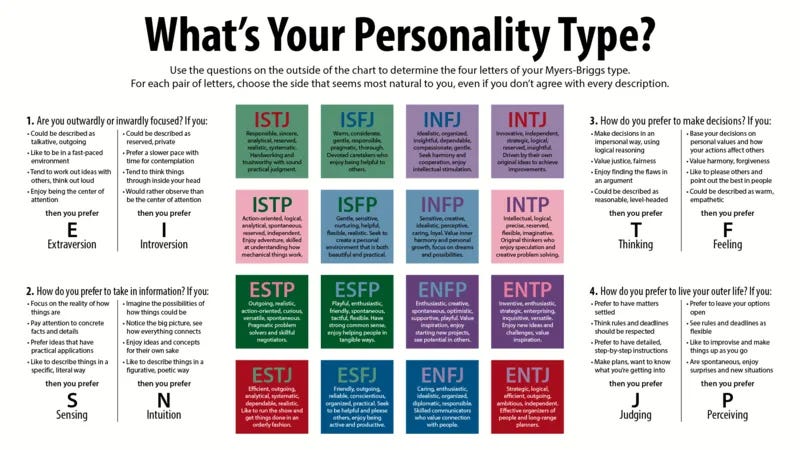
According to the test, I’m categorized as an INFJ. These letters correspond to one of 16 personality types that were discovered by the legendary psychologist Carl Jung which were then organized by the Myers-Briggs team.
For myself and other INFJs — who make up only 1 to 2 percent of the population — these letters correspond to what Jung considered the “four principal psychological functions” by which humans experience the world around us. In the case of INFJs, they are as follows:
I = Introvert
N = Intuition
F = Feeling
J = Judgment
INFJ: I is for Introversion
So, just what is an introvert? According to Dictionary.com, an introvert is, as it relates to psychology:
A person characterized by concern primarily with his or her own thoughts and feelings (opposed to extrovert).
After reading the results of my own test and finding out I was an INFJ, I was amazed at how accurate the results were. This definition may not look like much, but when I saw the way the test expounded on the definition, it was like the people behind the scenes were reading my mind.
As I began to analyze my own life, I saw that I was, in fact, an introverted person. Sure, people who know me best see me as a fun-loving cut-up, but when I’m behind closed doors…I like to be alone behind them.
It’s not that I’m unsociable; rather, it’s that I like to have time to process what’s going on in my head. (Which probably explains why I love journaling — aka “thinking on paper” — so much.)
I’ve found — even before the MBTI — that I work best that way. It’s an extremely daunting process, but until I can work out the details of whatever I’m so deep in thought about, I don’t feel complete or whole in any way.
But once I’ve had time to process the thoughts and emotions I’m feeling, I feel a renewed sense of energy, completion, and satisfaction that I just can’t get otherwise.
INFJ: N is for Intuition
Personally, I think the intuition portion of my INFJ personality hit the nail on the head more than all the other aspects.
For the most part, I like to be organized, at least to the point of getting started and getting some momentum behind me. When it comes to my guitar courses, I’m a natural outliner; I like to have a clear plan to follow so I’m not rambling around aimlessly trying to get to the end of a project.
But when it comes to writing, I can’t quite decide which direction I want to take.
I’ve been delving into the many books I own — and have recently purchased — on writing, some of which advocate outlining (aka plotting), and some of which advocate writing without an outline, or “by the seat of your pants” (aka “pantsing”).
The problem is, I’m too involved in the research of writing to be progressing with the actual writing itself. Deep down, I know this is one of the major fears I must overcome to be successful in my writing goals, but how to do it?
In short…
“Trust the Process.” — Unknown
“Trusting the process” is one of the many aspects I discussed in a recent review of a wonderful book on writing by Dean Wesley Smith that I’ll publish on Medium soon. It means “trust your intuition.” And being an INFJ, this is exactly what I needed to hear when I first read the book.
Other writing books quote similar passages. One of my favorites even mentions that, as a writer and avid reader, chances are I’m “already following a common story structure without even knowing it.”
Therefore, I should trust my intuition to guide me in the storytelling process, having read so many great stories that have no doubt imprinted on my psyche the basic elements of story structure (drama, tension, climax, etc.).
Another interesting point just occurred to me: This entire story — and most of my other stories — was written by the seat of my pants. Sure, I had a small idea of what I wanted to cover in this story, but for the most part, I’ve been winging it the whole time!
This goes to show that I should just throw caution to the wind with fiction, as I have with non-fiction pieces like blog posts and journal entries — which are also written without the help of an outline.
Again, if I can just allow myself to trust my intuition, there’s a great chance that my “gut feeling” won’t lead me astray — not just in writing, but in all areas of life.
And speaking of “feelings”…
INFJ: F is for Feeling
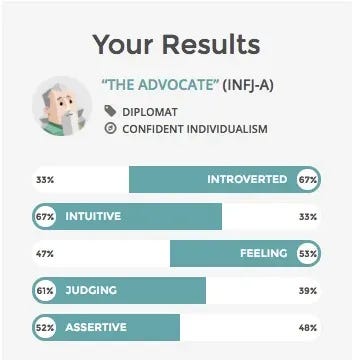
According to 16Personalities’ free personality test:
Feeling individuals are sensitive and emotionally expressive. They are more empathetic and less competitive than Thinking types, and focus on social harmony and cooperation (emphasis mine).
I’m definitely an emotionally charged person. I’ll admit, the waterworks begin to flow the moment I even sense an emotional moment in a movie is about to happen: a family reunited with their lost loved one, the death of a family pet, the loss of true love. I’m not ashamed; I can cry with the best of them. It’s just who I am.
Many people would think that a weird thing. Not INFJs. They get it.
Not only that, but I can definitely empathize with others in their own emotionally traumatic states. I find myself constantly being the one who has the need to reach out and comfort others in their time of anguish.
I may not know what to do, but I’ve found that listening — yet another aspect of INFJs — is a much better strategy than trying to give suggestions.
The problem is, it’s easy to let feelings get in the way. Just as any other aspect of INFJs (Introvert, Intuition, Feeling, Judgment) can be a strength, they can also be a weakness. The important thing is to find balance when it comes to utilizing your personality type and its quirks, regardless of what it may be.
INFJ: J is for Judgment
This last one’s a bit tricky. The judgment aspect of INFJs doesn’t mean that we’re judgmental of others; far from it. Rather, it denotes a preference for decisiveness, organization, planning, structure, clarity, and the like.
I find this a bit tricky when you look at the main component of INFJs: intuition. I’ve still got a lot to learn about this personality type, but on the surface, it seems to me that it can lead to a potential clash within one’s own mind if INFJs are both intuitive (free to explore, be curious, be imaginative, etc.) and judgmental (organized, structured, etc.).
I also find myself wondering if the popular right brain/left brain theories have anything to do with this potential clash of interests.
The right, creative side of the brain is constantly at war with the left, logical side. When writing by the seat of your pants, in order to silence the inner critic (left brain), you must plow forward and allow your creative side (right brain) to take over.
The left, critical side has its purpose, but only for later, when your first draft is finished.
Looking at this clash in the brain/personality leads me to believe that this could be the answer I’ve been searching for as to why I want to write but never seem to get around to it.
Dean Wesley Smith calls it the “critical mind” in his book. Steven Pressfield refers to it as “Resistance” in his book The War of Art. Point being: The right and left brains are constantly at each other’s throats (for lack of a better phrase).
Whatever you choose to call it, there always seems to be something that wants to keep you from achieving the goals you most want to achieve. If you’re an INFJ, you just have to be willing to silence those unproductive voices in your head and start listening to your intuition and feelings.
A Great Resource for INFJ Writers
While in my search for INFJs like me — especially in the writing community — I came across one particular site that piqued my interest very much.

A writer by the name of Lauren Sapala, also an INFJ, has a wonderful blog for INFJs who struggle with some of the problems I’ve mentioned above as well as more writing-specific hurdles to overcome.
When I first found her blog, I must have read seven or eight — or a dozen — blog posts she’d written specifically tailored to Introverts, INFJs, and INFPs.
She’s also written a book dedicated to helping INFJ Writers called (appropriately) The INFJ Writer.
Not an INFJ? No Problem!
With only 1 to 2 percent of the population making up the Myers-Briggs Type Indicator of INFJ, I wouldn’t be surprised if you didn’t fit into this category; I was surprised I even managed to.
The best thing you can do is find out what your personality type most likely is by taking the free 16Personalities test.
Just make sure you answer the questions as truthfully as possible; even double-check your answers if you have to. (This of course means that you answer them according to how you actually are as opposed to how you want to be perceived!)
It’s a fun way to pass the time, it’s free, and it’s likely to help you discover more about yourself than you ever knew before.
A Dose of Common Sense
All this being said, I am NOT affiliated in any way with the 16Personalities test, and I’m sure there are things I don’t entirely agree with, seeing as how I haven’t thoroughly researched the subject myself.
So my “official” disclaimer for this story is that I am NOT a psychologist, psychiatrist, or licensed practitioner of any sort—nor do I play one on TV.
Take this test with a dose of common sense and use your best judgment when taking the advice of anyone or anything on the Internet. I endorse the test for entertainment purposes only; nothing more.
Now, go have some good, clean fun, and learn a few things while you’re at it.
If you liked this article, please consider highlighting, following/subscribing to my Medium profile (Eric Beaty), sharing, commenting/responding — and/or using any of the other interactions Medium provides to readers — to show your appreciation for and to help others discover my writing. Many thanks in advance for your support. Until next time, if you’d like to know more about me, check out the links below.
- ✍️ Visit my official Author page
- 🗞 Subscribe to my Substack, Gleaning Words
- 📚 Get your copy of The INFJ Writer
Disclaimer: Some of the links on the page may be affiliate links. These links allow me a small commission on every sale at no extra cost to you. So if you’d like to show your support for my work, feel free to use the links on this page.