
I’m Always Going To Want At Least One Flight Of Stairs With My Apartment
That said, you can’t hack yourself into living till you’re 100
If you haven’t watched the Blue Zones documentary on Netflix, do it. It’s worth your time.
I loved it. But also considered it a bit absurd at times.
I’ll tell you why, as we discuss the merits of taking what people do in the Blue Zones and making these behaviors part of their lives.
A Blue Zone is a part of the world where residents live longer than the going averages, often hitting and blowing past 100 years of age. Places such as Okinawa Prefecture, Japan; Nuoro Province, Sardinia, Italy; and, a mere stone’s throw from where I live in Los Angeles, Loma Linda, California.
I loved it because any account of the Blue Zones can’t help but be inspiring. It puts a smile on your face. It gives you hope.
To see people who look 60, 70, and 80, but are actually 80, 90, and 100-plus living active, vibrant lives and, in some cases, doing more and doing it faster and better than people I have observed who haven’t even hit 50. It’s a breath of fresh air in an increasingly stale and unhealthy world.
That’s also part of what makes it absurd. It’s hard to believe they’re not putting you on when you see a 100-year-old farmer jumping on and off a horse with what appears to be zero effort. This guy — and others like him — literally move around like they’re half their age.
I loved it because I already do a fair bit of what many of these people do on a daily basis. I also plan to move to a part of the world with a relatively high life expectancy (Spain) where the culture and prevailing lifestyle will allow me to do even more.
This leads to more absurdity. But of a more critical variety. As we focus on the keyword of that last paragraph — culture.
On one hand, the host of the documentary, National Geographic fellow, Dan Buettner, who chronicles and, subsequently, touts Blue Zones says — paraphrasing —
The beauty of what’s happening in these places is that they’re not even trying to live to 100. They’re just doing life (culture). And this lifestyle clearly facilitates long, healthy lives given the similarities you can draw between blue zones.
Then, on the other hand, he runs a Blue Zones program “dedicated to creating healthy communities across the United States” (emphasis added). Long story short, Buettner and his team have manipulated social and physical environmental factors in parts of the United States (Albert Lea, Minnesota; Fort Worth, Texas; and three cities in Southern California’s South Bay), leading to impressive results. For example, the program has helped reduce rates of obesity and smoking, increased time spent exercising, and in Albert Lea, it actually added 2.9 years to lifespans after one year.
All fine and good. But don’t get too carried away.
I’m guessing you can find similar health initiatives — run by people who have never heard of the Blue Zones — that produced similar or even better results. It’s relatively well-established in the social sciences, particularly urban planning and related fields, that certain types of built environments help facilitate everyday physical activity, which helps produce favorable health-related outcomes.
Heck, way back in 2007, I published an academic article that concluded that people who drive more tend to have higher body mass index than people who walk, bike, or take transit to commute and run errands. The structure of your built environment (specifically density and mixing of uses, or lack thereof) is directly related to how much you drive. That paper still gets cited today and dozens, if not hundreds of studies came before it and continue to come after producing basically the same results.
As I noted in a recent edition of my newsletter:
When we speak of the physical environment, we tend to deal with elements in isolation. We forget that providing public space, fostering walkability and encouraging less auto traffic ultimately contribute to, if not dictate culture and lifestyle …
It’s all of these things and more. The stuff that melds together to define a culture. To offer a lifestyle.
The #1 problem in America isn’t even that we have a culture that tends toward private space, car use and ownership and suburban living, it’s that, across too much of America, this is your only choice.
Ultimately, how we situate ourselves matters with respect to levels of physical activity and even social interaction and a sense of community (all key Blue Zone elements). And how we situate ourselves reflects our cultural norms and inclinations.
People in Blue Zones do things that help them live longer without even thinking about it because it’s all part of their culture. No matter their physical environment, they have principles around nutrition, work, relationships, a sense of purpose, spirituality, and religion that guide them.
Here again, it’s how they do life.
I use the urban planning/built environment example for two reasons —
- It’s a major and telling reflection of culture, including and especially American culture.
- It’s often the first thing health advocates go after when attempting to incite change.
If we can only get people to drive less, go outside more, and have walking distance access to public space and healthy food, everyone will be better off.
We have to purposely and methodically introduce and implement structural tweaks to meet these goals and objectives because all of these things tend to go against our prevailing culture. We drive everywhere. We’re a sedentary society. We lack public space. And we eat poorly.
So, while I loved and got a lot out of the Blue Zones documentary, it’s a bit comical to use the Blue Zones as a blueprint for change in America. Even if every one of our citizens ran a marathon once a month and snacked on carrots and passion fruit instead of chips and candy, we’re about as far away culturally from these centenarians and their slightly younger counterparts as we can possibly be.
Loma Linda is an outlier, thanks largely to their strict religion organized around healthy living, service, and community. In most of the rest of America, all you can hope to do is tweak this or that element of the social or physical environment and pray for the best.
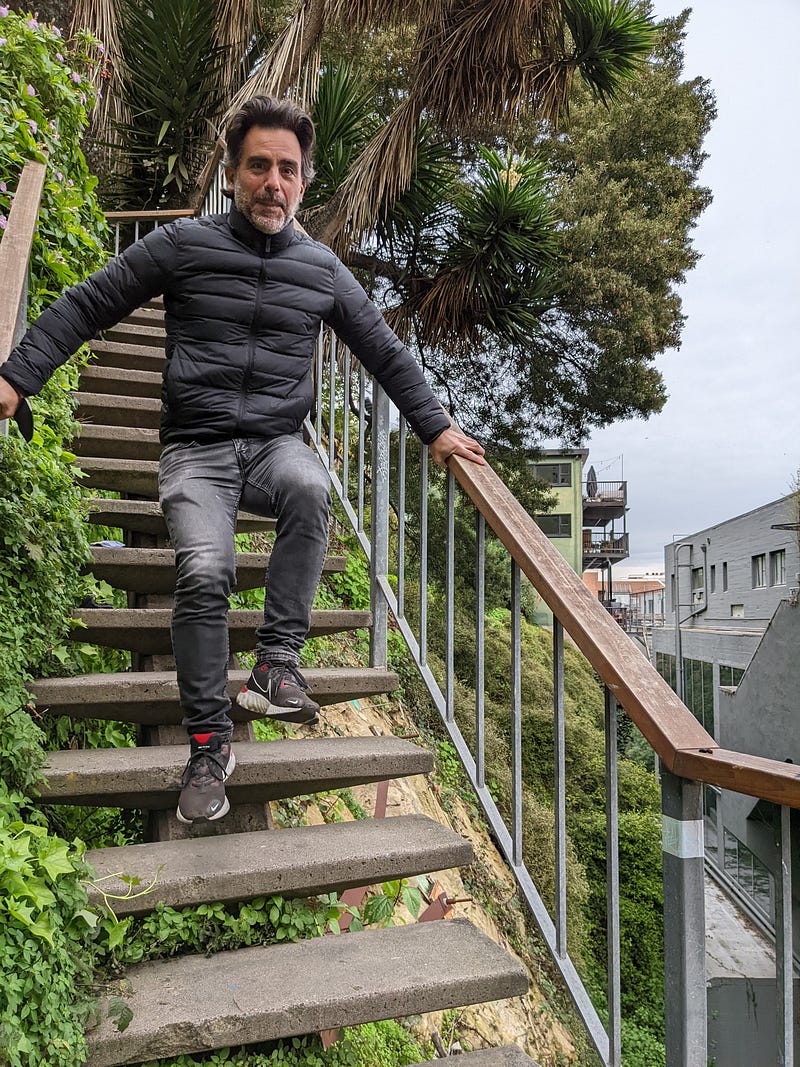
All of this said — to the title of today’s article — I hope to have one or more flights of stairs to traverse in the apartments we live in when we move to Spain. With no elevator. I have four flights now here in LA.
Because Buettner discovered something else interesting:
- In Sardinia, residents who had to walk uphill in their village on a daily basis lived longer than those who didn’t.
This leads to another cultural issue that might impede our ability to live longer, healthier lives in America.
We assume degraded health in relatively old age and beyond even before it happens. While we can come up with myriad examples of this, the best might be ensuring you don’t have steps to climb in the house you plan to die in. Because — come age 60, 70, 80, or even younger — how will you possibly be able to get up and down them?
Not a future I (a) want to look forward to or (b) helplessly predict.
Maybe if you walk those steps from mid-life — and stay active and physically and mentally healthy in other ways — those steps will be part of an exercise routine you won’t even have to think about when you’re old.
They will simply be just another aspect of you living — a long, healthy, and decidedly positive — life.
If you’d like to know more about the journey I’m on, follow me on Medium.