
I’m Afraid I May Have Fallen Victim To An Online Phishing Scam
I thought I was smarter than this.
I think I may have gotten hoodwinked.
It happens. We hear about people getting ripped off online all the time. I’ve even seen people I know the post about being fooled. But I never thought it would happen to me.
It started with an ad I posted to an online buy/sell website that got weird. I’m afraid I may have given more information than I should have before I caught on.
I am currently in a holding pattern, having decided to cease all communications and see what happens.
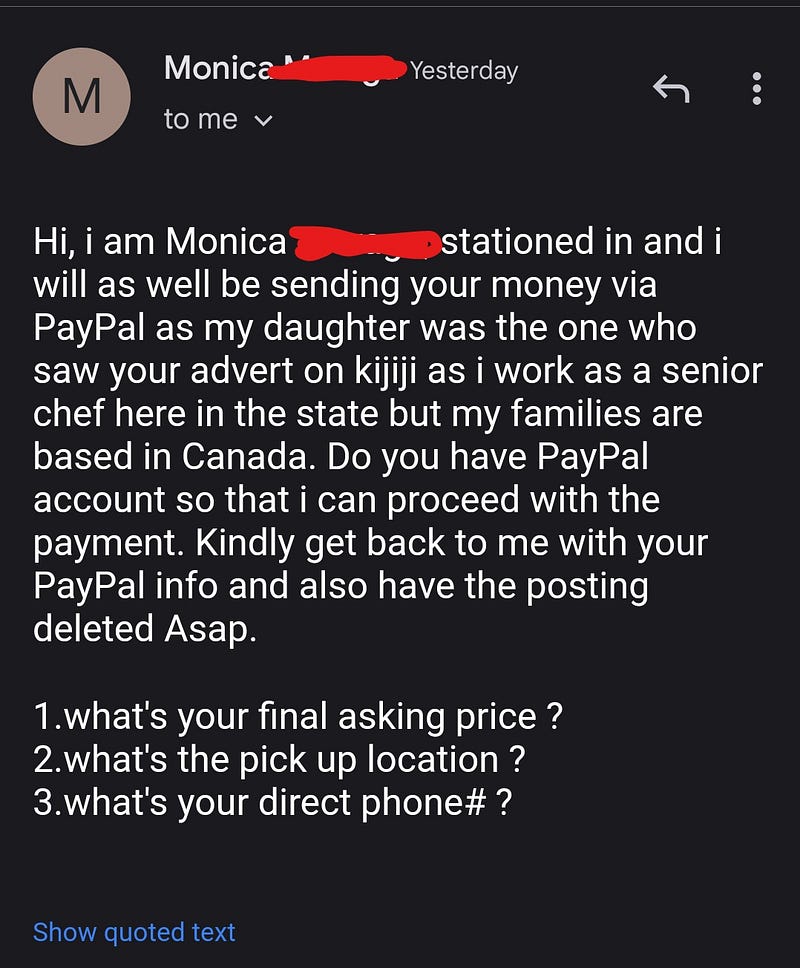
“My families are based in Canada.”
Guh, I should have known right there something was off.
Yesterday I posted an item on Kijiji (an online ads website, similar to Craigslist, that we have in Canada).
I received a text response almost right away, which led to an email exchange that was kind of strange.
“I work … here in the state,” and “My families are based in Canada” could have been the rushed, autocorrected text of a parent who is trying to balance spinning plates while working to keep a teenage son or daughter pacified, right? Right? I can certainly relate. In fact, I’m selling this item in Kijiji for my own son.
Maybe I’m just too nice.
The reason I gave it so much slack was because the exchange started with a text to my phone number that didn’t necessarily raise any alarm bells.
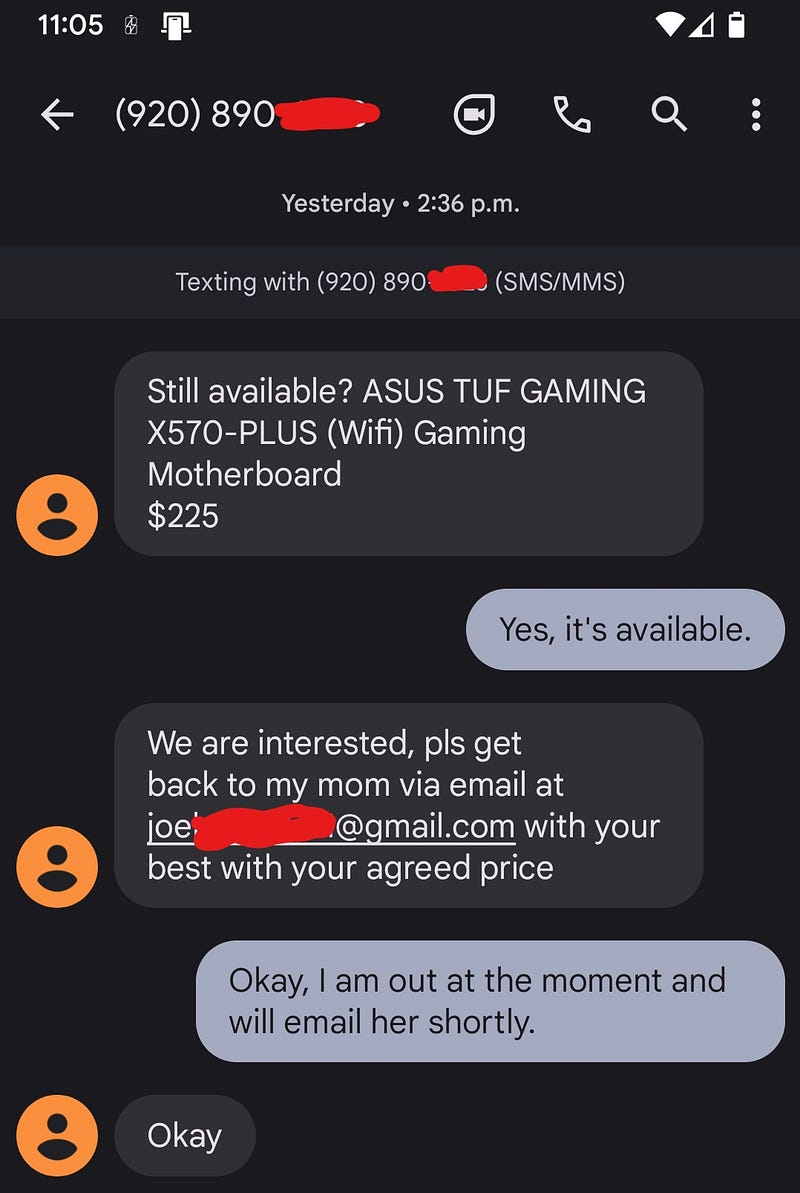
Okay, so a teenager wants a gaming motherboard to build a computer. No surprise there. Mom’s going to pay for it. Also, not surprising.
The FBI reports that its Internet Crime Complaint Centre received over 450,000 complaints in 2019, an average of 1300 people per day.
Consumerfraudreporting.org reports that over 84,000 people were victims of ‘non-payment/non-delivery scams in 2017.
The FBI says these kinds of crimes, where a buyer offers to pay for the shipment of an item for sale, then claims they did not receive the package so that they can request the payment be reversed, are increasingly being initiated by text message.
I was never contacted from within Kijiji about the item I had for sale. I was texted directly on my phone.
I’ve opted to have my phone number shown on ads before, but this is the first time that someone has used it.
Everyone is at risk.
A few years back, a friend posted on Facebook that he’d had his VISA card taken over via some kind of online scam. This guy is no pushover. He expressed surprise that he’d been taken advantage of, and I took note. I vowed I’d be extra careful going forward.
The FBI states that there were $4.5 billion in losses to individuals and businesses in 2019. It’s not just the elderly trying to figure out their computers.
I don’t consider myself naive. However, my fifteen-year-old son called it right away when I told him about the text message. He recently sold a gaming keyboard online and said those in the community he put it up for sale speak openly about this scam. Pay for the item, receive it, say it was not received, keep both the item and get the money back.
In fact, when I did an online search for the phone number and email used to contact me for this ad, there were several complaints on multiple sites that this person has been at it for several years, using the same name and email address!
So, What To Do?
I’ll start with what I’ve done to hopefully mitigate the damage in my personal situation and then I’ll share what the experts say to do to prevent getting into trouble in the first place.
The first thing I did was stop communicating with the entity. I imagine they have many scams on the go and wait for responses in order to detect who is still hooked on their line.
This is probably why they kept asking me questions while ignoring my own attempts to inquire about where they were located and what the heck they were talking about. Getting me to answer questions would show I was still baited.
Next, I took my phone number off of the Kijiji ad. I’ll let people contact me via the site’s onboard chat from now on, and, when comfortable, I’ll exchange phone numbers for delivery/pickup.
At this point, the potential scammer has my phone number and my email address. They insisted that I open a Paypal account and give them information, which I stopped just short of doing. This is the crucial part of the plan — they send payment via Paypal and then request a reversal of the charge when they receive the item, claiming that the victim has been negligent.
Hopefully, I’ll just never hear from them again. I plan to go cold.
PC Mag makes the following suggestions to keep yourself safe:
- Look closely at the web address of any site asking you for login information — there may be a letter missing or a number added. Also, be sure there is an ‘s’ after the http. This is how you know the site is secure.
- Don’t click links in emails from people you don’t know. You could be taken somewhere to be tricked into entering the information you don’t want to be giving away.
- Go directly to the source. If you get a text that purports to be from your bank, perhaps saying your credit card has been used in an unusual way, then go directly to your online banking to see if there are any warnings. Do not click the link in the text or email.
Going forward, I won’t be putting my phone number in online ads. Also, I will no longer give the benefit of the doubt when my spidey senses are raised. I thought it was rude to consider poor English to be a cause for alarm. That alone isn’t, but in combination with a demand to use Paypal for payment? I think I’ll set the parameters of my own sales from now on.
Bad people everywhere.
People have been finding ways to scam others for time immemorial.
While the internet has opened new opportunities to be taken advantage of, it also has given us collective strength to share experiences and give each other the heads up for danger.
It is my hope that this article helps you realize that it’s not that hard to make a mistake. I already knew to ignore requests for bitcoin arising out of some set of blackmail circumstances that make no sense. I also knew not to click links in my text messages, even if they seemed to come from my bank. Still, I almost got roped in here. Hopefully, they don’t have enough to hack into my stuff.
Trust your senses. Be alert. If it seems weird, it’s okay to suspect it.
Stay safe.
***
Support me and other writers on Medium by becoming a member.