
Gender Enforcement in Catholic Schools in the 1960s
This is how it felt to be told who you must be
Discovering that I am transgender at 61 years of age was a massive shock. Until then, my denial was so massive that I really had no clue that I had a female gender until she was standing in front of me. Frankly, I am embarrassed that I missed something so significant for so long. It offends my sense of intellectual conceit.
That error has caused me to spend a lot of time reviewing my entire life. I keep trying to figure out how I could have missed all the signs. I have found out decades later the signs were everywhere. I had to bury them to survive.
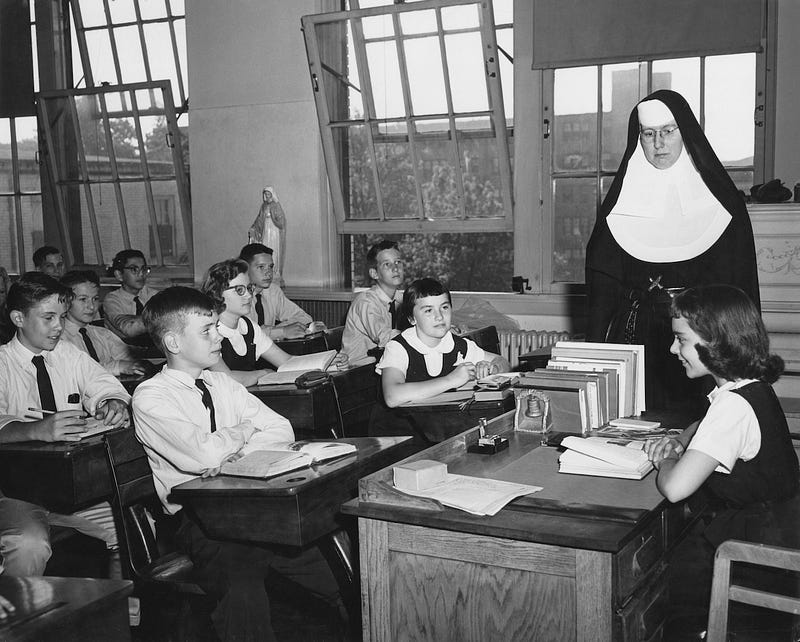
I now realize that my wall of denial had significant outside help in its construction. Looking back, 12 years of Catholic education starting 1960 were a major contributor to my binary jail cell.
One of the things that stands out was that physical punishment was acceptable and even encouraged, particularly against young boys. It kept us from getting too fidgety or mischievous. It taught us to take our punishment “like a man” and re-enforced the stoicism that we needed to be a “Man”.
In the early Sixties, boys idolized men in sports and in war. Catholic School helped toughen us. God didn’t like wimps.
I started first grade in 1961. I was attending Our Lady Needs Lots of Help in Brooklyn. It was to torture my soul for next 8 years of my life. It was a battle of a dogmatic, autocratic perception of Christ versus being born in a democratic country and living a pluralistic, cosmopolitan city. Catholic grammar school and I just didn’t fit together.
I was really excited to start first grade. My brother was three years older so I was getting the chance to join the big kids. I got to wear the school uniform, gray slacks and blazer with the school’s initials on the jacket pocket, a white shirt and the clip-on school tie. My mom slicked back my hair with a generous application of Odell Hair Trainer, a lotion that once applied to your hair and combed in, became hard as a rock. I spent many boring classes “breaking” the strands of my hair when I needed to do something other than pay attention.
We were taught by the Sisters of Mercy. Their names always started with “Sister Mary”. Some were great and some were just plain mean. I won’t go into any deep, psychological analysis but they represented transition and turmoil that the Catholic Church was going through in the 1960’s. There were one or two lay teachers. My mom was periodically called on to substitute teach. She even had my class for a day in 5th grade to my everlasting mortification.
Here is a brief summary of those moments intended to correct my behavior by the representatives of the Catholic Church:
First Grade: Sister Mary E, warned a female student that if she had another “accident” in her class, she would make her put her nose in it. She did and she was made to do it while the class watched.
Second Grade: This was the craziest year I remember. I was a fidgety student. School was rigid and I was anything but. Sister Mary C and I just didn’t see eye to eye. It was a year of a battle of wills and I had no idea that I was in combat with the wrath of God, as applied by Sister Mary C.
I regularly got detention. Wednesdays seemed to be my day. Sister Mary C would take me to the window and point at the school buses parked outside and threaten to send me to “bad boys’ school,” saying I would never see my parents again.
In reality, those buses came every Wednesday afternoon with the Catholic kids attending public school so they could get religious training at our school.
Regularly, I was sent to my older brother Bill’s class to get a note about my latest misbehavior to be signed by my parents (I guess that I “lost” the ones given to me personally). This a was almost a weekly ritual.
It started with a knock on his classroom door.
It was usually opened by the door monitor of the day, usually a girl student who was sucking up to the nun. She seemed to take great glee in announcing loudly, clearly and with excruciating long pronunciation: “Biiiillllyyy, it’s your brother againnnnn!” He would come to the door, beet red and mumble threats at me under his breath. Once the door closed, I took advantage of the freedom the walk back my classroom gave me. I strolled and always stopped for a drink at the water fountain. I never wasted a moment.
This pattern went on for weeks.
I was about to lose my battle of wills with Sister Mary C. She called in the big guns; she had the power of God on her side (plus my very active childhood imagination built on a regular dose of the wrath of God in religion class).
I had gotten my second report card. As Sister handed it to me, I received her maximum “you are going to hell” stare and was told to make sure I got my parents to sign it. The only thing that stood out what seemed to be a very large “F” for conduct. I mumble the seven-year-old version of “oh shit” and slipped it in my school bag.
For the rest of the day my mind ran through every conceivable way out of this trap. After hours of struggle, I came up with my brilliant strategy. My F grade was written in pencil. I simply erased the “F” and wrote in an “A”. I strategically waited until early the next morning. I woke my dad up and in a panicky voice, whispered that I needed him to sign my report card. He was sleepily agreeable. I then erased the “A” and rewrote in the “F”. I was safe.
But I wasn’t.
I hadn’t count of Sister Mary C being a former FBI agent. She saw the obvious erasure and an outline of the “A” and she brought the righteous hammer of God on me.
Sister Mary C dragged me across the street to the convent for the “spanking machine.” Now let me take a moment to explain the truly gruesome emotional impact the threat of that punishment would have on a second-grade kid in 1962. We were taught that nuns were the “brides” of God. They even wore a wedding ring. No one was allowed to set foot in a convent, particularly the boys. Students volunteered or were drafted to carry the nun’s heavy schoolbags to the door and no further.
I was now being dragged through that sacred portal of the front door of the convent and down the darkened steps to the convent’s dungeon into God’s inner sanctum. I was going to hell for sure and this was it.
Sister Mary C had me sit on the lower steps of a dark basement while she left me to turn on the “spanking machine”. I haven’t a clue how I didn’t wet my pants, but as I heard the distant sound of the spanking machine warming up, I howled every promise a seven-year-old on death row could muster to escape God’s justice.
In what seemed like an eternity, but probably only 3 minutes, the machine stopped and Sister returned. She then escorted a very penitent second grader to the front door of the sanctum and released me into the bright sun of freedom once again.
I don’t think I told my parents. Even if I did, the question was the same for every kid who got punished in the 1960’s, “what did you do wrong?”
Sister Mary C’s psychological torture strategy must have worked. I don’t remember the rest of that year.
Corporal punishment was a part of my Catholic educational process up through the end of my sophomore year in high school.
Between the Sisters of Mercy in grammar school and the Christian Brothers in high school, I was slapped in the face, cracked in the knuckles with rulers, and clocked on the head with text books. I had the short hairs on the back of my head and sideburns pulled, I was whacked by wooden pointers and had my head banged against a blackboard with enough force to see puffs of decades-old chalk escape.
Along the way, both priest and brothers touched me inappropriately. Fortunately, I knew enough to escape without any deep emotional scars or actual physical harm.
Oddly I don’t blame anyone. It feels like it just happened.
While this does seem grossly out of place in today’s world, it was the standard in the world in which I grew up. It wound up being a part of my male upbringing that set the stage for the explosion of gender dysphoria later in my life. The experience added thickness to my wall of denial as I continued to repression of my gender.
Living in this male dominated life may explain why it took 60 years to finally confront my gender. I had no room to be a woman.
Thankfully that world faded away.
Emma Holiday
Writers note: I wrote this as a window into a world that, thankfully, has disappeared. It is good to note that we are making progress in making things better in our society. It maybe slow but it is happening.
Second, I wanted to document the gender funneling that people experienced in that period of time. It was a militantly binary world. It has helped me to understand the reason for the depth of my gender denial and why it took 60 years to finally discover I was transgender. It has been a painful process but with exciting results.
I am now finally me.
Finally, If you have read any of my writings on Medium you will have noticed a definite theme: the incredible pain of gender dysphoria and all the difficult aspects of just being transgender.
My writing has three specific goals:
1. Writing is my therapy. I have a very limited outlet for my thoughts so I write to find a way to process the most profound experience in my life. I need to understand and I need to accept myself to move forward.
2. Being transgender, for me, is a very lonely existence and if I can share some of the things that I feel and think as I go through the process of transitioning with others who are transgender and, in some way, lessen their pain and sense of loneliness, then all of this public exposure of my personal thoughts is not a waste.
3. I write to help cisgender people understand that all trans people want is to be simply understood, accepted and treated as a normal person. We are.
Thank you for reading my work.
Please also read: