
I’m a Self-Taught Developer and I Used These Free Resources to Land My First Job
These resources will help you become a developer without spending any money
I am a self-taught developer. After many years of practicing and learning how to code in my spare time, I finally landed my first job as a developer.
It took a lot of time and effort, and many different resources were used — but I managed to pull it all off without spending a dime.
It’s not impossible that other people currently are in the same situation I was in. Having to work a standard 9-5 job with hopes of someday changing career path.
Maybe they can’t afford to go to school or resign from their current job to pursue the dream of becoming a programmer. It takes a lot of time, and it isn’t easy — but this article will hopefully convince you that it absolutely is possible without spending any money or quitting your job.
I have gathered the best resources that taught me how to code. I have used all of them and I wholeheartedly recommend them to anyone who would like to become a programmer. So, without further ado — here they are.
1. CS50’s Introduction to Computer Science
Harvard’s introduction to computer science is probably one of the world’s most popular online courses, with over 1.4 million enrolls. And that is for a good reason.
This course is, in my opinion, essential if you want to become a developer. It really teaches the fundamentals of computer science — how things work under the hood — which will make it easier to understand what you are doing when you code.
David J. Malan, the teacher, is amazing. He really cares about his lessons, and the lectures, albeit being two hours each, seem to fly by. The course is divided into parts, focusing on different important concepts of programming.
You’ll start off with C, to later work solely with Python (unless any changes have been made for next year’s edition). They also cover basic HTML, CSS, and JavaScript.
CS50 is a 12-week course at Harvard, so the tempo is quite high and the problem sets every week are difficult. It takes a lot of time to complete them, and I would recommend really taking the time to learn what you are doing.
Don’t stress about it. The community is also very helpful in case you need help.
2. Object-Oriented Programming With Java

Harvard isn’t the only university that offers free programming courses. Helsinki University probably offers even more in terms of quantity — and the quality is outstanding.
Object-oriented programming with Java is an online MOOC divided into two parts. Unlike CS50, this course is read-only, meaning no videos or lectures. You’ll read your way through the course.
As you’ve probably figured, you’ll only use Java in this course. But don’t let that fool you — even though you might not want to learn Java, this course is more about learning programming than actually learning the syntax.
I promise you, even if you’ll never touch Java again — you will thank me for taking this course.
The course is more focused on the concept of object-oriented programming, which is used in many other programming languages. It’s also a very good course to start with — you’ll cover all the basics of programming, including concepts and syntax.
The best about this course (or basically any course on this list) is that you have to do things yourself. Learning by doing.
Every concept has a programming exercise that you have to pass before you continue, which makes you actually write code (instead of just reading). Which is, in my opinion, the best way to learn.
I cannot stress how good this course has been for me — I really recommend this to anyone, whether you’ll want to work with Java or not.
3. Full Stack Open
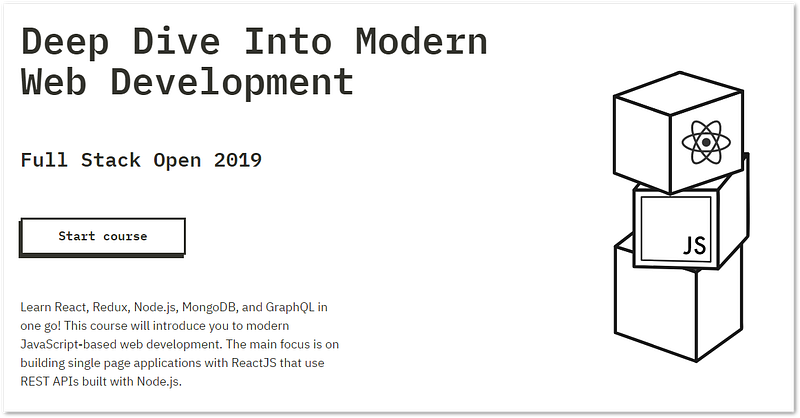
Whilst still talking about Helsinki University, let’s talk about another course they’ve published. Full Stack Open is their course for people who want to get into web development.
It is JavaScript-based and covers front end as well as back end. I’ll probably recommend taking the two other courses first — this course requires basic knowledge about programming, and focuses more on frameworks.
Full Stack Open is very much like the Java MOOC. It’s read-only, so you’ll read your way through the whole course.
You’ll cover a wide variety of frameworks. You’ll learn React, Node.js, Redux, and MongoDB, among others. Basically, some of the most important parts of becoming a web developer.
This course doesn’t work exactly like the Java MOOC in how you submit your exercises. Instead of working with a new exercise for each new concept, you’ll work on projects. At the end of a part, you’ll submit your project via GitHub.
Other Resources
These three courses are the ones I have taken. Every one of them provides you with a certificate once completed (although you have to pay to get it for CS50).
All of the courses will make you think for yourself and actually write code, instead of just following someone on a video tutorial.
I have used many other resources as well, which aren’t actual online courses. I’m not going into depth with these, but I figure I’ll mention them in case you want to use them as well.
/r/learnprogramming
I have probably visited this subreddit every day for the last couple of years. Either to post something or just to browse. All of the courses have been found through this, and people are, in general, very helpful.
People post everything — tips, tutorials, questions, and advice. I really recommend giving this a shot if you’re really into learning programming.
Most languages also have their own subreddits. If you, for example, want to learn Python, you could visit /r/learnpython.
dev.to
I found this community quite late, but I’m so glad I did. Dozen of posts, tutorials, and discussions every day, mostly about programming. It covers everything about development, but mainly focuses on web development.
Everyone is so friendly and helpful, and it’s a joy just to read the comments. Lots of positivity and good advice from programmers around the world.
SoloLearn
This resource is included mostly because of the great mobile application. They have tutorials for almost any language in their app — which makes it easy to pick up learning while on the go.
I would not solely depend on this, but it is certainly a good addition to the other resources.
Conclusion
So, that’s it. The three (free) courses I took online, and some of the other resources I used to learn programming.
I hope they are of use to you and if you manage to get through all of them, I’m sure you’ll be able to look for your first job. Good luck!


