
I’m a Pagan, a Witch, Not a Christian, and I Love “The Chronicles of Narnia”
Keep these books on the shelves for kids… and have a chat with kids after they read them and see what they say


I am a bookaholic. I was born that way. My earliest memory from childhood was playing with a dictionary; I didn’t know what it was at the time, of course, but I somehow knew it was a special, powerful, and magical thing.
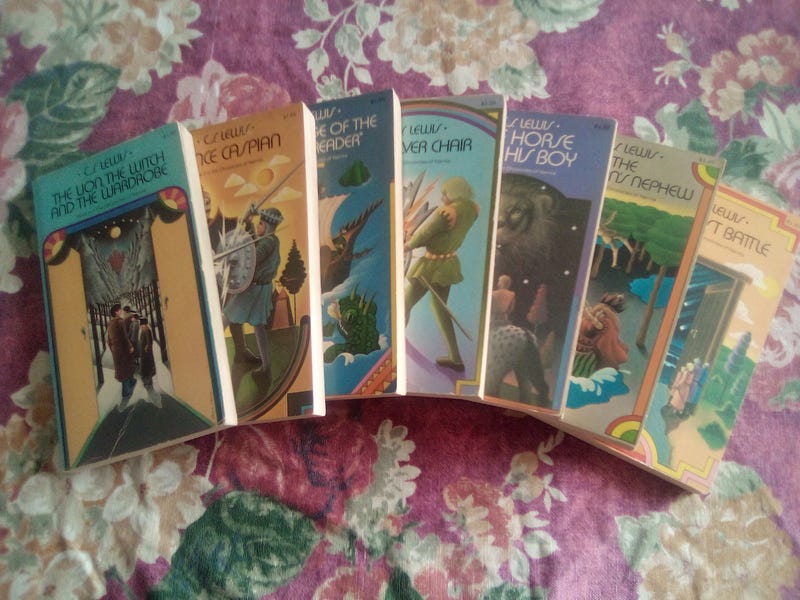
After numerous occasions of buying me Barbie dolls, which I never played with, my parents finally recognized my addiction, and on my ninth birthday (1977), they gave me a box set of The Chronicles of Narnia. The best birthday gift I ever had in my life.
I still have them.
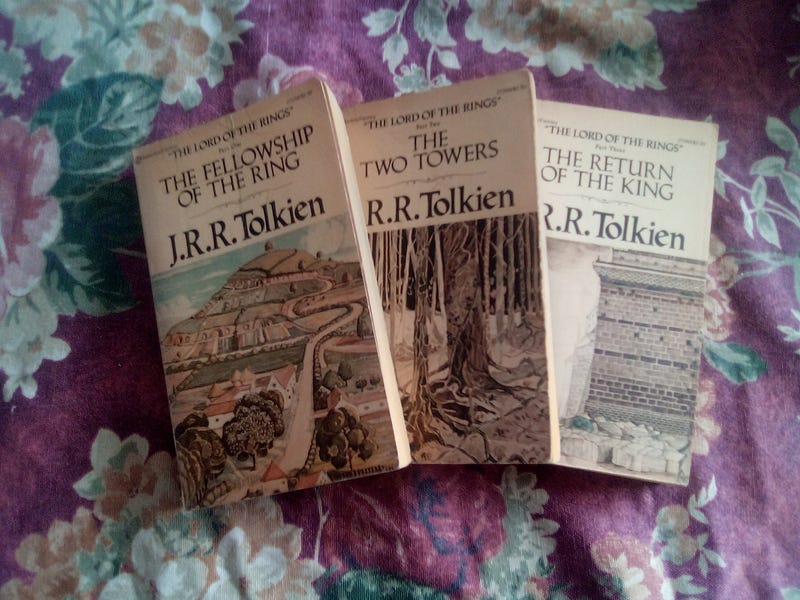
My eldest brother (15 years my senior) recognized not only my addiction but also my above-average vocabulary, owing to my then-as-yet undiagnosed autism. He gave me the Lord of the Rings trilogy.
I still have them too.
It would not be an exaggeration to say that these two sets of books saved my life. As an autistic girl who, like most autistic girls, slipped through the cracks of the diagnostic criteria for autism which have been based solely upon rowdy little boys who like math a lot, I was a miserable kid.
I grew from a miserable kid into a borderline suicidal teenager.
But I had an anchor, an escape hatch that kept me alive: my imagination.
As a child, I lay down on my bed and then slipped through the wardrobe door into a land of talking animals. I sailed with Lucy on the Dawn Treader. I braved Mordor and I was going to be the hero, bringing an end to the evil Sauron. Maybe, I imagined, I would even dare confront him face to face. Afterward, I was certain I would become the first female Wizard and then I would get to talk shop with Gandalf.
Aslan comforted me. It was nice to know a lion was not scary but instead simply kind and strong and benevolent. The exotic Calormen mesmerized me, and I wanted to visit their land and learn more about them and their culture.
As a teenager, I asked a lot of questions of my parents, in school, and at churches. I annoyed everyone with my questions. I looked at the wonder of the world while wearing fantasy-tinted glasses, and that was an advantage. Why? Because I always questioned what was right in front of me, knowing there was likely more there than met the eye.
In college, majoring in political science, I took elective classes on Middle Eastern history and Islamic civilization, quite off the beaten path for a white woman born and raised in Utah. Was I inspired to do so by the Calormen of Narnia? Perhaps yes, subconsciously at least.
Here on Medium, I stumbled across a composition critical of The Chronicles of Narnia by Seth Myers.
He highlights and details the racism and Islamophobia in these white Christian propaganda Narnia books. Everything he highlights about these books is spot-on correct. He not only thoroughly catalogues the racism and anti-Muslim bent, but also takes note of the sexism, like how Susan is good with a bow and arrow but not allowed to fight because she is a girl. He even takes note that the primary villainous antagonist is a witch.
Everything he highlights and criticizes is well worth criticizing and I applaud him for doing so.
Nevertheless, his conclusion that therefore they “don’t deserve a spot on bookshelves” is dead wrong. I am living proof of why.
His thesis hinges on the fact he states children are “malleable.” I say kids are a lot smarter and perceptive than we give them credit for.
Even though nine years old, I saw the racism, sexism, and Christian allegory in the book for what it was plain as day. It all screams off the page with no subtility or masking. I saw all of that and… rolled my eyes. I recognized even then that fiction is a mirror of an author’s heart and soul. I recognized that C. S. Lewis was a man writing within a very white, very Christian, very patriarchal society and culture.
Advice often given to aspiring fiction writers is to “write what you know.” I say that is silly advice because by definition that is all that any writer can do.
So, I gave him a pass on that. I understood, even at the age of nine, that he simply didn’t know any better. I — just like a lot of kids, maybe most kids — do know better. Kids don’t read a story to do a political, socioeconomic, and philosophical analysis of its subversive agenda. Kids like the talking horse! And so did I!
For the rest… they get it. Intuitively, they get it. Then they shrug and move on to the good stuff like the talking lion saving the day.
If you don’t believe me, have some kids read these books and then sit down and have a chat with them. Don’t talk at them, just let them speak what is on their minds. I think you will be surprised by what you hear.
I know what you won’t hear. You won’t hear a kid announce, “You know what? I’m converting to Christianity. I think all Muslims are ugly and deceitful. Witches are all evil. And women should stay at home and be nice.” Trust me, you ain’t going to hear that.
I read the Chronicles of Narnia over and over and over again. I grew up to be a woman with a fascination for the Middle East; a fascination for the beauty, wisdom, and poetry of Islamic civilization; I grew up to be a pagan and a witch (Wiccan) with my mission in life to defend religious liberty from Christian Nationalists; and, for good measure, I joined Black Lives Matter.
And you know what? All of that wasn’t in spite of The Chronicles of Narnia, but because of The Chronicles of Narnia.
With of course an assist from Tolkien and the Lord of the Rings.
Both authors were Christians, but there was plenty of good — and instructive — paganism in their works of fantasy.
My point is that ultimately, you never know how any book might inspire — for good or bad — young people, so you should not ban any books.
Instead, teach children to ask questions. Teach them to have a mind always awake and aware that there is indeed always more there than meets the eye.
By the way, I still do love lions. In addition to being a pagan and a witch, I am a Tarot card reader.
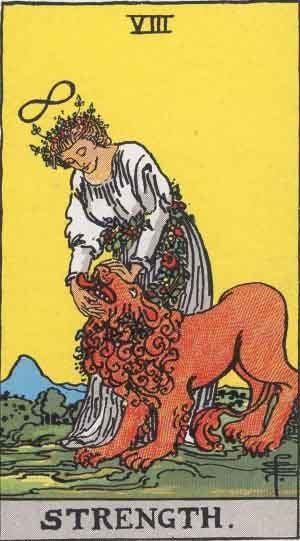

As you might also guess, I am a feminist as well. That Tarot card shows an image of a woman taming the lion with love and gentleness, roses wrapped around her waist and around his head. And that is strength.
I think there is a good fiction story to be told there, and I might just be the one to tell it.
Of course, if I write that work of fiction on paganism, Tarot, and witchery, it will no doubt make it onto a banned book list in some school somewhere here in America. Good. If I were to write a book that was banned, I would count that as the greatest compliment I could ever receive.
One small footnote: Speaking of more than meets the eye, C. S. Lewis and J. R. R. Tolkien had an interesting and fraught friendship of mutual criticism and inspiration. If you would like to read more about that, check out an article by Ethan Gilsdorf on the Literary Traveler entitled “J.R.R. Tolkien and C. S. Lewis: A Literary Friendship and Rivalry.”
That these two men were friends (at least to a point) and met regularly in a pub with their literary club called The Inklings was of course something I never knew as a kid, clutching to my chest my two favorite sets of books.
What a remarkable coincidence… though in pagan, Tarot, witchy land, there are no such things as “coincidences” but rather only meaningful synchronicity.
Leave the door open to every child to have a moment of meaningful synchronicity with whatever book touches them in whatever way it works its mysterious magic.