
EXPRESS YOURSELF
I’m a Novelist Living Without an ‘Imagination’
How discovering I have aphantasia has changed the way I see the world, my work, and the power of the mind
My name is Casey Lawrence, and I am a writer with aphantasia.
From the prefix a- meaning “without,” and the Greek root word phantasia, meaning “imagination,” aphantasia describes people who lack the ability to produce mental images. When I close my eyes, I see static — not pictures. Until I was a grown adult, I thought phrases like “picture a beach” or “visualize the outcome” were purely metaphorical. Exercises like “counting sheep” or “taking a mental snapshot” have always been meaningless to me, and the idea of “creating a mind palace” or any other meditation technique that involves using visual imagery seemed totally ineffective. When I read or write, I do not “hear” a voice reading the words on the page; I cannot make my brain read this in the voice of Morgan Freeman. I have no “interior monologue” — or at least not how most people describe it. My thoughts are not auditory, nor visual. I’ve never known anything different.
If this sounds strange to you, you’re probably one of the majority. Most people, it would seem, have some sort of visual imagination. For some people, imagination is like a high-def picture in their mind; for others, its like writing on a whiteboard in front of their eyes. Some people can hear, see, feel, and even taste thoughts — and each of these sensations falls somewhere on a scale like the one below. This scale is illustrated with a series of shapes ranging from “photo-realism” to “nothing” (hyperphantasia to complete aphantasia):
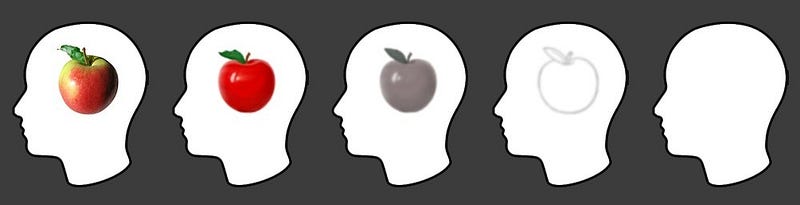
On this spectrum of ability, I fall on the far right (5). That’s right: I got nada, not even the suggestion of an apple when I’m asked to imagine an apple.
I’m not alone, but it’s hard not to feel that way sometimes. In an incredibly witty and moving account of how he discovered his own aphantasia, Blake Ross writes that
Reading this article [about a man who lost his visual imagination after a brain injury] was extraterrestrial puberty. I walked in a doe-eyed human; … by the end, my voice had cracked and I breathed fire. Because as mystified as the reporter was with his patient, so I was with the reporter. Imagine your phone buzzes with breaking news: WASHINGTON SCIENTISTS DISCOVER TAIL-LESS MAN. Well then what are you?
For Ross, finding out others had visual imaginations was like discovering everyone else had a superpower. For me, it was like finding out that a group of friends I see every day are part of a secret club I wasn’t invited to. I felt very alone, confused, and, I’m not going to lie — jealous. If everyone else has this superpower, why don’t I? I asked myself. It would make my life so much easier!
I first discovered that I lack visual imagination during a mandatory “Leadership” program I took at Brock University. At the start of each session, we were asked to visualize our “mind palace,” a space we created on the first day of the course. We all had our eyes closed as the group leader read a script meant to help us: you walk down the stairs, open the door, drop your backpack in your favourite place in the room — your backpack contains all the day’s worries, the assignments due, the stress in your life — leave it there as you prepare to join in this activity…
Blah blah blah. I would always keep peeking, checking the clock while everyone else did their two-minute meditation. That’s not to say I hadn’t made a “mind palace.” I did the activity as best as I could. I can even describe it for you, the same way I narrated it to myself every day we did this technique:
I go down concrete steps to a basement door. It is a heavy metal door painted burgundy, peeling around the edges. Inside is a warmly lit bar, with vinyl booths and a pool table near the entrance. I drop my backpack on the pool table and head to the back of the room, where a karaoke stage is set up. The couch in front of the stage is threadbare but well-loved. It smells a bit like stale pizza. There is music playing faintly in the background — it’s “Barracuda” by Heart (the Rock Band version).
My “mind palace” was based on a real place, a bar-turned-youth-group where my friends and I hung out in high school. But no matter how hard I concentrated on this description, remembered little details about the place, “visualized” dropping off my backpack, I never felt like I was really “there.” I was always sitting in a classroom in the Mackenzie Chown building, with my eyes closed, feeling rather stupid. I could never hear the music, feel the warm air hit my face as I got out of the cold stairwell, smell the pizza. It was just words to me.
I expressed my frustration to my boyfriend after one such session, complaining that I just “couldn’t get into” the meditation. It was then he revealed to me the essential piece of what I’d been missing: everyone else could see their happy place, not just describe it. They actually went there.
“Can you see pictures in your head?” I asked, astonished.
“Yeah. That’s how I think. I don’t even think in words, just sounds and pictures. I have to translate everything when I write or it would come out phonetically.”
After some questioning back and forth, it became clear to us that we were on opposite ends of the phantasia spectrum. His thoughts are all visual or auditory. None of mine are. The best I could describe my thoughts to him was as a ticker tape on a news program. My thoughts come up as a string of words, sometimes very rapidly. If I don’t say or write them down, I may forget them, which is why I’m often very frustrated when someone interrupts me when I’m writing. Losing the flow can seriously throw me off, like a newscaster falling behind the teleprompter. But I don’t “see” or “hear” the ticker tape. It’s more of an abstract flow of words, and my partner can’t really wrap his mind around what that means.
Like Benedict Cumberbatch in BBC’s Sherlock, my partner can project images into the real space in front of him. He says it’s like writing on a window. He can conjure and dismiss images, sounds, tastes, and smells at will. He can create music in his head, or read in different “voices.” He sometimes struggles with spelling and even with speaking, because his thoughts don’t necessarily come to him as language and have to be translated on the way out.
This was, obviously, a revelation. I was already a published novelist twice over when I learned that most people actually “see” the things they’re imagining, rather than just narrating them. I felt like I was going crazy, trying to figure out how everyone else’s brain worked. You can “see” people in your mind? You can “conjure up” your mom’s face out of memory? You can “create” faces you’ve never seen before for your characters? I can’t do that.
It fascinates me that other people have this power and what they choose to do with it. My partner, Rhys Lemoine, is a scientist with the brain of an artist, or so it seems to me. He uses his extraordinary visual memory to collect and organize data; as part of his research into quaternary megafaunal extinctions, he makes maps of human and animal migration, the waning and waxing of megafaunal populations, former and current plant and animal ranges, and so on. But he can also draw just about any animal from memory, and his drawings are beautiful. He would have killed it as an 18th-century naturalist, illustrating his own discoveries of plants and animals.
I, on the other hand, have always been artistically challenged. I can’t draw or paint anything without a reference. My proportions are terrible when I can’t see what I’m drawing. But I’ve been told I’m a good writer; Human Parts recently published a writing experiment of mine, “Beyond Recognition,” that tells the same story in 100, 500, 1000, and 3000 words. People seemed to like it, and the reviews of my books were good too. If you’ve read my fiction, you might never have guessed that my brain doesn’t “do” pictures. And why would it need to? Is having aphantasia actually a handicap, or just another way of being neuroatypical?
To answer some questions you might have:
How can you be a novelist without an imagination?
The strange thing about it is, many people with aphantasia go on to be writers and artists and musicians. On the whole, this quirk of my neurology does not impede me from living my life or from being creative. In fact, I think having my thoughts default to “word-format” might make it easier for me to write.
When I first figured out that other people could “see” things in their mind, I have to say that I was jealous. I thought it meant that other people had a leg up on me when it came to writing fiction. Rather than making up a face using just words, they could “picture” one? It seemed unfair. But the longer I’ve thought about it, the more I’ve come to realize that my writing style is dependent on my brain being exactly the way it is. I’ve come up with some extraordinarily beautiful lines in my lifetime. I love metaphors and wordplay and puns. Although not necessarily a “visual” person, I do consider myself a “visceral” person; I experience the world as sights, sounds, textures, tastes, smells, temperatures, emotions, pressure. Perhaps because I am not a “visual thinker,” my writing uses more of the other senses?
When I write, my work usually comes out as a complete object. Despite moonlighting as an editor and proofreader when I’m not writing myself (or working on my PhD dissertation…), I rarely have to edit my own work to any significant degree. I’ve never seen quite sure why, but I have a feeling that my aphantasia has something to do with it. My work comes out in a single stream, fully formed by the time it gets to paper. Before that, it’s rattling around in my brain for days or weeks or even months.
So I guess I feel like my craft benefits from my neuroatypicalities. When I write something like “the sky was the colour of a fresh bruise,” I might not be able to see it, but I feel it. When I write that “the woman sitting across the bar is the most stunning woman I’ve ever seen,” you might have a better idea of what she looks like than I do, but I don’t think that matters as much as people think. What matters is that the narrator is stunned by her beauty. I don’t have to be able to picture people to know if someone is ethereally beautiful, and what effect that has on my character.
How do you recognize faces if you can’t picture people?
I don’t. While I’m not completely face-blind, my brain works by using text-based descriptions rather than photo-recognition, so I find it really hard to remember faces. I’m great with names — horrible with faces. Yes, even those of people I love. (It’s why I take a lot of pictures. I’ll forget what something looked like if I don’t keep a record. Even my own face!)
I can tell you what my partner Rhys looks like: red hair, mutton chops, 5'6", stocky, freckles, glasses. When he started shaving his head, I added “bald” to the list, which usually makes it easier to place him. But I once walked right past him on the street because I wasn’t expecting to see him. I had zero recognition seeing his face in a crowd. He had to stop me and grab my attention, and it still took a second for his face to click.
Because my memory is text-based, it isn’t always accurate or up-to-date. When I describe my father, for example, I think of him as incredibly tall, thin, and wiry, with a moustache and blond hair. He hasn’t had a moustache since I was about four years old, and his hair was lost shortly thereafter to male pattern baldness. He’s only about six feet tall, and I’ve been 6'2" since puberty; in his fifties, he’s not as thin as he used to be. But I still know my dad when I see him — eventually.
Do you prefer movies over books?
Absolutely not. I’m an avid reader, as I think most writers are. I don’t need to be able to picture what I’m reading in order to enjoy it. Unlike many people, who seem to get upset when a film adaptation of their favourite book makes a character look different than they pictured, I’m usually just let down by the lack of detail. Sometimes I’m frustrated when the film changes something about the plot or characters, but it’s usually because something was cut for time. Books are nearly limitless in possibility; films have very tight time and logistical constraints. Don’t get me wrong, I love a good movie or a TV series; but there’s something special about a book.
Do you dream?
I do. I dream every night, or nearly. I’ve even been known to lucid dream. Everybody dreams. You’re asking the wrong question. What you’re probably wondering is: How do you dream? In pictures, or in words?
If I’m totally honest, I don’t know. Since I remember my dreams in the same way I process regular memories (as descriptions, as text, as plot and dialogue — not pictures or sounds), I honestly have no idea if I dream in pictures and then store those dreams as text-based memories, or if my dreams are like a text-based choose-your-own-adventure. Are my dreams just The Oregon Trail? I couldn’t tell you. What I can tell you is that my dreams are wild and varied; sometimes I have control over them, but usually I don’t; sometimes I’m me and sometimes I’m a character from the last movie I watched; sometimes they’re crazy and sometimes they’re very mundane. In the case of the latter, it’s very easy to mix a dream up with reality!
Are you otherwise neurotypical?
No. While I think it’s possible to have aphantasia and still consider oneself neurotypical, I almost certainly also have autism and ADHD, which definitely affects the way I experience the world. I was hyperlexic as a child (learned to read very early, and read above my grade level throughout school) may also have dyscalculia (which is like dyslexia, but for numbers). I also have some mild synesthesia. In fact, the closest thing I get to sensory imagination is synesthetic — an involuntary connection between two senses. Certain numbers evoke emotions for me, and I associate certain sounds and tastes with a colour. These aren’t visual — I can’t see music, unfortunately, although that form of synesthesia sounds beautiful — but they are involuntary thoughts, and that’s as close to phantasia as I get. (This study shows a link between aphantasia, synesthesia, and autistic traits — I’m not alone!)
Some misconceptions about having aphantasia
As many as 2% of the population experience aphantasia, but the phenomenon is incredibly under-researched.
Despite being nearly as common as having red hair, having aphantasia is seen as a strange, and even disturbing, quality. Because it’s fairly rare and not well-understood, there are a lot of misconceptions about aphantasia. An article in The Guardian from 2016, “If you can’t imagine things, how can you learn?”, seems to want to classify aphantasia as a learning disability. Author Mo Costandi claims that “research into visual imagery would seem to suggest that students with aphantasia are likely to experience difficulties with learning” even though “there is no research confirming that this is the case.” He also quotes neurologist Adam Zeman (University of Exeter) as saying, “We know that children with aphantasia tend not to enjoy descriptive texts, and this may well influence their reading comprehension” though there has also been no substantial research into this claim, either.
As someone with aphantasia who was also hyperlexic, identified as “gifted” in school, and excellent at rote memorization and reading comprehension, I find these assumptions baffling. The idea that visual imagination is necessary for educational success implies that those without will not be able to succeed in traditional schooling, which was not my experience. In fact, by this time next year, I’ll have a doctorate in English literature. On the other hand, my partner, who has hyperphantasia, struggled with reading and was somewhat speech delayed. Perhaps our experiences do not represent the norm; however, I think it is irresponsible to put these ideas out there without extensive study, or, at the very least, interviews with people with aphantasia!
And it’s not just pop science that seems to be getting it all wrong about people with aphantasia. A few months ago on Twitter, I had the unfortunate circumstance to come across this thread, which started with an innocent question from @RestlessIRoam:
The replies in this thread do not pass a “vibe check.” In general, the comments are either ignorant or accusatory. One user replied, “Idk… how can you have a conscience without [internal] dialogue? I don’t buy it” and a reply to that tweet reads, “That is it. They have no conscience.” One Twitter user responded to the tweet by saying, “Only sociopaths dont have a wee inner voice. 😆” and another says, “Lies & deceit. You will not convince me. 😱” accompanied by a GIF of a frightened dog.
Although this thread obviously represents a small sample size, it does demonstrate the general population’s ignorance on matters of neuroatypical thoughts. The comments tended toward denial, fear, or disgust at the idea of people having thoughts in ways other than how they experience theirs. The belief that people whose brains process information differently “have no conscience” is dangerous; it implies that we are somehow Other, and that we lack morality or decision-making and problem-solving skills. Thinking this way sets a precedent of treating people differently based on how their brain works, and that’s a road that always leads to eugenics. Aphantasia, lacking an interior monologue, and having any other sort of difference in thought processing are not disabilities, only differences.
Would I change myself if I had the option?
When I started writing this article, my partner, reading over my shoulder, asked this question of me. The truth is: I don’t know, but probably not. There are many things about myself that I think I would change, if I could. I could do without having IBS or food sensitivities, and maybe I’d like to be a bit shorter, so I’d have better circulation and less head-rush. But my brain? The way I think? If I changed those things, would I even be me anymore? There’s a part of me that thinks that I wouldn’t.
While I appreciate that other people have visual memories and imaginations, and that those visions can be powerful mental tools, the whole concept is still pretty alien to me. In many ways, I’m glad I don’t “hear voices” in my head, “daydream,” or become totally immersed in a book I’m reading. To me, it’s everyone else who is strange! I’m just how I’ve always been. Discovering my aphantasia has changed how I think about how other people think, that’s all. Publishing this might change how other people think about me but it can’t change how I think about myself:
Abstractly, complexly, and without any visuals whatsoever.
Thank you Ravyne Hawke for inspiring me to write this story with her Weekend Writing Prompt: “Describe a time in your life when the world around you felt out of control. How did you handle it? Did you handle it, or did it make you go crazy?”

Support the author:
For more like this, follow me on Medium or check out more of my personal nonfiction. I also write nonfiction journalism and longform fiction. I don’t monetize poetry or flash fiction. My novels are temporarily out of print; find out why in my article, “The Dreamspinner Press Controversy.” You can also find me on Twitter or like my public Facebook page.
If you’re enjoying my content, consider showing your support by buying me a coffee. If you sign up using my referral link to get unlimited access to all of Medium, I receive a small commission.


