
Nadya Okamoto Explains What She Learned as a Candidate for Cambridge City Council
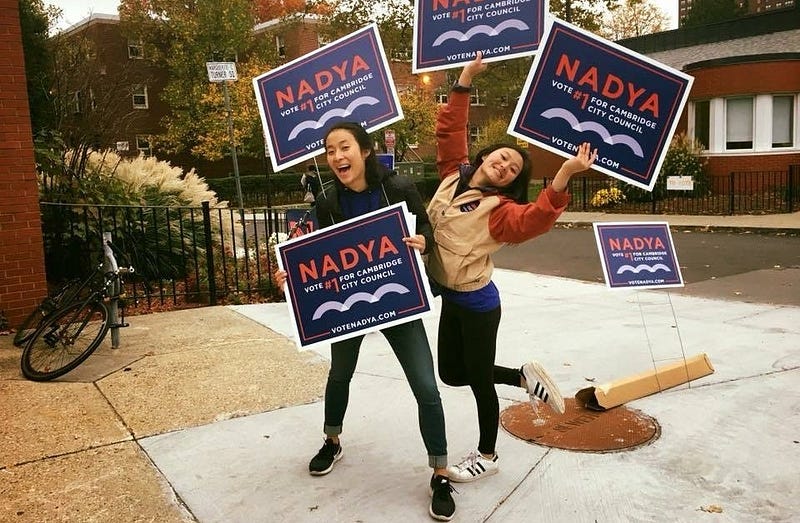
“I would just lose, right?” I replied.
I had never heard of someone my age running for office and winning. But after learning that we did not have undergraduate student representation on the city council even though more than 30% of the Cambridge population is under the age of 25, and over 31% of the adult population is enrolled in the universities — I felt ready.
I assembled a campaign team: my friends, the badass young women and men in my life who inspired me with their work ethic, passion, and generosity, and somehow convinced them to take a risky leap with me as I ran for office — even on top of college. I learned how to file for my candidacy, and the general structure of a political campaign. Soon enough, my team and I found ourselves living together in a two-bedroom apartment that we found on Craigslist.
We had anywhere from 4 to 11 people staying in the apartment at any given time — all bunking together every night. Practically none of us knew how to cook, and for the whole summer we ate cereal, quesadillas, eggs, frozen food, and green smoothies.
There is a common saying in the campaign world: “If you’re not tired, you’re not doing something right.” I traveled frequently — continuing to lead my organization, PERIOD, traveling for speaking jobs and conferences and leaving the team to run a campaign with a sometimes-absent candidate. Campaigning is exhausting because you can always be doing more, so you feel like you are not doing enough. With practically no break between the rigorous demands of freshman year at Harvard and the campaign, we were tired.
There were two major things I underestimated when we jumped in: how much pushback we would get from residents and people all over the United States for even considering a run as a 19-year-old Asian-American student, and alternatively, how much national support we would get for those same reasons. Every day that we canvassed, volunteers would come back with stories of doors that were slammed in their faces. No matter how many friends and family members told me to ignore mean comments, if they would come from other Harvard or MIT students, I would keep myself up at night reading every message (and then Facebook stalking the senders).
At the same time, we continued to realize that we were a small part of a larger national movement for young women and people of color in politics. As an endorsed candidate of Run for Something, a national organization supporting young, progressive candidates, we received private messages and social media shout-outs of support on a daily basis from people all over the world.
On a personal level, my candidacy swallowed every aspect of my life. My social life in school suffered. I tried to attend parties with friends, but sometimes left quickly after other students would pull out their phones to take Snapchat videos as people yelled, “Nadya for City Council.” I would open social media to mindlessly scroll through my feed only to see that a peer sent me a mean-spirited message. I felt so incredibly alone. Did they not realize that I was also a 19-year-old with insecurities just like them?
I was so tired. But I felt I could tell no one because I wanted to appear strong, confident, and capable.
I was so confident in my platform and the reasons I was running, but the campaign took a toll on my confidence. The questions that I got over social media and in-person made me start to ask myself, with anger and disappointment, Who do you think you are? Why don’t you just focus on school and be a normal college kid?
Originally published at https://www.teenvogue.com.