
Illumination Curated: Alternative Healing
Similia Similibus Curentur
The Gift of Homeopathy
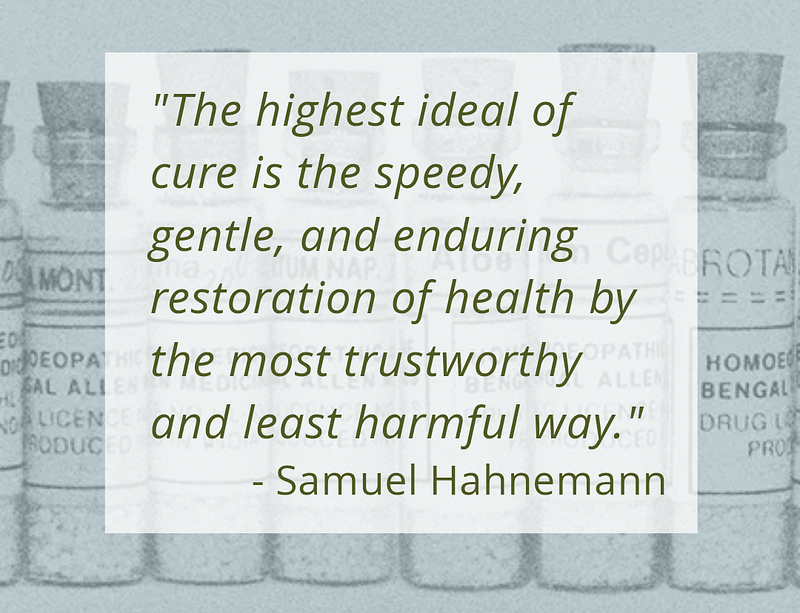
“Homeopathy avoids anything that is even the slightest bit debilitating”
Dr. Samuel Hahnemann
As part of a decision to live a life with a strong respect for communication, collaboration and seeing things systemically, it makes sense to consider a health maintenance perspective such as Homeopathy. Homeopathy emanates from nature and is a wonderful example of holistic healing. It was founded by the German physician, Samuel Hahnemann, in the 19th century. Hahnemann was a renaissance man who spoke numerous languages and would stay up all night every other evening to acquire knowledge. Hahnemann’s system of healing has weathered nearly 200 years though it continues to be attacked by corporate pharmaceutical companies and those who cannot accept the efficacy of anything except allopathic medicine. It is effective and non toxic.
The American Medical Association was founded to oppose homeopathy’s successful clinical results, which were seen as being in competition with its allopathic members. The term allopathic, which was coined by Hahnemann, referred to those who prescribed high doses of toxic medications and were still bloodletting at that time, though it has come to be defined as a protocol opposite to homeopathy. (Allopathic: The method of treating disease using agents that produce effects different from those of the disease treated.)
Homeopathy is based on the “law of similars,” Similia Similibus Curentur or “let likes be cured with likes.” The homeopathic pharmacies regulated by the Homeopathic Pharmacopeia of the United States (and included in the FDA by US Senator Royal Copeland from New York, himself an MD who also ran Wards Island Homeopathic Hospital)) dilute and potentize a substance in water. Each homeopathic remedy is diluted until it is nearly non-existent. This process of dilution is often criticized by opponents of homeopathy. However, there is an abundance of research and clinical practice that demonstrates the effectiveness of Homeopathy (see* below for research citations). The Homeopathic remedy Oscillococcinum available in most drug stores has been proven to successfully treat flu like symptoms when taken within 48 hours of the onset of symptoms with no side effects.
When taken in a homeopathic potency a remedy will allow one’s immune system to be activated, healing the presenting symptom. The first remedy that Hahnemann “proved” was China officinalis (Peruvian Bark/Quinine Tree). Given that this substance elicited symptoms similar to Malaria, he used it to successfully cure and prevent the spread of that disease. Arnica is another well known remedy that is used widespread for trauma and contusions. It is derived from a mountain daisy that if taken full dose will give you bruises (not to be taken this way), but when produced as a homeopathic remedy will treat contusions and muscular injuries.
When conducting an assessment, a homeopathic practitioner will ask many questions to find the holistic essence of an individual. The assessment consists of a detailed interview that includes mental, emotional, and physical narratives; as well as dreams, traumas and any unusual symptoms that will help to assess the temperament and unique attributes of those being evaluated. The assessment enables the homeopath to discover the most appropriate remedy. For example, there are over 180 remedies for depression, yet the correct remedy for someone depends on it being congruent with who that person is emotionally and physically (see Luc De Schepper’s “Discovering Life: Homeopathic Portraits,” Full of Life Publishing: Santa Fe, NM).
There are presently approximately twelve hundred FDA listed remedies in the United States and over three thousand remedies that have been proven worldwide. The process of “proving” a remedy involves it being taken by healthy people during a controlled study. Subjects record in a very detailed manner, all symptoms elicited by the remedies, as well as sensations, modalities (what makes it better or worse, etc.) and where the symptoms are located. If a remedy produces a symptom in a healthy subject, given the philosophy that “like cures like” it will heal those same symptoms in a person afflicted with them.
In the late 1800’s, and well into the mid-twentieth century, there were thousands of medical doctor practitioners and numerous homeopathic hospitals throughout the United States with years of successful clinical results. For example, there were twenty-one homeopathic hospitals in New Jersey and forty in New York State, which also had homeopathy being practiced in its State Psychiatric Hospitals for nearly one hundred years. Flower Hospital in Manhattan (which is now the New York Medical College) and Hahnemann Hospital, now Drexel University in Philadelphia were flourishing centers as well as numerous other American Homeopathic Medical Colleges including the University of Michigan and Boston University to mention a few with many documentations of clinical successes.
During the well-documented 1918 Flu Pandemic, homeopathic hospitals that treated cases on an individual basis had a death rate that was nearly 80% less than traditional allopathic hospitals. Most of these homeopathic institutions met their demise due to the influence of pharmaceutical companies and cultural changes of the 1950’s. However, homeopathy thrives in Europe and South Asia and is on the rise again in the United States. It has also been documented and been useful in treating the current Covid-19 pandemic symptoms in Cuba, Africa, Europe, and India (https://hpathy.com/homeopathy-papers/homeopathy-to-prevent-and-treat-coronavirus-infection-amma-resonance-healing-foundation/ )
Homeopathy advocate Dana Ullman cites in his book “The Homeopathic Revolution: Why Famous People and Cultural Heroes Choose Homeopathy” that eleven American presidents were treated with homeopathy as well as heads of state throughout the world including Gandhi and Churchill. Even John Wayne stated, after punching a foe in a film “better get this guy some Arnica.” Famous entertainers, literary greats, scientists, artists, spiritual leaders, athletes and many more, then and now, support and reference successful healing experiences using homeopathy. A statue of Hahnemann rests not far from the White House in Washington D.C., the only physician to be honored with a national park designation.
A 2012 thorough study by the Swiss Government cites homeopathy as being highly effective, and treatment using it more cost efficient than traditional medicine. The study was conducted by an impartial Dutch research firm and underwritten by a country that is home to several of the world’s largest pharmaceutical firms that have constantly opposed homeopathy.
Dr. Luc Montagnier, the Nobel Prize Laureate who discovered the AIDS virus, supports homeopathy. In addition, as previously mentioned, many scientists who are conducting research of water molecules have confirmed that water does retain memory of the molecular imprint of substances despite it being dissolved more than it was believed possible.
Implications for the Gift of Homeopathy:
A few years ago, I attended a seminar on Alternative and Complementary Healing at a local Law School in New Jersey. One of the presenters, who represented the American Medical Association (AMA) and was from a university in California, discussed research covering over twenty alternative healing methods. Most of the healing methods were being rigorously and, in many cases rightfully disputed. When the presentation was nearly finished and with yet no mention of homeopathy, I raised my hand and asked, “What about homeopathy?” The speaker paused and smiled in a manner that was quite different than his demeanor of the past ninety minutes. He then asked, “Do you use Homeopathy?” I smiled back, and he continued to say that they were following a sizable number of patients being treated with homeopathy in San Diego and Rochester, all of whom were getting better from their presenting symptoms. He shrugged his shoulders and said, “Well Homeopaths spend much more time than the recommended eleven minutes that the AMA suggests for consulting with patients, therefore it must be the placebo effect.” His sheepish smile at that moment seemed incongruent amongst his many slick and extensive research charts.
Was there ever a time in your life that you felt uncomfortable with traditional western medicine?
How might any experience regarding your health could have been more in harmony with who you are and what may have been occurring at that time in your life?
Have you ever had any side effects from medication and how did you cope with it?
How might an integrative alternative healing modality complement your health care?
Would it be valuable for you to consider using homeopathy as part of your health resources? (To find a Certified Classical Homeopath go to the website of The Council for Homeopathic Certification at homeopathicdirectory.com )
*Research:.(see the Homeopathic Educational Services’ website for research information https://homeopathic.com/?s=research and Dana Ullman’s article in the Huffington Post, “Dysfunction at Wikipedia on Homeopathic” October 1, 2014, http://huff.to/1ssZ8Dp , as well as the American Institute of Homeopathy, the association of American Medical Doctors, https://homeopathyusa.org/uploads/Homeopathy-Research-Evidence-Base-12-13-2019.pdf , as well as the National Center for Homeopathy, https://homeopathycenter.org/research-on-homeopathy )
Further resources:
See Luc Montagnier, Nobel Prize Winner, Takes Homeopathy Seriously, January 30, 2011, By Dana Ullman, The Huffington Post and Homeopathy Vindicated as Cost-Effective by Swiss Government, March 23, 2012, By Dana Ullman, The Huffington Post; an excellent book describing the state of modern medicine and the hope that an individualized approach can offer is Green Medicine: Challenging the assumptions of Conventional Health Care, by Larry Malerba, D.O., North Atlantic Books: Berkeley, Calif, 2010


