
Ikigai: Uncover Your Reason to Get Up in the Morning
The Japanese philosophy of working your purpose, not just a job

Any time I’ve struggled with certain sections of my life I can trace long-term down-moments to a lack of purpose. Whether I was stuck in a job I hated or I hung out with the wrong people — even a business venture that didn’t jive with who I am — the low points were all traced back to lack of purpose.
We all need a real, visceral reason to get up in the morning.
Ikigai is the Japanese philosophy of purposeful work. According to this article, the two words combined to form ikigai mean “a reason for living.” In Okinawa they call it “a reason to get up in the morning.” In the end, it’s all the same. Ikigai is the merger between who we are, how we can serve others, and what we love to do.
I like to name this core belief your calling.
In his Ted talk, How to Live to Be 100, author and speaker, Dan Buettner shows us that populations who live with purpose, who do work that jives with their reason to get up in the morning, live longer.
Whenever we’re stuck between who we are right now, what we’ve become, and where we want to be, there’s a real rift in the Force. Without a feeling of purpose, not only can we slip into deep depression, but our attitude towards life effects those around us as well.
The deterioration is slow. Almost unnoticeable. Until it isn’t.
We might stay at a job we hate for years (or decades), because the promotions or ‘attaboys’ are timed at perfect intervals — right before we run down the hall, with no pants, screaming and wearing a hockey mask. So, we stay. We keep doing the work, because that’s what we’re supposed to do. Right?
Wrong.
Life without a reason to get up in the morning isn’t fully-lived. This is called existing. Living and existing are not synonymous. This article in Psychology Today shows that mental health and addiction rates increase when a person lives without a sense of awe and purpose — that we need something bigger than ourselves to look forward to. And with purpose we feel more benevolent towards others.
We know it’s important. Maybe we feel something’s missing. But finding one’s ikigai can be tough for some people. We’re taught to go to school so we can get a good job. And if we do well, maybe we can buy a little vacation cottage and a small boat to pull behind the minivan.
But nowhere in the industrialized, life’s path for the western world, is the cultivation of purpose.
Sure, we can choose electives in high school and college. We might travel abroad or take a few years off to find ourselves. But for most folks, we settle for work that’s less-than. We shove the real dream deep to the back of the sock drawer. We take the best job offer that comes along. And twenty years later we wonder what happened.
It’s never too late to find your purpose.
I found mine later in life. The purpose was always there, but it took a lot of digging to uncover it. Now I write. And I don’t write just because I want to. I write because I can’t imagine not writing. This is the feeling of ikigai.
What’s your ikigai?
Your reason for getting up in the morning is different than mine, is different than the lady down the street and the barber on the corner. This is the beauty of work and why we’ve got such diverse offerings. One person’s perfect life is another person’s nemesis. If we all liked the same kind of work the world would be a concrete cube. But we don’t. And the system is perfect.
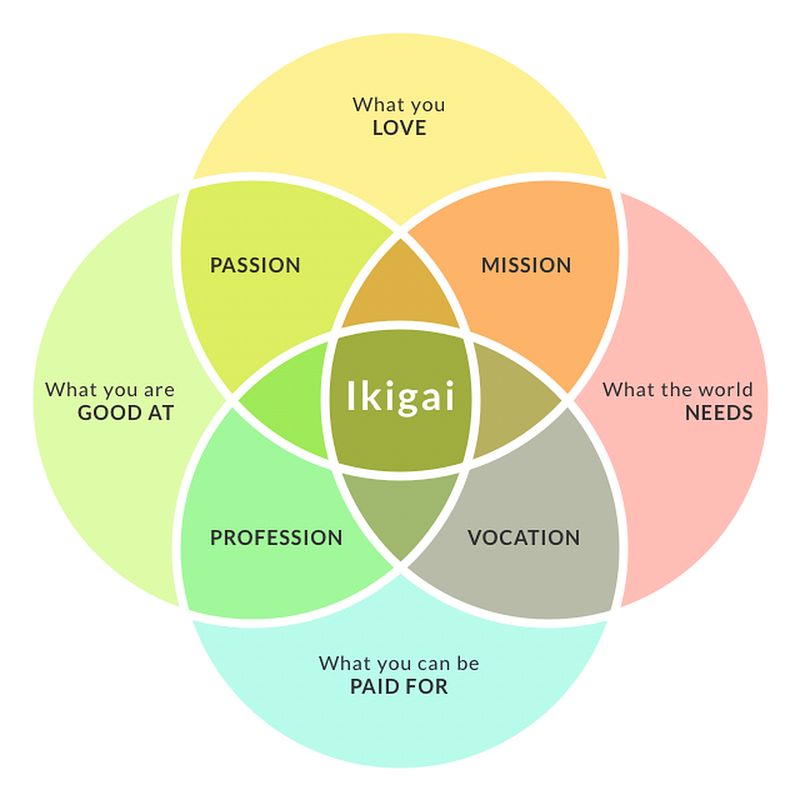
The method of discovering your ikigai involves a series of intersecting traits, wants, needs, loves, and a market for it. When all those components intersect we find our reason for waking.
What you love:
Don’t worry about the money. Money is never a reason to wake up. Money is the end-result of doing your work that matters most, to both you and others. First, you’ve got to uncover work you love. No matter how silly others might find it. Make a brainstorm list of everything you love.
What you’re good at:
As cool as it would be to be able to do any work we love, there’s also a practical side to your ikigai. We’re all built for different skills and abilities. This is the moment to be real with yourself. Take your list of things you love and circle all the items you’re good at. Be brutally-honest with yourself here.
What the world needs:
Now take your list and look at the needs of the population. Is there a need for your work? Are people already doing this kind of work for others? Maybe you love collecting rubber bands. Cool. Is there a need for rubber band collectors out in the world? Probably not. Time to cross that one off your list. When we uncover work that helps a big-enough population of others, then we find our purpose. But there’s one more step before we’re done.
What you can be paid for:
This is the final step. Just because the world needs your work doesn’t always mean they’re willing to pay you for it. A good litmus test for paid work is to find other examples of people already getting paid to do the same thing. If there’s no example (or a similar example) of someone getting paid to do this work you love, maybe this isn’t the right work. It’s not always an advantage to be a first-mover in a niche. You don’t want to have to convince people they need what you make or do.
Your ikigai
When all these circles of passion, mission, vocation, and profession intersect, a certain magic happens. If we can get paid for our calling, not only do we feel purpose, but we can support our family with the work we love and enjoy.
I’m a true believer in that you’re never too old (or too young) to find your work that matters most — your reason for waking.
We don’t want to fail the rocking chair test (where we picture ourselves sitting in a rocking chair at the end of our lives, reminiscing about all we’ve done and accomplished). We don’t want to look back and shake our heads. Regret is the most-useless human emotion.
This discovery (and subsequent journey) of your ikigai is a lifelong pursuit. When people find their reason for waking they don’t want to retire. Why retire when we feel so much purpose in doing our work? Subsequently, these people live longer too. I recommend you watch the movie Jiro Dreams of Sushi (Netflix) for a perfect example of ikigai and the life-long pursuit of perfection in purpose.
How will you wake up tomorrow?
When we wake up to purpose the day looks different. We look forward to Mondays instead of dread them. We might work longer hours in pursuit of greatness, but the hours spent don’t feel like work.
Our customers are happier, because we’ve helped them get what they want — in a way they can appreciate your craft.
The type of work doesn’t matter. We’re all wired to do different things.
When we can serve others in a way that makes us feel great about ourselves too, everyone benefits. We’re more present for our families (as long as we don’t become obsessed with the work, but that’s a different topic). Our income grows in relation to our ability to provide for the marketplace. And we can pass the rocking chair test at the end of our lives, knowing we’ve lived with purpose.
What other choice is there?
Why not try living with purpose?
The only downside is that it make take a few tries to uncover your best work. As one of my professors used to say “your job is what you do, but your work is who you are.” It’s time to uncover who you are.
We’re waiting for you.
Now is also great time to start (or grow) your email list.
I’ll show you how to get your first 1,000 (or your next 1,000) readers without spending a hot nickel on ads. Past students include New York Times bestselling authors (yep, the ones you see in the bookstore), high-caliber university professors, attorneys, doctors, scientists, artists… and regular folks too — just like you and me.
Your email list will help you build a legacy creative business.
If you want to grow your creative business you need email before you lose that valuable reader’s attention. Start your list before you need one. Once you need a list it’s almost too late.
Tap the link (offsite link).
Guarantee your seat before I start to charge an enrollment fee.
We’re waiting for you.

August Birch (AKA the Book Mechanic) is both a fiction and non-fiction author from Michigan, USA. As a self-appointed email marketing expert for writers and creators, August helps indies make more work that sells and sell more work they make. The core of August’s process is your email list (offsite link). When he’s not writing or thinking about writing, August hangs-out with his beautiful wife and handsome son, carries a pocket knife, and shaves his head with a safety razor.

This story is published in The Startup, Medium’s largest entrepreneurship publication followed by +440,678 people.
Subscribe to receive our top stories here.


