
Ikigai: The Most Powerful Japanese Concept to Lead a Long and Wealthy Life.
— Learn how to apply it to your content creation to increase your views.

Japan is one of the longest-living countries in the world.
People live an average of 84 years, and many reach the age of centenarians. This fact has always been related to its diet rich in fish, vegetables, and fresh produce, but it seems that there is another more subtle factor called Ikigai.
It is a Japanese term that can be translated as,
Ikigai: Your reason for being.
And it holds within it a powerful philosophy of life.
If you ever go to Japan and ask an elderly person about the secret of their vitality, they will tell you, "To have a strong life motivation, a mission or purpose that makes you get up strong every day."
How to discover your Ikigai
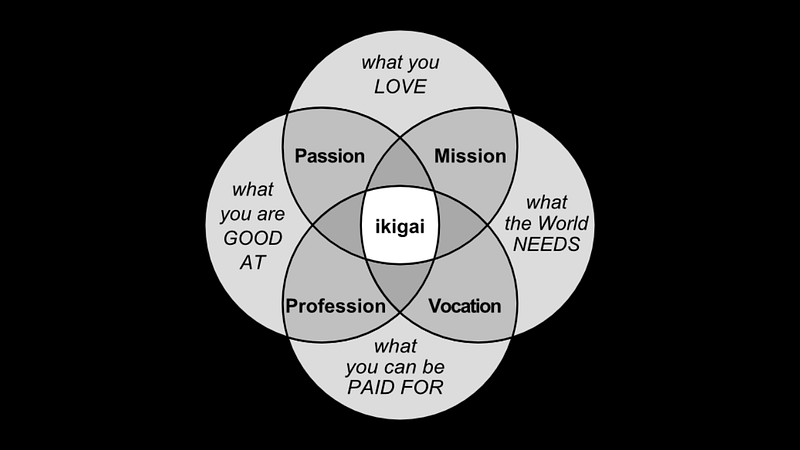
To discover your Ikigai, you have to be honest and answer the questions you can read in the image.
- What do you love?
- What you're good at?
- What does the world need?
- What can you be paid for?
Answering these questions gives you a lot of information about yourself and what your life can be.
- Knowing what you love helps you discover your passion.
- Knowing what you are good at helps you find a career.
- Knowing what the world needs gives you a mission and a vocation.
- Knowing which skills will make you money will make your passion sustainable.
The intersection is the key.
As above, so below; as within, so without. — The Kybalion.
I put this alchemical principle so that you understand that everything is interconnected.
As it is outside, it is inside: as it is in nature, in everything you intend to achieve. Think of each of your joints. Why do they move? Because they have knees kneecaps, i.e., elements that unite different parts of your body. Without these joints, your legs, arms, hands, feet, etc., would not work correctly, right?
When it comes to finding your purpose is the same, it would help if you found your intersection to find your Ikigai.
- It does you no good to be the best at something the world doesn't need.
- It does you no good to work at something you hate every day until you die.
- It does you no good to dedicate yourself to something you are not good at.
- And it won't be sustainable over time if you don't find a way to monetize your passion.
You have to find something that you love to do, that the world needs, that you are good at, and that you know how to monetize. That's your Ikigai.
For example, I wanted to be a Rap singer, but even though the world needs singers, and there are ways to make money with music, and I love to sing, I am not a good singer. Therefore, much to my regret, my Ikigai is not music.
On the other hand, the world needs writers, and I know how to monetize it, and I'm passionate about writing, and I'm reasonably good at it. That's my Ikigai.
Ask yourself the right questions, answer yourself honestly, and you will find yours.
Practical application to content creation
Let's assume you are clear about your Ikigai and that it somehow coincides with creating content on the internet in the form of,
- YouTube videos
- Articles
- Books
- Social media content
In this case, you can use the same method to increase your visits.
Ask yourself:
- What do you love to talk about?
- What can you talk about because you're good at it or have a lot of specialized knowledge on the subject?
- What does the world need?
- Will I get paid to talk or write about it?
Remember, at the intersection is the key.
- You have to love the subject.
- You have to know a lot about it.
- It has to be a topic of interest to the world.
- And you have to know that it can be monetized.
If your content meets these points, your visits will increase exponentially.
Why don't people make it?
People don't make a living from their content because they are not honest in answering the above questions. That's the harsh truth.
- If you don't love the topic you talk about, you won't be able to talk about it for years. Imagine talking about technology because it's trendy, but it bores you. You won't write about it long enough to see the results. And your work won't be as good as someone passionate about it.
- You have no credibility if you don't know what you're talking about. Many people want to make it big with psychological advice. Still, they don't realize that people like Benjamin Hardy (among others) in this platform write, a guy with a Ph.D. in psychology and probably one of the best writers on the internet. So why would anyone read psychological advice if you are not a psychologist and can read a real one?
- If the world doesn't need it, no one will read it. Many things have no interest, and people write about them thinking they are a new niche. But it's not true, your school comic collection is not a niche in itself, and you won't be able to make a living writing about it.
- There's no point in writing it if it doesn't make dough. That is harsh but true. If you want to write for yourself or as a journal or share your experiences with your friends, you can talk about whatever you want, but don't self-deception. Professional writers write about things that can be monetized: self-help, travel, music, video games, economics, history, etc.
So you know, if you want to be professional: be professional.
Did you enjoy this article?
If you haven't signed up for Medium yet, and want to read all my articles, use my affiliate link!
There's no additional cost to you, and I'll receive a small commission — thanks for your support!


