
Ikigai : The 4-Step Japanese formula for Happiness.
We all want to be happy but the majority of us have no idea what to do.
Should we focus on making more money?
Should we focus on pursuing our passions?
Should we give up all of our material possessions and become a monk in the mountains?
Everyone seems to have a different take on it.
So there is this proven formula that has actually been around for hundreds and hundreds of years of formula for happiness. See, the Japanese have a concept called Ikigai which roughly translates into a reason for being happy.
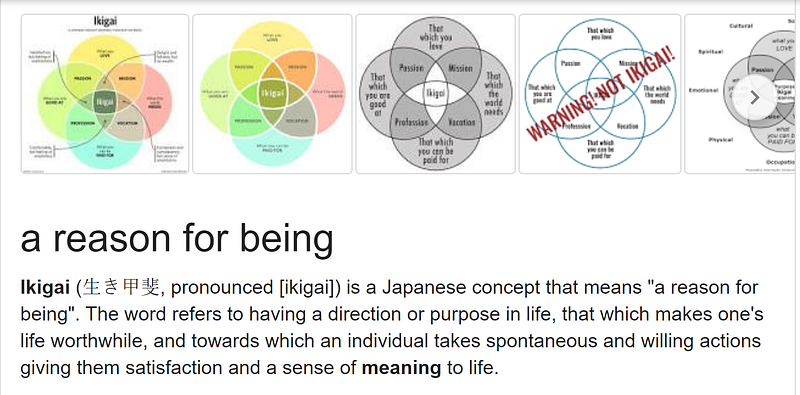
In order for you to be happy you need to spend your time doing something with Ikigai you need to have a purpose for being here. But this is easier said than done because there are four components that you need to check off in order to achieve Ikigai. And without all four you will never truly be happy.
The first component is that it needs to be something that you love. We all have things that make us feel good. Things that make us stop thinking for short periods of time to just be present and aware of what’s happening right now in front of us. The more technical people will call this flow state. But the majority of us call it love. That’s why so many of us enjoy the arts, drawing, dancing singing and reading because it takes us into the state of bliss where we feel good and are focused on the task in front of us.
That’s why some of us fall in love with one another because being with that person allows us to forget about all the other problems in our lives at least momentarily. I don’t need to get into too much detail about this component because we know in our gut when we truly love to do something it’s a feeling that we humans all share.
The second component for Ikigai is a little bit more tricky. It needs to be something that the world needs. We’ve been hardwired to feel good when we know that we’re needed in a community. Back in the day when we were hunters and gatherers, this was easy.
Everyone played an important part. The cook was just as important as the hunter, the Builder was just as important as the caretaker back then. Whenever you put in work you could see the immediate positive effects your efforts had on others. But this isn’t the case nowadays. Most of us work in offices being given small roles in a massive company, where, even if we work our butts off it’s hard to see the positive effects our work has on the rest of the world.
It feels like our work isn’t really helping anyone. It feels like if we quit our job one day no one would even care because to be honest nothing would change.
This is why I started writing on Medium. I wanted to make an impact — on whatever scale. You need to find something that you can do, that will create a visible positive effect on those around you.

The third component for Ikigai is that it needs to be something that you can get paid well for. Let’s be real, money is what puts a roof over your head, food in your mouth and clothes on your body. Without enough of it you’re gonna spend the majority of your time stressed out of your mind wondering how you’re going to get by. It’s not enough to just be making some money.
You need to be getting paid well enough to live a comfortable life. So it really depends on where you live.
For example you could live like a king off of $30,000 a year in some countries, but in a place like New York City that would barely be enough to cover your rent. If you’re not making enough money to live without stress then you will never achieve happiness.
The fourth and final component you need to have in order to achieve Ikigai is that it needs to be something that you’re good at. Now this doesn’t mean that you need to be born with talent. This actually means that you’re able to put in the time and effort in order to get better at the skill.
Let’s say for example you want to become a motivational speaker, when you first get started you’re terrible. You have stage fright. You forget what you’re supposed to say but over time as you practice more and more you start to overcome these obstacles. You start getting applause from the audience. That’s what it means to be good at something.
Not to be good from the get-go but to be able to overcome obstacles and improve at this skill this overcoming of obstacles creates a very fulfilling feeling inside of you.
Now the interesting thing about this Japanese formula is that you can tell where you are in life and what you need to work on by looking at the components you have so far. If all you have is something that you love and are good at, then you have what’s called a passion. People who fall into this category are all the aspiring singers and aspiring artists.
The main thing stopping you from being happy is the fact that you aren’t getting paid enough for your skills; nobody seems to notice your talent. If you find yourself in this category then you need to focus on marketing yourself. So that you can start getting paid well.
On the other hand if you have something that you love and you can see how the world needs it then you have what’s called a mission. A lot of people who fall into this category are the amateur bloggers and activists who talk about things like saving the planet or going vegan. These are people who want to see positive change in the world but unfortunately they aren’t good enough at public speaking, persuasion or writing to actually be able to convince people to join their cause.
If you’re in this category then you need to focus on getting better at your craft, figuring out how to convince people. Instead of just stating your opinion loudly, now if you’re someone who has something you get paid well for and are good at then you have what most people in the world have, which is a profession.
That boring nine-to-five job that pays the bills what’s stopping you from happiness is the fact that you don’t love your work or see how any of this can actually make a difference in the world. If you find yourself in this category then you need to try out new things and figure out what it is that you truly love doing and finally if you get paid well and it’s something that you know can help the world, then you have what’s called a vocation.
A good example of a vocation are professors. They get paid decently well and their job does have a positive effect on the world. They’re raising the future generation, but they often fall into the bad habit of teaching the same things every single year which stalls their improvement. If you find yourself in this category the main thing you need to make sure you have is that you are constantly getting better at your job, constantly challenging yourself to improve.
In order to be truly happy with your life you need to achieve Ikigai you need to be spending your time doing something that you love, that you can get better at, that pays well and that the world needs. Without all four you will always feel like you’re missing something inside of you.