
Japanese Ikebana’s Beauty Lies in its Simple and Assessible Philosophy
Two simple but important life lessons from flower arrangement
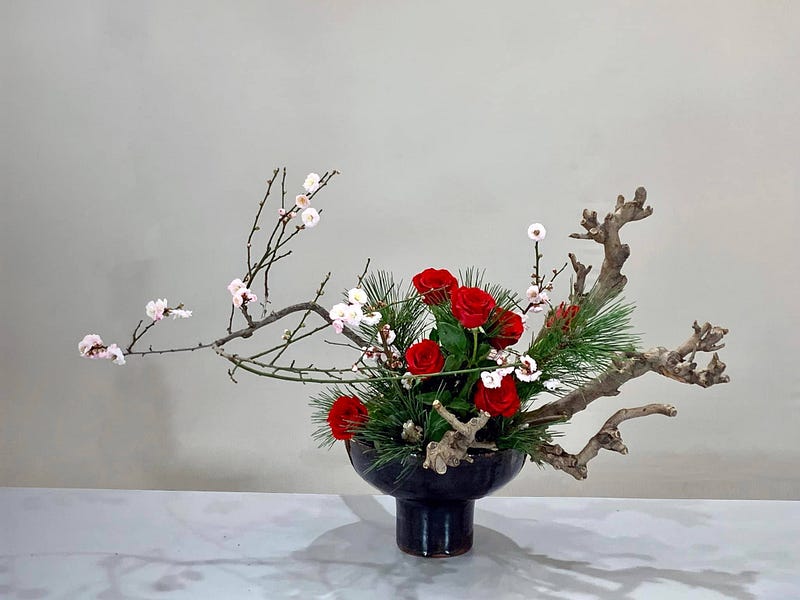
Several years ago at the Asian Arts Museum in San Francisco, I spent a charming afternoon learning about Ikebana (the Japanese art of arranging flowers) with the President of the Wafu School of Ikebana in the California chapter, Fusako Hoyrup Sensei.
The word Ikebana means “live flowers in a container”; it allows us to enjoy indoors the charm and beauty of nature — landscapes, the seashore, or the lakeside. The practice dates back to the 6th or 7th century in Japan as simple offerings on Buddhist altars but has now become an art form in everyday life in Japan. There are now about 3,000+ schools of Ikebana in Japan.
Ikebana means “live flowers in a container”; it allows us to enjoy indoors the charm and beauty of nature.
The Wafu School, founded in the early 20th century, emphasizes complete harmony among the flowers, vases, and the environment. Wafu style brings out the “natural beauty”, respecting the flowers and plants in their natural state.
The fundamental way of arranging the flowers is to create a trigonal pyramid (or more accurately an inverted, oblique trigonal pyramid.) The lengths of the 3 main stems are different and can be simplified as long, medium (2/3 of long), and short (1/3 of long). The length of the long can be determined by the height of the container + the width (at its widest) of the container. Then, you can add complementary or supplementary stems as necessary.
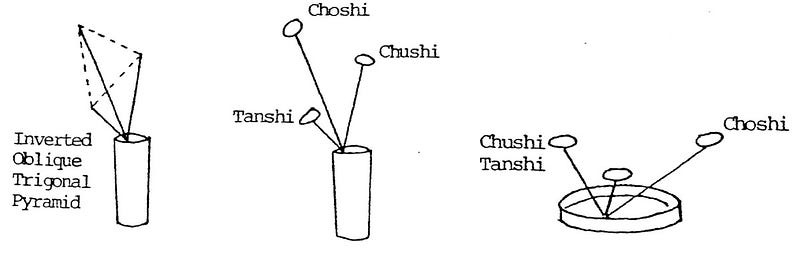
These flowers and plants harmonize with each other as well as with the artist and the environment. You would know which flowers to buy or use because the flowers talk to you. Arrange the flowers and plants facing toward the sunlight because this is the natural way how plants grow! This way gives the arrangement more depth and natural beauty.
Here is the result of my very first Ikebana lesson — ta-da!
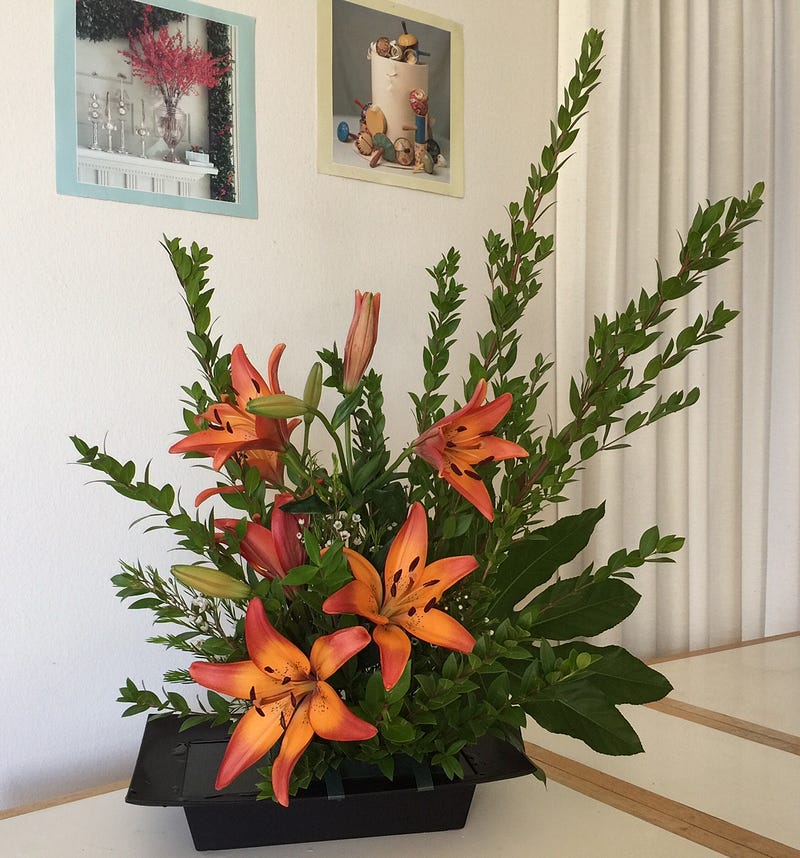
Could you guess that the focal point of this arrangement is the 2 lowest-placed tiger lilies? Can you sense that the flowers are coming toward you?
Thanks to Sensei Fusako Hoyrup, I have learned some simple but very important lessons in life as well:
Bond with nature and appreciate it anywhere.
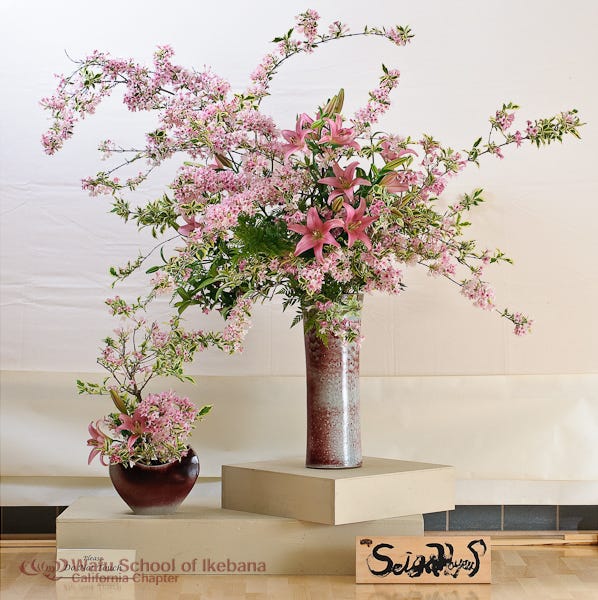
Here is a lovely arrangement by the master, herself. She used some of the smaller stems to create the second arrangement.
The original article first appeared in Simplecherishes.
Thank you very much for stopping by!
If you like my writing, support me at ko-fi to help me create an East-West Wellness Journal. Thank you so much!