
Igniting A Futuristic World of Epiphanies
“How do we best prepare ourselves for the future. By learning how to think differently about the future.” — Thomas Frey, Futurist
During my years in Colorado, I became acquainted with Thomas Frey. As the founder of the Da Vinci Institute, a think tank located in the Denver-Boulder corridor city of Louisville, Colorado, Frey invests his time, energy and attention unearthing futuristic trends and innovations that inform our lives.
Having heard Thomas speak for groups on a number of occasions, I can tell you that he is damn interesting. His history includes stints as Google’s top-rated futurist speaker, Innovation Editor for Futurist Magazine, and an award-winning engineer for IBM.
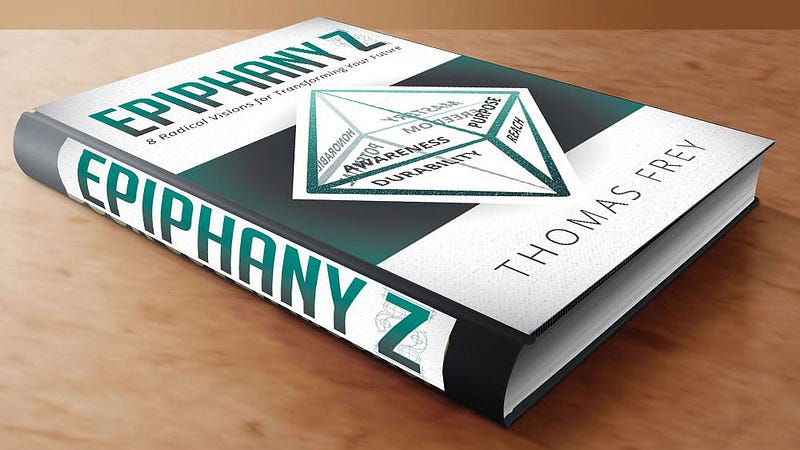
Recently, I downloaded his latest book “Epiphany Z: Eight Radical Visions for Transforming Your Future” which doesn’t disappoint. In it, he explores the exponential acceleration of technology, its consequences and the radically different perspectives on society that can emerge from it.
Frey says that epiphanies or “eureka moments” which he admits to encountering on a frequent basis are what make us humans compellingly interesting as a species, constantly rocketing our lives forward by sending our minds in new directions.
In short, Thomas’ book delivers an intriguing look at the seismic technological, economic, social, geopolitical changes that continue to transform our world and our lives.
With 2018 rapidly coming to a close, I asked Tom to provide us with some of his more recent thoughts about epiphanies and the global future.
On The Power of Epiphanies
The idea of waking up in the middle of the night with these so-called epiphanies is pretty common. Often they can keep you up and kind of torture you. Then you take the idea, twist it around so you can mull over it again and again.
On What To Ultimately Do With These Epiphanies
[Laughter] Most people have no idea as to what to do with their big epiphany when they show up. I’ve found that it’s best to either do something with it or just let it die. And this letting it fall away is kinda like letting a baby you gave birth to die. But unlike in the past, we have so many opportunities to do something with it.
There are so many outlets for our ideas, whether it be through social media or other channels online. There are also different sites where you can get other people involved in your idea. In the end, every new business and product gets started with an epiphany.
On Those Grand Epiphanies
Those are the ones that are going to change your life. That’s why I spend a lot of time thinking about these.
On Launching An Idea
I’ve witnessed a much greater appreciation for what it takes to get one of these ideas to actually grow legs and take off like a rocket. It’s harder than most people imagine.
On Funding It
There is so much hype around getting VC funding for one's startup when in reality this method only applies to a few types of businesses, ones that are highly scalable. So there’s been this mystique around VC funding. But now we’re beginning to understand that there are a lot more financial channels to work in terms of funding an idea.
On Having a Minimum Viable Product
What’s fundable and what’s in sync with the market often comes down to the concept of Minimum Viable Product. That’s part of the vocabulary of young people these days. It was such a novel concept when it first came out because people thought that you had to have a finished product ready to go, take a truckload of them to the store and then they would start selling them for you. I can’t tell you how many stories I’ve heard of people who when they discovered a new innovation, ordered it in mass quantities with only a crude prototype. They then just sat in their garage because nobody wanted it.
On Automation and Job Loss
In 2012, I was giving a TEDx talk in Istanbul and made the prediction that by 2030 over two billion jobs were going to disappear. I keep getting quoted on it in newspapers and the global media. But I never intended it to be a doom and gloom statement. It was meant to imply that with an estimated two-billion unemployed by then, we are going to need to create new jobs at a faster rate than ever before.
On Talent and Skills Demands
It is important to emphasize here that we’re not talking about automating entire jobs out of existence. Rather I believe we are automating tasks out of existence. By way of example, if you were a utility meter reader, you did more than just go out and read the meters. Now because meters can send in a wireless signal with information versus having someone physically go out and read those meters, the job itself will get redefined.
Sure, jobs can be done with fewer people but that doesn’t mean that the entire job will go away. In the last 64 years or so the only job that has been totally automated out of existence has been that of elevator operators. By one count a hundred years ago, we had like 65,000 elevator operators. Now there are only a few left, primarily for security purposes.
On The Future of Cars
We often forget that the cars we drive today have actually been in development for 120 years. During this period, almost everything about the car was designed around that person driving it. All sorts of measurements had to be done for the seat adjustments, viewing angles and reach envelopes. Now we’re moving into an era where people are going to be no longer driving. So car designers are going to have to focus on things other than driving like having conversations and playing video games to watching movies. With this transition, these features become much more important.
On The Future of Deliveries
We’re always going to have things delivered. In fact, statistically, the number of objects delivered to our homes continues to go up. On the other hand, letters to our homes continue to go down or level out. So all of this begs the question as to whether there are more efficient ways of getting physical things delivered to the home. You hear all of these stories in the media about drone delivery services. Frankly, I believe we’re a long ways from making that happen because we don’t have the systems in place for this occurring on a large scale.
On What We’ll See With Eyewear
By 2024, roughly 10% of all eyewear is going to be connected to the Internet. Imagine walking down the street and saying to yourself “I like the jacket that she’s wearing.” The voice enabling on your glass will have the capacity to start pulling up that jacket on the Internet. You’ll be able to get the right size for you through your own personal scan of the system. Even better, you’ll be able to have it tailored exactly to your specifications and shipped to you the next day.
On The Impact of Change
Big data along with artificial intelligence will have a profound impact on doctors, financial planners, lawyers and even writers like me. The good news is with each of these disruptions comes the opportunity to start anew.
On User Experience And Its Importance
I’ve always had such high hopes for the Internet of Things. But, just to give you an example, I ordered a lamp from Amazon that was Alexa enabled. I went to hook it up to Alexa and I spent over an hour trying to get the darn thing to work. The message I walked away with from this experience is that we’re just not ready for prime time yet. All of these things remain too geeky. And while it’s easy to speculate on how these things are going to change our lives, user interface continues to come up again and again and again.
On What Future Trend Is Rapidly Emerging
The idea of spot merchandising and hyper-individualized products I believe is right around the corner. I predict that by 2030 we’re going to have over 100,000 new micro-industries that get launched in this space. Take shoes for instance. With nearly 21 billion pairs of shoes now sold in the world it is projected that within five years, 5% of those will be smart shoes. These smart shoes mean different things to different people. Some can open pores in the side of a shoe. Others can change the amount of cleat that is sticking out of the bottom; they can open up or close tight and become waterproof or open. You’ll be able to quickly scan your feet with your phone, send it and get hyper-individualized shoes that are customed designed specifically for every little need you have.
Fry’s Final Thoughts
My hope is that we’ll be able to prepare humanity for worlds unknown, prepare our minds for thoughts unthinkable, and preparing our resolve for struggles unimaginable.