
If You’re New On Medium and Struggling, One of These Will Help
Writing more won’t help if you’re making mistakes that kill results. Long post warning. Like a course, but no fluff.

Last week I wrote about established writers struggling on Medium and seeing their views drop as much as 50%. While true, the post was disheartening to new writers who are just getting started.
“Oh, great. I’m starting at the worst time…”
A lot of new writers said that. And it is tough here right now. So I’m writing this for writers who are struggling to get some traction here.
Can I be blunt?
Know what the most common advice people give new writers here?
Write more. Write every day. Write twice a day.
Stop looking at your stats and write. Write and then write some more. Put your head down and write. Write, write, write.
Yes. You should definitely do that. The crickets you’re publishing to like the tapping sound and you’ll feel productive and hopeful for a while.
Sorry. That was totally sarcasm.
Look. Here’s the blunt truth. Around 47,000 new stories get published every day on Medium. 65,000 writers published their first story in the partner program in 2020.
I’m not saying you shouldn’t write. But “write more” is not going to help you.
You wake up tomorrow and decide you’re going to publish an article here. Great. Your post and 46,999 other posts will be going up that day.
Volume is not how you rise to the top. If you think it is, I have a bridge to sell you.
Too many people confuse “how it was” and “how it is”
You see it everywhere. Boomers telling young people they’re not working hard enough if they can’t buy a house. Fifty years ago, you could buy a house on minimum wage. You can’t today.
Five years ago “write more” might have been good advice here. Today? Good luck with that. 47K new stories every day. 65K new writers last year. Write more doesn’t cut it. You need strategy, not a pat on the head.
It’s not about putting in your time. That’s B.S.
Perseverance is a good trait. It will get you through the lows because writing here is a rollercoaster more than anything.
I had 105K views in December. 30K in March.
That’s what perseverance is for. To ride through the lows. Perseverance isn’t how you start. It’s how you don’t quit in the dip of the rollercoaster.
Ever notice that lots of newbies shoot to the top really quick? Why didn’t they have to do their time? Ever wonder that? Because it’s not about how long you’ve been here. Never was. Never will be.
Success comes down to getting three things right.
(1) Your headlines. (2) Your story matter. (3) Your visibility.
That’s all there is. One of them is not working for you. Maybe all of them. But you need to figure that out. No one can figure that out for you. There’s no “course” that will diagnose the problem for you. You have to do that.
Until you figure out which of those is the problem, “writing more” won’t help.
Here you go. Hope you find this helpful…

You can’t get a read if you don’t get the click first. Titles are crucial. Doesn’t matter how good your writing is if no one clicks your titles.
1. You have to write a headline they can’t “not” read. A title that, once seen, they “have to” click.
One day I saw two posts on Medium. One was called The Tree; A Poem.
Right under it?
How Quitting My Corporate Job for My Startup Dream F*cked My Life
You want to put money on which got more clicks?
Here’s more titles that did really well…
— Today’s Problem With Masculinity Isn’t What You Think — Prepare for the Ultimate Gaslighting — 103 Things White People Can Do For Racial Justice
Those are some of the top posts on Medium. Of all time. Now imagine those titles surrounding *your* title that says “The Sky. A Haiku.”
You know?
It’s painful to see weak titles. And then the writers get dejected and think they hate you and your writing sucks, etc. No, you just write weak titles.
The weakest gazelle is the first to go down…
People do not see your titles in a vacuum. Your titles are surrounded by other titles. If your titles are the weakest of the bunch, you don’t get the click. It’s that simple. The weakest gazelle is the one the lion eats for dinner.
We all strike out. Here’s 3 of mine… see my dud?
- An Artist Created Lifelike Photos of the Wives of King Henry VIII (100K)
- If you think “toxic femininity” is real, you are part of the problem (50K)
- The Nectar of Life (24 views) (for all of time) (*sigh*)
I wrote that horrible title. Don’t write horrible titles. Or at least, try really hard not to.
Writing good titles is hard work.
That is not news to people who make an income writing. This comes as a shock and surprise to people who think writing is easy money. Hahahahah. No. Sorry. Hard work. And the hard work starts with titles.
You have to write a title they can’t “not” read. A title, that once seen, they “have to” click because curiosity won’t let them do anything else.
2. If your title is about you and you aren’t famous, it better be a wtf confessional or a cautionary tale.
I wish I had the guts to share all the crappy titles I see because there’s so darn many of them. A flood of them, every day.
But it would make people feel like crap and I can’t do that. Besides, I’ve written my share of truly bad titles. That’s how we learn.
Here’s a recent example. I saw an article called “Finding My Power” or something blasé like that. That’s not the exact title. I don’t want to embarrass the person who wrote it. But it was boring and self focused.
The title felt like a personal journal entry. Know what it was about?
It was about learning to work for himself because of the pandemic. How he lost his job and had to figure out how to make the side hustle actually pay the bills before the tiny savings account ran out. And he did.
A lot of people would want to read that.
A lot of people are struggling financially right now. And here we have someone that achieved what so many haven’t, but he isn’t going to get views because the title sucks and sounds like self reflection.
Man, I could think of a dozen stronger titles off the top of my head.
— It took me 9 months and a pandemic to make my side hustle pay. — How the pandemic forced me to learn to make money freelancing. — I lost my job and learned to make money because of the pandemic
And those aren’t stellar. Honest, they’re not. But they’re better than a title about “personal power” that sounds like a dang journal entry.
Don’t make your title about you unless it’s dishing something a whole bunch of people want to gobble up. Otherwise, tell them what it’s ABOUT.
People need a reason to read
They scan titles looking for something to catch their eye. If you’re not already famous, your daily musings aren’t what catches their eye. Mostly, they want to be entertained or educated. To laugh or learn. Know what I mean?
So if you’re writing about yourself and it’s a shocking confessional, they’ll read that out of curiosity. If it’s a cautionary tale, they’ll read it to learn the lesson.
But if you don’t know why a reader would read what you wrote… how are they supposed to know? If you know? Tell them!
3. Some people say titles don’t matter. They’re dead wrong. And in the app? Author names don’t show.
Can I tell you a secret? Seth Godin writes dreadful titles more often than not. I read them anyway. Because it’s Seth Godin. He’s been writing long enough he doesn’t need to futz around with headlines. We know he’s worth reading.
Are you Seth Godin? Yeah. Me, neither.
Barack Obama writes lousy titles, too. So does Chrissy Teigen and Ev Williams, for that matter.
Obama can write a post called “My End of Year List” and it will shoot straight to the “trending” section. Not even kidding. It happened.
That would not happen if that was your title. Or mine.
Chrissy Teigen can say write a piece with the title “Hi” and get 81K claps and stay in the trending section for four days solid.
You think you or I can get away with that?
Hahaha. No. We are ordinary folk. Ordinary folk do not live and breathe by celebrity exceptions. We need titles to do the heavy lifting for us.
Weak lousy titles don’t bring you new readers…
I have 10K followers and I can’t make a crap title go viral. Maybe the writers with 257,000 followers can. But you know who clicks and reads those duds? The people who already know their writing.
Duds don’t bring in new readers. Not until they hit “trending.” Obama can hit trending with a crap title. So can Ev Williams. But can you?
Also? Names don’t show on the app…
I’m going to guess around half the readers here are on a phone app. People who use the Medium app don’t see the writer’s name.
I just learned that from a commenter who complained about it. So much for name recognition. Name recognition doesn’t happen on the app. So you only get the benefit of “name reputation” on the desktop version.
Now, let’s take those famous folk. Obama or Ev Williams write a post with a dud headline. All the desktop users see who it is and push them into the trending column. Then the app users see it trending and click, too.
You think that’s going to happen for you? No.
4. You probably misunderstand what clickbait is and that’s partly why your titles are weak and lame.
Some people confuse “interesting” and “clickbait.” lol. No. Interesting headlines aren’t clickbait. Know the difference? Clickbait withholds.
— The One Shocking Secret To Getting More Done.
That’s clickbait.
Notice how it doesn’t tell you what the “shocking secret” is? You see it all over the place. One weird trick to losing weight. One secret to making more money. Shocking secrets are what clickbait is made of.
— Time Management Isn’t How You Get More Done. Priorities Are. — Stop Wasting Time Managing Time and Set Priorities Instead
Those are off the top of my head and would rate poorly in the headline analyzer. They kind of suck. But you get the idea. They do not withhold anything. Good headlines don’t withhold.
They don’t promise “one weird trick.” they promise something real. The reader knows exactly what they’re going to read about. And it sounds interesting. Those are not clickbait. They’re headlines.
Did you know most clickbait fails the headline analyzer?
— Why Prince Harry’s interview with James Corden made Oprah angry (80) — The Royal That Oprah is So Mad at Right Now (score: 63)
Titles that “withhold” don’t generally score well. They are clickbait. No one likes them, not even the headline analyzer.
5. Use the headline analyzer to learn the syntax of a strong headlines
Most of the titles people create for stories here would be great book titles. Maybe even chapter titles in a book. But they’re not headlines.
That’s partly Medium’s fault. See?
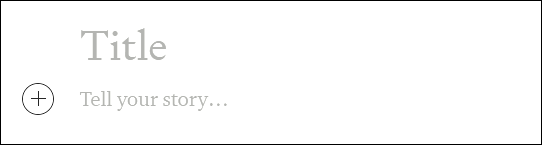
They ask for a “title” — so writers give them one. What it should say is “headline.” Pedantic, I know. But it would make a difference for new writers who are literally giving them what they asked for.
The headline analyzer can teach you to write stronger titles if you play around with it. Take a concept and try saying it in different ways. See how it scores.
— If You’re New On Medium and Struggling, One of These Will Help. (86)
— 12 Tips for New Writers Who Are Struggling on Medium (71)
— The most common mistakes new writers make on Medium (67)
— If You’re New and Struggling on Medium, These Tips Will Help (65)
— Medium Tips for New Writers Who Are Struggling (59)
The tool isn’t the strength… learning the syntax is
You’ll notice that when you use the tool, it highlights “types” of words.

Yellow words are common. Red words are uncommon. Purple are power words. After you play around a bit, you’ll start to learn which words tip the score. Words like how and why. Unusual words and words that evoke emotion. As you start to absorb it, your titles will improve.
It’s not about the analyzer — it’s about learning to make your string of words stand out from the other strings of words on the homepage. :)
6. Have you seen what happens if you put a number in the title? (No, I don’t mean a listicle)
Can I show you something astounding, amazing and weird that you might not have noticed? Seeing this is an instant wtf moment.
Open the Medium homepage in a new tab and type a number in the search box. Literally, a digit. Any digit. 3. 5. 7. 11.
Or just click here to see a sample. (open it in a new tab) (I’ll wait)
Do you see the views they have? Are you saying WFT yet?
Go ahead, type more numbers. I’ll keep waiting. If you aren’t saying WTF yet, go make some strong coffee because friend, you need to wake up. If you’re looking at the views and saying “omg, wtf?” — we’re on track.
This is not about writing listicles.
I mean, you can write listicles if you want to. I won’t tell you not to. There’s an audience for everything under the sun, including listicles. But this isn’t about listicles. It’s about our human fascination with numbers.
There’s a whole lot of ways to use numbers that aren’t listicles.
That said, listicles perform pretty well, too. Especially in long posts. Kind of like how a book has chapters and no one whines about that. Can you imagine books without chapters?
Now go grab a whole bunch of those winning titles. The ones with 10K and 20K claps. Paste them into a word document and see if you can use them with different topics to write titles that will kick some butt.
As you follow the “model” of other successful titles, you’ll be learning another model for a good title. Because there’s more than one way to write a good title. As your titles improve, so will your results.
7. A picture speaks a thousand words. Or not.
Just a brief word on cover image. Unsplash has been stapled to Medium for years. People tend to search a word and use one of the first images that comes up. Which means a lot of the images have been used to death.
Before you choose an image, search Medium for the topic you’re writing about. What you don’t want to do is write yet another post about the same topic using the same image readers have seen a dozen times already.
You need to stand out. Your title carries most of the weight, but the image is a factor, too. Don’t just use Unsplash. Try pixabay, pexels, and piqsels, too.
Plus, you can search google images and click Tools> Creative commons to find a wider variety. Cool part is Google will search all the public domain repositories at ones. Pxhere, pixabay, etc — they’ll all show up.
The headline writer is the poet among journalists, stuffing big meaning into small spaces.” — Roy Peter Clark, The Poynter Institute

Once you get the click, the challenge is keeping the reader. Not much sucks more than getting the click and then losing the reader. You had them. And then you lost them. Here’s some help with retention…
8. Format, format, format. Also, subtitles should be section headlines, not book chapters.
You would be amazed at how many people lose readers because they didn’t bother to format a visually appealing story. Formatting is so important. If a reader loves your title and clicks — only to see a wall of text?
They’re gone. It’s too much for the eyes. TL;DR
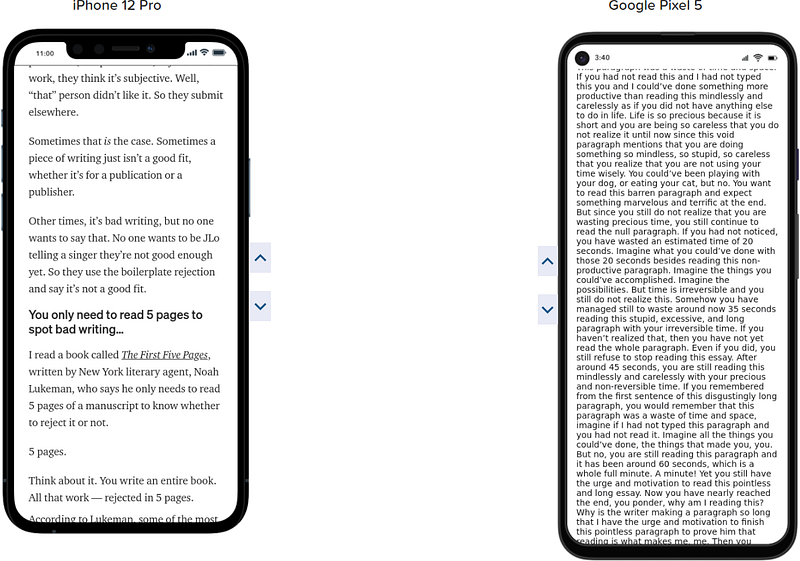
Double the paragraph length for mobile…
If you have a paragraph that’s 2.5 lines long on desktop — it will be 5 lines on most phone screens. Got 5 lines on desktop? That’s 10 lines on mobile.
Doesn’t take much to become a wall of text. Proof your writing on your phone, or go look at your articles in the mobile simulator
It’s okay for the odd paragraph that you can’ t break up, but not the whole piece. You need to format with mobile in mind.
Also? Use strong subtitles to pull the reader through the story
Most people botch subtitles as badly as they botch headlines. They write book chapter-titles instead of subtitles.
When you chunk your content, look in each sentence to see if there’s a gut punch somewhere. Use that as the subtitle for the section.
Good subheadings can be the “trick” that entices a reader to dive in and read.
A lot of people scan the article first to see if it looks interesting. Subtitles can be why they say yes. When subtitles are intriguing, you’re more likely to get the read.
Don’t forget pull quotes
Pull quotes add visual interest. Doesn’t matter if you pull them from your story, or use quotes that are relevant to the piece.
People tend to scan a piece before they read it. Pull quotes also increase the odds that they’ll be intrigued enough to start reading.
9. If it bleeds, it leads. Start with a bang.
Stephen King once said he can spend months or even years figuring out the opening line for a new book.
If you’re writing online, it’s even more important. A weak opening can undo the best headlines. Titles grab attention. The opening has to keep it.
Know what they say in journalism? If it bleeds, it leads.
Quentin Tarantino said when he’s writing a movie, the first thing he does is pick the opening music. Because the music sets the mood for everything that will follow. That’s what your first line does as a writer. Sets the tone.
Here’s a few ways you can start with a bang.
- Ask a question. Do you know the first movie that showed a naked woman? It was…
- Use an anecdote. I worked my butt off to get my client on Oprah and he blew it…
- Use a metaphor His eyes were spitting anger and I didn’t care…
- Use a weird statistic It would take 200 years at $15/hour to earn what Bezos makes in an hour.
- Use a “pitch” style opener Ten minutes. That’s how fast you can fix your titles. Want to see?
- Start with the word “you” You want to sleep better, right? Well, here’s why you’re not…
- Invoke the mind’s eye, to make them see something Remember when the towers fell, and we couldn’t stop watching?
- Say something shocking I was not sorry when my uncle died…
- Start with a quote Hell is empty and all the devils are here. — William Shakespeare
10. Your first draft isn’t an article. Sorry.
Hemingway said the first draft of anything is garbage. It should be. The first draft is how you get everything out of your head so you can work with it. To figure out direction, and what you’re trying to say.
The worse your first draft is, the better.
It gives you more material to work with. Throw all your thoughts on the table. It’s not a story or an article yet. It’s a brain dump. Sometimes, going on tangents helps us find the focus. The real magic happens in editing.
There are writers who can just type out a story and have it done on the first shot. It happens less often than you think. It’s more likely to work that way if you start with an outline and know what you want to say.
But if you’re repeatedly hitting publish on a first draft and not getting much by way of results, that might be a problem.
If you want to write faster, start with an outline
Writing fast is not my forte. I wish it was. I’m working on it. But here’s what I do know. If you do a brain dump as your first draft, you’re going to have way more editing and it’s going to take longer.
If you want to write faster, get clear on what you’re trying to say. Start with an outline. Create a working title and working sub-heads. Then fill them in. You can change the headline and subheads to stronger ones later, but the outline will help you keep your thoughts in order.
11. You need to hold the reader’s interest. Good storytelling beats technically correct writing.
Noah Lukeman is a New York Literary agent whose clients include Pulitzer Prize nominees, NYT best-selling authors and American Book Award winners.
He’s tough as nails and only reads 5 pages of a book before he knows if it’s going to get rejected. Doesn’t take more than that, he says.
Bad writing shows up real fast. It’s always in the first five pages.
He says the most common errors are a weak opening, too many adjectives and adverbs, slow pace, cliché, too much rambling and lack of focus.
Doesn’t that sound like half the writing here?
Writing for print and writing here aren’t the same.
If you’re submitting a manuscript to a literary agent, you better have your duckies in a row. If you don’t know what a trope is, you’re in trouble.
But here? Half your readers don’t know what a trope is, either. Not really. They saw the meme, maybe. Most of them have no clue what a preposition is and they don’t care if you start or end a sentence with one.
They just know if you can tell a good story.
Interesting can be subjective, too.
I write about people from history. The Tudor Kings and Queens, dead philosophers and first wave feminists. If that’s not your cuppa, it won’t be interesting to you. And that’s fine.
If it doesn’t interest you, it’s not for you. As long as people who love that stuff don’t find me boring. Because if people who love that stuff think I’m boring, I’d be in trouble. You just need to be able to hold “your” audience. Not mine.
Having a great story and telling it well aren’t the same.
That’s what I see most often. People who have a great story idea, but don’t know how to move the story along. Or they lose the trail of the story and run off on tangents. Some people can get away with it, but not many.
The best way to test your own writing is to ask someone to read it out loud to you. When you hear someone else read your words — hoo-boy. You see way more than when you read it back to yourself.
The second best way is to read it out loud. Because reading out loud will still show you stumbling places you won’t find reading silently in your head.
The places you stumble will be where readers stumble. That’s a promise.
12. Experiment with read time…
Everyone knows the “average” read time here is 5–7 minutes. So you should totally write pieces that are 5–7 minutes, right? Not necessarily.
You know how they get averages, right?
There’s four people in a room. Three of them are children, roughly 3' tall. One is a basketball player. 6'6' tall. Average height of the people in the room is 4' tall. Except, not one person in the room is 4' tall.
Same with writing. If there’s a 10 minute story for every 2 minute Haiku, that’s an average read time of 6 minutes. Experiment with different post lengths. See which work best for you.
Keep in mind that writers here get paid on read time, so 2 minute reads aren’t ever going to do much by way of ringing the cash register.
Topic affects length, too. People will read a longer post if they’re learning something or it’s super entertaining. A 10 minute journal post, maybe not so much. Sort your statistics by reads to see what’s working for you.
13. Your niche might be a rut. Try different topics.
When I first started, I couldn’t get traction to save my life. I dabbled in a whole bunch of spaces. A little poetry. A little marketing, design and copywriting — which are basically my day job.
Then I read a post that ticked me off and wrote a feminist rant in response. Wow. More views than I’d ever had up to then. lol.
Emotion trumps almost everything else.
I don’t mean you need to weep or rant all over the page. What I mean is that when there’s strong feelings behind the words, it comes across.
If a psychologist writes about the early stages of dementia, that’s going to be an entirely different “story” than if I tell you what it was like when my Dad was in the early stages of it.
One is informational. The other is emotional. One will have a specific audience that wants that knowledge. The other will have a wider audience. We all have a Dad.
Not all topics pay the same
If you start experimenting with topics, you might find a sweet spot. A topic that you can write on well, where competition isn’t too wild, and it pays well. Over time, that topic will float to the top in your earnings chart.
Today, the topics that earn the most for me aren’t the topics I wrote about a year ago, or two years ago. I’m still experimenting. You probably should, too.
It’s easy to look at this site and think you have to write self growth or tech to make get seen. Not necessarily true at all.
103 topics Medium distributes under… [source]
Have you ever looked at the topics page on Medium? They have 103 topics they “distribute” content under. There might be one that works better for you than the topics you’ve been writing on.
Arts & Entertainment: Art, Books, Comics, Fiction, Film, Gaming, Humor, Music, Nonfiction, Photography, Podcasts, Poetry, TV, Visual Design
Culture: Culture, Food, Language, Makers, Outdoors, Pets, Philosophy, Sports, Style, Travel, True Crime
Equality: Accessibility, Disability, Equality, Feminism, LGBTQIA, Race
Health: Addiction, Coronavirus, Fitness, Health, Mental Health
Industry: Business, Design, Economy, Freelancing, Leadership, Marketing, Media, Product Management, Remote Work, Startups, UX, Venture Capital, Work
Personal Development: Creativity, Mindfulness, Money, Productivity, Writing
Politics: Gun Control, Immigration, Justice, Politics
Programming: Android Dev, Data Science, iOS Dev, Javascript, Machine Learning, Programming, Software Engineering
Science: Biotech, Climate Change, Math, Neuroscience, Psychology, Science, Space
Self: Astrology, Beauty, Family, Lifestyle, Parenting, Relationships, Self, Sexuality, Spirituality
Society: Basic Income, Cannabis, Cities, Education, History, Psychedelics, Religion, San Francisco, Social Media, Society, Transportation, World
Technology: Artificial Intelligence, Blockchain, Cryptocurrency, Cybersecurity, Digital Life, Future, Gadgets, Privacy, Self-Driving Cars, Technology
An opening line should invite the reader to begin the story. It should say: Listen. Come in here. You want to know about this. — Stephen King

If you have a killer title and an interesting story, there’s still one more hurdle. Getting visibility. And hoo-boy, lots of mistakes are made here, too.
14. Stop obsessing on publications!
Let me tell you the craziest true story. A new writer on Medium decided to create her own publication. She only had about 200 readers herself.
The new publication had none, of course.
Then she wrote a story and it went viral. It had 82,000 views at last count and has earned her over $2500 so far. Know what the kicker is? She didn’t publish that viral piece to a big publication.
She’d published to the new one. The one with 3 followers.
Three. lol. Three followers. The publication didn’t make her post go viral. Medium distribution did. Good title. Good story. Boom.
Going viral with no audience
At the end of December, Medium shared the top posts of 2020. So I plunked them into the way-back. I wanted to see how many followers the writers had when they published, not after going viral.
Many of the top posts of 2020 were published in no publication at all, and some of the writers had very tiny following when they published the piece that went viral and gained the more followers.
Know how they did it? Distribution.
Another crazy but true story…
I kept reading stories about how successful people have to get up at 5 AM. Which is — whatever. If you like getting up early, go for it. But that’s not prime performance time for night owls.
So I wrote a rebuttal and listed the time that a bunch of famous writers wake up and go to bed. The list had some night owls in the bunch, including a famous author who goes to bed at 5 AM. Haha. Take that early birds!
I was so eager to hit publish, I forgot to add it to a publication. Imagine my surprise when one of the biggest publications reached out and asked if they could publish it. I was like — wtf? I didn’t know that was a thing! lol.
How’d they find it? Distribution.
Please don’t misunderstand …
I am not saying “distribution” is the holy grail. It’s not. But publications aren’t either. A lot of writers really get hung up on publications. A publication can help you find your readers — that’s true.
There are great publications on Medium. Tons of them. But even a great publication can’t help a weak story with a weak title. Know what I mean?
15. Comments can help if you’re not a jerk about it.
Comments are a tool that can help you grow.
You’re probably noticed that some of the established writers don’t interact much. They don’t have to. It’s the celebrity rule of life. The rules are different for people who have an gigantic audience and people who do not.
Interacting with other writers’ work can bring you visibility— if you do it right. Comments can put you in front of a lot of people very quickly.
But, be aware that you can alienate people very quickly if you do this wrong. Also? A LOT of new writers do this wrong.
DO NOT drop links in other people’s comments. It’s rude.
Do not… DO NOT… drop links to your articles in other people’s comments. That’s about the rudest thing you can do here. People will see it and avoid you like the plague.
Plus? The writer can hide your comment. And then poof — like waving a magic wand, they make you disappear.
Also? Don’t try to be sneaky, by saying “oh, I wrote about that” and hope people will come read. It’s tacky and looks like you’re not there to comment at all, just to try ride on someone else’s coat tails. Don’t do that.
Just interact like a human being, for heaven’s sakes. Only narcissists need everything to be about them. Someone else’s content isn’t where you promote yourself.
Also, don’t just post “nice post” — it comes across like you’re just trying to drop your name everywhere, without bothering to contribute. Sometimes, it makes people wonder if you even read the post.
If you interact like a human, and say something that makes people laugh, or learn something, or otherwise be helpful, people will see your name repeatedly on those topics and come check out your work, too.
Plus? It’s fast.
I bet you can write dozens of comments in the time it takes to write one article. With the comments, other people see them. If you come across like an enjoyable human being, they’ll come check out out. :)
16. Turn on Medium’s “follow by email” feature
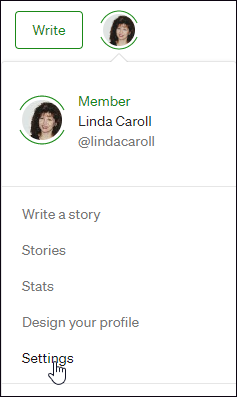
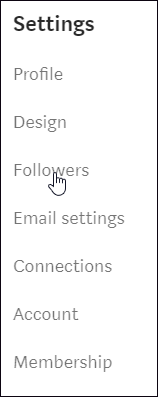
Did you know Medium lets you email your stories to people who want to receive them by email? No? But it’s not turned on by default. You need to turn it on first . You can read more here, but here’s how:
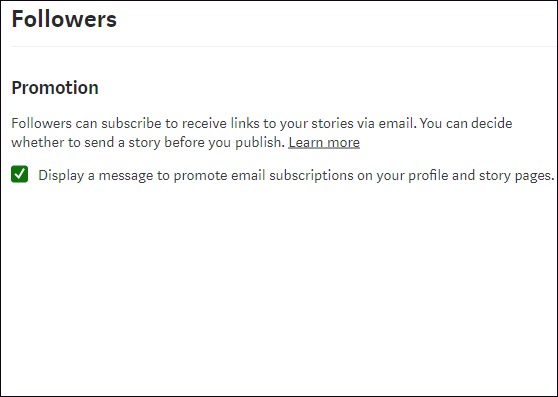
First, turn on the feature…
Go to your settings > followers. Then check the little box.
You can choose which stories to email when you publish…
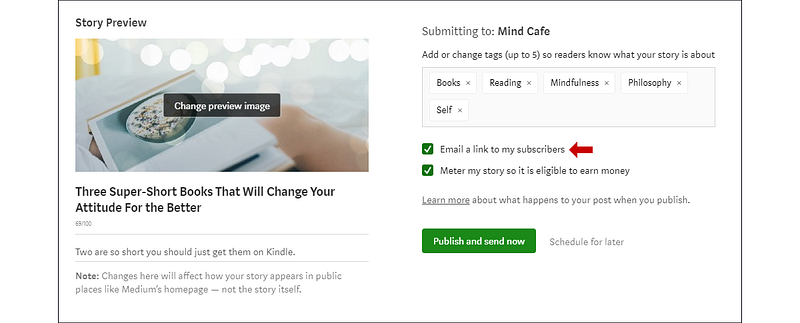
See the red arrow? When you’re publishing, you can choose whether to send the story to people who subscribed to receive your stories by email.
Please, please use it with consideration.
Do not click that every day. People will get sick of that faster than smelly farts in a small room. And you can’t pretend it’s not you, because it is.
Don’t use the feature to make people sick of you. You will alienate readers if you overdo it. They’ll unfollow and stop reading.
But if you choose carefully, and send maybe once or twice a week, sending only the stories you’re really and truly proud of — I think this feature could work really well to keep in touch with your readers.
17. Create a custom url for Google/SEO
I have a love/hate relationship with getting Google views on Medium. On one hand, we don’t get paid for external views. On the other hand, if a post gets a lot of external views, it sometimes seems to trigger internal views. Like a snowball rolling down a hill.
It’s like the algorithm “sees” an article getting reads, so it starts to show it to more people internally. Which is terribly not technical as far as an explanation goes, but it’s happened to me more than once.
When you write a post on Medium, the title becomes the url.
Problem is, a good title does not always make a good url in Google’s eyes. The good news is that you can specify the url you want to use for your post.
Robots are kind of stupid
Mostly, because they’re not really robots, they’re math equations. Search engine robots (algorithms) tend to think the first few words in a url are most important. But if you look at your title, I bet the first few words aren’t the ones that might match a search for what you’re writing about.
So you can use the customization to re-arrange you url so it’s more pleasing to Google, and has the “important” words at the beginning.
Please note: you can only do this in draft mode. Once you hit publish, you can’t change to a custom url anymore.
It’s a really simple process. Here’s the steps…
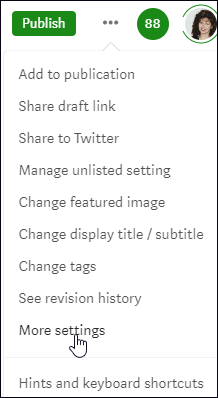
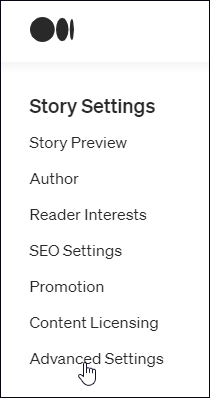
— 1. While editing a story, click the 3 dots in the top-right corner — 2. From the drop-menu, click > more settings. — 3. Then go to > Advanced settings and custom link.
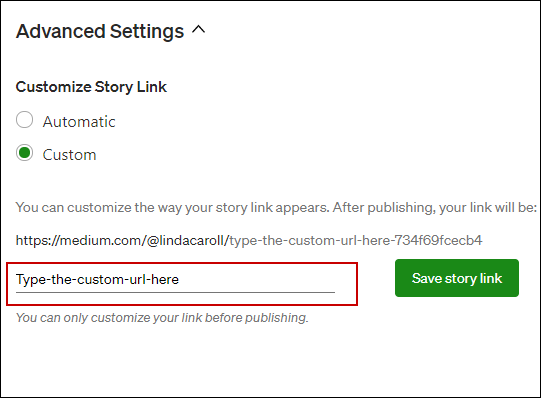
Don’t keyword stuff…
Don’t overdo it and stuff your url full of keywords related to your post. Googlebot will just look at that and laugh. It’s a big OOPS, which in technical SEO terminology means Over Optimization Penalty, Stupid. :)
18. Start your own publication
Nope, it won’t have any followers for a while. But that’s okay. It will grow. And publications have some features that you don’t have on your writer profile.
— You can link to external pages in the navigation (like your site) — You can sort content by tags — You can send email to your followers.
Read that last one. You can email the people who follow your newsletter. The “follow by email” feature (#8) only lets you email a post to people who want to get content by email. Not all your followers.
But publications can send email to all their followers. You could literally run a small “mini” newsletter. Or send a weekly or monthly digest.
Feeds here are fickle. Just because people follow you or your publication doesn’t mean they are seeing your content in their feed. But you can email it to them. If you have your own publication.
It’s real easy and Medium walks you right through. Here’s the guide.
19. Experiment with footer links…
When people get to the end of your story, some of them will leave Medium. Most of them will go somewhere else. You can either give them something else to read, or they’ll click something Medium or the publication gives them.
Pages here don’t just “end.” There’s always more reading. If a reader made it all the way to the end of a story, why not suggest something else they’d like, or point them to your profile page?
Caution…
Some publications don’t permit writers to link to other articles, profiles or their site at the end of a piece because the publication wants to use that space to retain the reader. Be sure to know in advance.
20. In Closing… Take Nothing Personally
A lot of creatives take results personally. When they write a piece and it doesn’t do well, they blame themselves. I suck. No one likes my writing, I’m not good enough, I’m never going to be good enough, etc.
You can’t do that. Honestly. Just can’t. Maybe your piece was absolutely awesome but 3 celebrities posted articles the same day. Maybe there was some hiccup in the feed and no one even saw it, not because of you.
Maybe three months down the road, it suddenly finds traction and goes wild. It happens. All. The. Time.
Best approach is to think like a scientist. Try stuff. See what works. And don’t take anything personally. Because honestly? There’s a woman out there making a living writing Yeti porn. lol. I kid you not.
Taste is subjective. Experiment with topics. Work on titles. And don’t take anything personally. There are enough people “out there” who will criticize at every opportunity. You don’t have to be one of them.
Happy writing!
“You are never too old to set another goal or to dream a new dream.” —C.S. Lewis


