
RELATIONSHIPS
If You’re Going to Bail, Do it Right
Leaving is hard to do, but it can be done well.

“He took care of everything Katie. You don’t need to do anything but sign some paper.”
My dad’s best friend was an attorney and had helped him get everything sorted out before he died. It was my father’s last act of taking care of me. He knew that I would be in no condition to think through complex issues and make big decisions. He knew I would need all my resources to manage the intensity of the emotions quietly consuming me. Such is the experience of receiving a “good” goodbye, even though it’s hard, you feel loved through it. My dad also gave me one final life lesson: you will never escape goodbyes, but you can say one well.
My mother taught me quite a different lesson on goodbyes. Her first one was when I was six and she left me and my brother after our parents’ divorce to, as she would say, figure herself out. She never stopped trying to figure herself out, and over the entirety of my life, put me through multiple goodbyes. With each one, she taught me how much damage can be imparted by a careless departure.
What this juxtaposition has taught me is that goodbyes are not wrong or something to be avoided, but the way one facilitates a goodbye is important. Goodbyes come in a lot of contexts; breakups, deaths, graduations, survival strategies, respites, and so forth. If you are a person interested in leaving someone’s life better than you found it, utilizing the pain inherent in separation for good, or simply not being a dick– read on.
I will provide one caveat. This article is not meant to address those leaving violent or abusive relationships. If you are contemplating, or in the midst of leaving an abusive relationship, the number one priority is your safety and the safety of those in your care. https://www.thehotline.org/
Take Ownership
This is at the heart of a well-done goodbye. If you are the one who is leaving, it is incumbent upon you to take ownership of this decision by informing those you love that you are leaving. You wouldn’t walk out of your house without telling those you love where you are going, and when you might be back. So why would you do that in someone’s life? Goodbyes are hard, there is often sadness, disappointment, grief and anger in some combination coming from both sides. Not confronting these emotions with your loved ones doesn’t make them go away, it makes them worse.
Don’t ghost them, make them drag it out of you, or stumble upon your decision. If you are feeling so bad about your decision to leave that you can’t speak your truth, then it might be a good idea to look at the motives around your decision. Is your reason to leave a healthy one or are you following an unhealthy pattern? And an announcement on social media doesn’t qualify as ownership. In fact, that would fall into the category of “letting them stumble upon it.” If you respect what a person has brought to your life, and what you have given to theirs, then it’s vital to have a personal, adult conversation. Even if it’s going to be difficult.
The GOODbye Strategy: Set a specific time to have a conversation about your departure with those who are significantly impacted by it. Make it devoted time, in a safe environment where no one will be rushed. Be prepared to answer the obvious questions of why, when, where and how.
Leaving is 100% About the Other Person
I think everyone who’s engaged in online dating has heard “It’s not you, it’s me.” Or “It has nothing to do with you. I’m the problem.” Or “It’s a personal problem and I just need to be alone.” These excuses are a straight up cop-out, and really one of the worst things you can say to someone you’re no longer interested in spending significant or intimate time with. Not only does it not give someone a clear understanding of why you are leaving, it also leaves the other person with zero agency in the relationship. You’re leaving a person and leaving them with nothing; no room to understand, no option to change the situation and no support from you.
Let’s be honest, that’s exactly the point isn’t it? You don’t want to have a conversation with them or hold their space, so you tell them it’s not about them, which actually screams the opposite. Because if it wasn’t about them why would anything be changing? Why would you have any issues sharing the details of your decision not to be in their life in the same capacity you have been sharing everything else? What you’re really communicating is not only that they are not worth an explanation, they are not worth any honesty either.
Also be aware that because a move or a change is good for you, that doesn’t cancel out the negative emotional ramifications for others. Don’t try and negate their heavy feelings by wanting or expecting them to be happy for you. That is not the lived experience they are going through. A great example of this mistake is when a person tells a loved one they should be happy that their relative passed from a long illness because they are no longer in pain. I hope I don’t need to explain why this is an awful thing to say to someone in the throws of grief. Hold the space for someone’s pain, don’t try and make them feel bad about having it.
When you leave, your focus needs to be on the people you are leaving as much, or more, as it is on you. My dad was dying of cancer. I can’t imagine a bigger ‘personal problem’ than that. He had a lot going on, but he managed to get his affairs in order, and make time for the people he loved to talk about the future without him. If you aren’t focused on the process and feelings of those around you then you simply don’t care about their feelings. If you do care, then make a plan for them just like you are for yourself.
The GOODbye Strategy: Make a list of people who will be impacted by your leaving whether physically or emotionally. Detail a separation plan for each one of them including how they will be impacted, what information they will likely need to process your departure and strategies or suggestions you can offer to make the transition easier. This is especially important when a child is involved.
Don’t Involve Others
There are exceptions, especially with young children where a therapist may offer some real value, but in general bringing other people into a goodbye only complicates it. Wanna leave your marriage? Don’t have an affair. Wanna talk to a loved one about your decision to leave? Don’t ask a mutual friend to do it for you or have the conversation with everyone around that person and not them. And for God’s sake, don’t make it a social media moment.
Goodbyes are as intimate as hellos, and should be treated as such. Just as you pay special attention to someone when they enter your life by giving them the best of yourself, minimizing uncertainty, and giving them your focused time and thoughts, so you should when saying goodbye. Nobody else can do that for you.
The GOODbye Strategy: Use tools that reinforce intimacy in your relationships. Write a personal letter or use a closure ritual (see below). Most importantly, give them a sense of control by listening and responding to the needs of the other person. If they need to talk it through, make yourself available. If they need some space, don’t try and find a surrogate, just let them have it.
Build As Long of a Runway as Possible
If you only take on one piece of advice from this article, make it this one. Without exception, I can say that nobody likes a surprise goodbye. It compounds the trauma infinitely. Sometimes we don’t get a choice in the matter, but if we do, always take the long runway.
My divorce transition was approximately 4 years. That may seem like a long time, and it was, but I think it was the key to the positivity we were able to bring to a very difficult situation for us and our kids. Here’s what time does. It builds in a sense of control to match the fear inherent in a transition. When a person has time to absorb and process their emotions, their reactions are tempered and it’s much easier to find alignment with the trajectory of what’s happening. If someone is rushed into a goodbye, they will inevitably cope by stuffing those feelings down in their soul to be dealt with when they have . . . you guessed it . . .more time.
The GOODbye Strategy: Unless someone dies suddenly, most goodbyes are many months in the making, at least in the head of the person who’s leaving. It starts with the realization that something needs to change or has changed, then comes the planning, and finally, the actual leaving. This of course can be compressed, but the point is there are in most cases multiple early opportunities to start a conversation and you should do so. If you’re keeping a lid on it because you haven’t quite settled on leaving, even more reason to open the dialog early. If you decide to stay you’ll still benefit from open and honest dialog.
Answer the Why
The number one question a person has on the other side of a goodbye is “why?”. This might be a hard question to answer but you should work as hard as hell to do so. Here’s why. The human brain operates as a storyteller. It takes past experience, combines in with present information and spits out a future scenario and recommended actions. It gives each of us the story. If the brain doesn’t have present data this cycle gets stuck, kind of like skip on a record. It will keep processing what it has over and over making it difficult to get forward motion. Alternatively, the brain will fill that void with information from a past experience and make something up on its own that’s not necessarily accurate. So without the why, a person can get stuck or invested in something that isn’t true. Both of these outcomes are damaging. They can impede someone’s ability to move forward from the relationship and/or give them a broken dye that they will cast all their future relationships in. This is where deep damage happens.
The GOODbye strategy: Figure out your WHY for the emotional health of everyone involved. If you don’t know it, or don’t have the courage to share it, you would be best served by getting some competent therapy to help you transition with as little trauma as possible.
What’s your track record?
If you are wondering whether you’ve cultivated a good practice around goodbyes, look back and see how many relationships you’ve retained after a departure or how many strained relationships you have since a departure. Also, how many relationships “died on the vine” or abruptly, meaning there wasn’t any discernible closure moment.
The fact is that people who invest in good goodbyes don’t really have goodbyes. That’s because they don’t leave relationships, they transition them with courage and compassion. This usually results in transitioning the relationship into a different form by having something to reconnect to after healing — usually accompanied by time and space — has occurred.
If a connected transition isn’t possible —say in the case of an affair ending — you take accountability for the mess you made by treating the affair partner as a human being. Not just as the unfortunate casualty to your dumpster fire life. It’s okay to set boundaries, but do that with acknowledgment of the mess you made. If you can make room for the other person’s process around that, do so. For example, you might not be able to engage in a dialog about moving forward, but you can make it okay for the person to send you a letter about their feelings with the express understanding that you will hold space for those feelings without responding to them directly.
Whatever you do, don’t succumb to not engaging in closure, especially if you really want to move on from a relationship. Because when you deny closure you are almost guaranteed to continue that relationship, at least energetically, for much longer than you need to.
One final caveat. There are times when someone engages in a pathological process instead of a healthy one. Physical or digital stalking, invading personal space or initiating non-consensual contact, or engaging relationships that are outside of the one that has ended, are all signs of someone who is struggling with mental health issues that are precluding a healthy closure/transition. No-contact boundaries and outside intervention maybe required, and are completely appropriate in these situations.
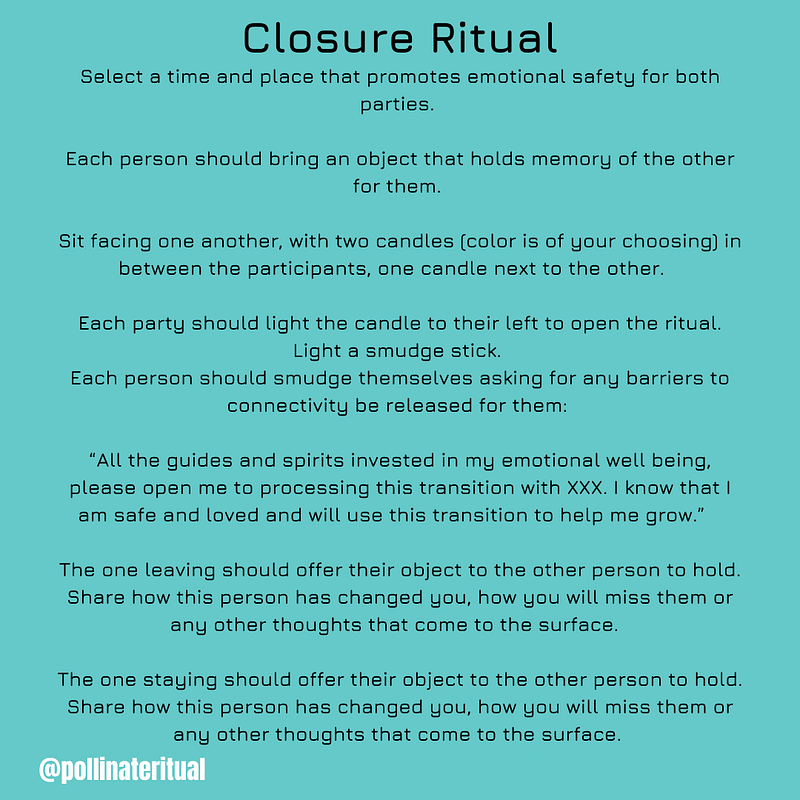
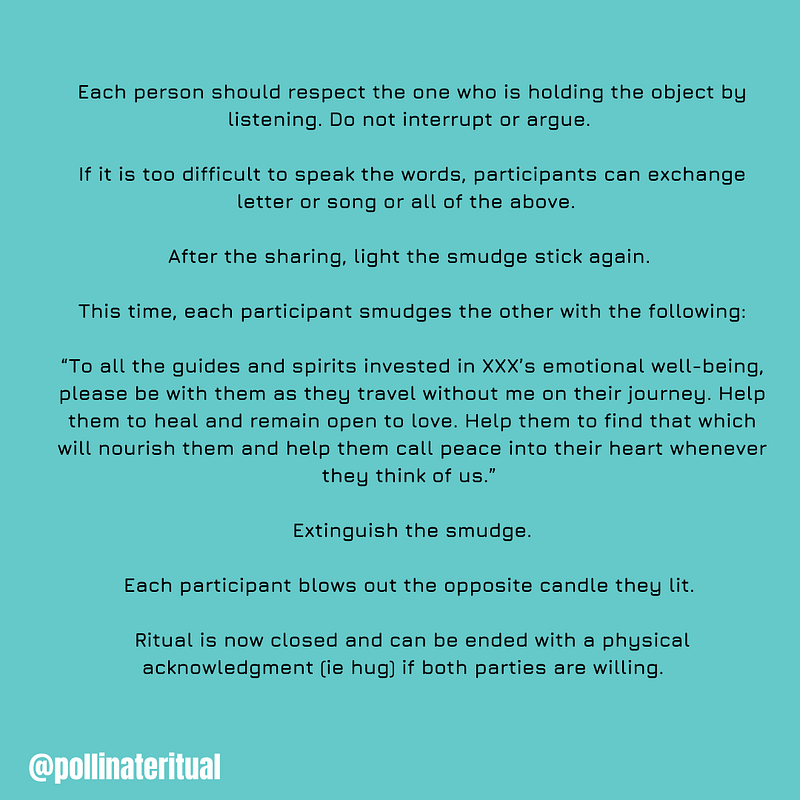
Closure Ritual Closure rituals can be powerful tools for positive transitions. They should come at the end of a healthy process using some of the steps outlined above and should always be consensual and for the benefit of both parties.
© Kathryn A. Dickel 2021