
If You’re 20-ish And Don’t Know What To Do, Follow These 5 Steps
Whether it’s college, work, love, or life — it works.

It might be a quarter-life crisis, but usually, it’s not one “big” one. It’s little day-to-day thoughts, doubts, and wondering, “what the hell am I doing.” And it’s not some mystery — meaning has always been one of the toughest things to get right in life.
For me, I was about 23 when I made the realization, had a panic, and then called on every self-improvement book, intelligent mentor, tried-and-true strategy, and gut feeling I had.
I made some decisions back then, and now in my late 20s, I’m infinitely better. I’ve traveled 25+ countries, tried my hand at multiple professions, built solid relationships, experienced crazy events, been in insane situations — all putting a smile on my face as I write this to you.
As I remember the crappiness of those early 20s and believe me, I’m not a perfect “found-my-meaning-type” monk right now either, I think to myself, “Wow, I really wish I had more guidance back then so I wouldn’t have had to go through all that.”
Now fast forward to “present me,” and I thought, “Hell, even if I did, I wouldn’t have read it!”Everyone thinks their situation is unique, but in reality, and I believe this is actually quite a comforting thought, we’re all very similar.
And after meditating on what I did, how it solved my problems and considering why it worked, I started remembering everyone who’d come to me with the same set of issues — issues of meaning.
I found myself giving the same advice when it came to this topic — again and again. So I got to work and put together a five-step guide for this make-shift quarter-life crisis we all go through.
And look, it’s simple, it’s five steps, but that doesn’t mean it’s easy. It’ll take time, effort, and some rewiring of your thinking, but it works — here are the basics.
Five Steps And Clear Skies
It’s all about clarity. It’s overcast right now, so whether it’s day or night, you can’t see the sun, you can’t see your northern star, and this climate isn’t going to do when we need some clear blue skies — so let’s play mother nature.
My Five Steps To Clarity
- Reframing The Problem — “I don’t know what I want.” has to be the most defeatist fake fact we tell ourselves. In this step, we reframe it to something we can work with.
- Finding Your First Principles — After we reframe, we get an idea of what practical things we’re interested in. This then gives us a way to figure out what our values are. Do we value experiences? Do we value freedom? This is where we find out.
- Setting Up Frameworks — These are blueprints that work for us, guidelines for our goals, what strategies we use to get there, and how we manage failure. This is where we get things done.
- Creating A Personal Feedback Loop — We now know our interests, values, and goals. Now we need a way to try it again and again. We’ll never get it right the first time, but if we don’t take action and get comfortable with failure, we’ll be paralyzed by fear forever.
- Finding Success — You’d think this doesn’t need to be a step after the other four, but it is. Many of us don’t know what success means to us, and we go back into anxiety mode after achieving something; this is where we fix that.
Example: The Five Steps Doing Their Magic
Step 1 — Reframing
The Problem: I don’t know what I want to do in life.
Let’s Reframe this: “I don’t know what I want to do, sure, but I don’t know a lot of things — what do I know for certain about my life, myself, my interests?”
- I know for certain I like being creative.
- I know for certain I like learning.
- I know for certain I like to travel.
- I know for certain that eventually, I want to start a business.
- I know for certain that eventually, I want to start a family.
Note #1: We can expand on this with Probing and Mind Boxing — you can get this whole chapter for free here.
Cool now, what does that say about our values?
Step 2 — First Principles
Let’s find our First Principles: Let’s pick travel and do the 5 Whys.
Note #2: The 5 Whys are one of many effective ways to get to your first principles, and a lot of the time, it’s less than 5.
“I know for certain I want to travel?” 1. Why?
“Because I want to meet new people, eat different foods, see the world.” 2. Why?
“Because meeting new people, going on adventures, trying different foods is different, it’s fun, it might be fulfilling.” 3. Why?
“Because they’re new experiences, and new experiences make me feel fulfilled.”
New experiences. You value having new experiences over anything. And you figured that out by pretending to be a curious (and annoying) toddler asking “why” a few times.
Step 3— Frameworking
We know the things we want to try and why we want to try them: It’s time to set some goals and frameworks for ourselves.
To start taking action, we need to use The Road-Log-Retro Framework. We’ll cover The Road in this article because it’s the first thing you need to do — the rest are in the expanded version at the end of the article.
The Road is my analogy, and it has three elements — The destination, path, and steps you take on that path.
The goal is the destination. The strategy is the path to that destination. The tactics are steps you take on that path.
A pen, paper, and some thinking for this example go something like this:
- We Reframed our problem and found out one of our interests was travel.
- We did the 5 Whys and found our First Principle for our interest was experiencing new things.
- We need to set goals, find a strategy to achieve them, and then employ tactics (actions) to get there.
Goal: Have as many adventures abroad as possible.
Strategies: Travel to culturally different countries. Travel to cheaper countries to maximize the time there. Always say yes to opportunities to try something different. Find and follow like-minded people. …
Tactics: Make a list of countries known for their different foods, culture, architecture. Post on Reddit to get advice on exciting things to do. Scan backpacking blogs to get price ranges and budgeting advice. Google tools to help find the cheapest times to fly or stay. Research popular activities in each country on your list on TripAdvisor. …
We go from broad to specific, and before we know it, we’ve broken down our destination, how we get there, and the steps we can take.
Step 4— Personal Feedback Loop
We’ve set our goals. Our frameworks are in place. Now we need to start acting: A feedback loop is all about action. Trial something, learn, and then make changes.
Ideally, we would have already done our Mind Box exercise in Reframing, which would lead us to an easy-to-choose list of initial actions.
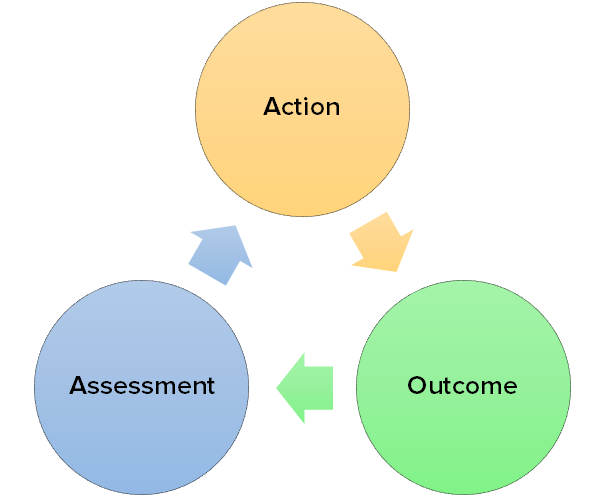
Input/Action/Trial: I’m booking a cheap trip to Asia for two weeks because traveling is important to me. Output/Learnings/Error: I liked Asia, made new friends, hostels were a mixed bag, and I didn’t like being solo all the time. Adjustment/Changes: I will continue traveling Asia, pick hostels with more privacy, and spend more time traveling with people.
And that’s the first loop. We keep looping every time we want to take action or a collection of actions we defined in Step 3. Because as we learn what the actions lead to, we figure out if they align with our strategies, and if they don’t, we need to change them so we can align and be on the correct path to our destination — the goal.
Step 5 — Finding Success
You now know the things you’re interested in pursuing, you’ve got a handle on why you’re interested in them, and you know how to go after those interests in a way that lets your take action and learn.
Now it’s all about succeeding and making this process your own.
You need some success criteria.
If you don’t, the default definition of success becomes the amount of money, quality of abs, and how attractive your sex partners are — all great, none suitable to be success criteria because you can never have enough. It’s not your definition of what success looks like.
It’s other people’s definition — ick.
Make the criteria practical, make it specific, and achievable. Have fun with it and take moments to enjoy it when you hit the mark.
Take these five steps seriously and watch what happens — what’s the worst-case scenario? You try something new, and it doesn’t work? Hell, it’s better than trying nothing— trust me, I’ve been there.
If you want some expansion on any of these five steps — you can get the complete guide here. I hope you find it helpful :)
And if you want to read more, you can support writers like me here.
Talk soon,
Sah


