
If You Want Personal Growth, Get out Of Your Own Way
How to stop deceiving yourself and start speeding up self- development
What’s the One Thing I can do such that by doing it everything else will be easier or unnecessary?
This is the leading question in Gary Keller’s book: The One Thing.
It’s the ultimate prioritization question. When you find the right answer, it’s all downhill.
Sometimes, though, finding that one thing seems impossible. I tried in my business and failed often.
But when it comes to self-development, I think I found the One Thing.
I’m practicing a single skill every day that:
- points me to the most important areas to improve,
- helps me find the best solutions,
- allows me to evaluate progress correctly.
And without it every growth tactic becomes useless: you waste time on the wrong things.
We live in a reality of our own making
The only pizzeria in my town sucks.
But my mom is such a cheerleader for her birthplace that she keeps singing the praises of its indigestible and lame pizzas. It’s embarrassing.
Our perceptions are colored by beliefs, values, genetics, attention, habits, and so on. Even our senses cannot be trusted: my mother is living proof.
Memories are not better. Not only the initial data acquisition is imprecise, to say the least. But our brain keeps rearranging connections and memories based on new experiences.
Try comparing memories of a past trip with your travel companions: everyone’s highlights will differ. Sometimes what delighted one person was a nightmare for another one.
So, neither what you experience, nor what you remember coincides with the actual events.
But it’s the best we can get. We need to make the most of it.
Is your self-development misdirected?
You can’t improve what you don’t measure.
— Peter Drucker
Wait a moment: if my perception and memories are fake, how can I say whether and what I need to improve? Maybe I think I suck as a writer and keep paying for courses and coaching. But I am actually good enough and should focus on sales to get more writing clients…
Isn’t this thought scary? For me, it’s infuriating.
Every decision in our self-development journey is based on an approximation of our situation. We know it’s far from perfect. We don’t know how far.
How do you decide what to work on?
Your self-improvement goals depend on comparisons:
- with some successful case studies,
- with your old wrong habits,
- with a desirable status.
But are those terms of comparison actually how you see them?
People have been longing for the good old days at least since the invention of writing in ancient Mesopotamia, 5,000 years ago.
— Source
But often those good old days had much worse living conditions. Not an effective comparison, in my eyes.
How do you find the right approach to improvement?
For every personal development challenge, there are countless different guaranteed solutions.
To choose the right one, you need to understand where you are and what you are capable of. No one else can tell you. You need to trust in your own assessment.
How do you evaluate progress?
Self-improvement is an infinite journey.
You find a problem, choose a strategy to fix it, try it for some time, reevaluate, update your strategy, and repeat.
Our imprecise perception can ruin this step, too:
- did you actually apply the strategy correctly, investing the necessary effort?
- Are you evaluating your results objectively?
For example, a friend of my bandmates came to our latest rehearsals. After the first song, he said to me, wide-eyed: “You’re GOOD!”. “As a singer or guitarist?” I asked. “Voice, guitar, everything!”.
But in most areas, I am my own worst critic. I see myself as a mediocre guitarist and cringe at every slightly out-of-tune note I sing.
Realizing all of the above made me angry. I don’t want to waste time. I want real improvement.
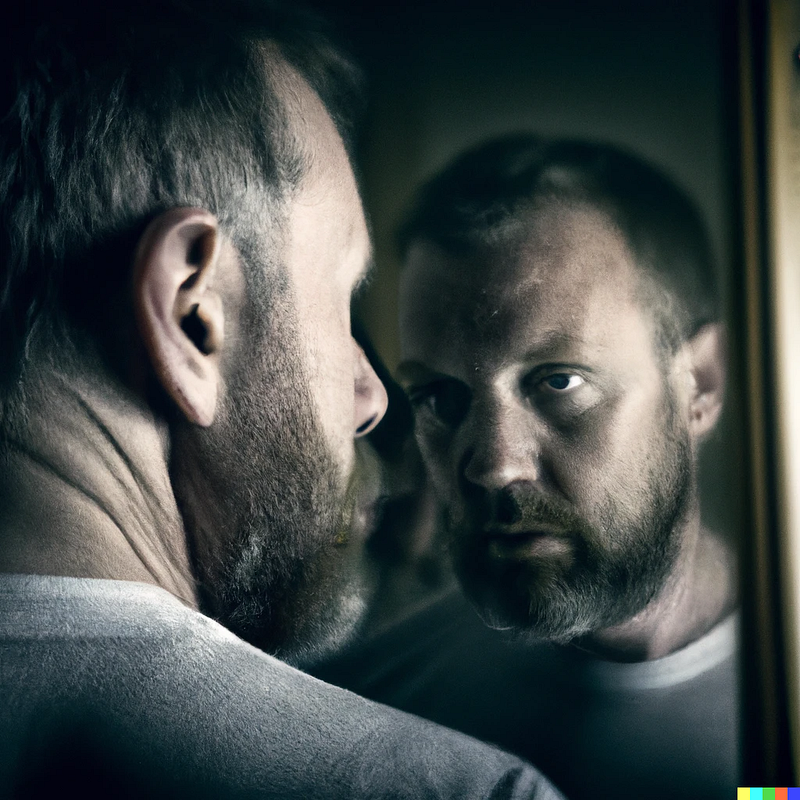
This leads me to the One Thing. The foundation of self-development is reducing the gap between reality and perception.
In other words: increasing self-awareness.
How to increase self-awareness, a tiny step every day
Maybe in the future, we will be implanted with high-resolution sensors and supercomputers. We will be able to record and process an exact representation of reality. For now, though, our hardware is inadequate.
Realistic perception is out of our reach. But we can keep improving it day after day. We can remove the layers of the onion and get closer to the core.
I am not some kind of all-seeing Buddhist monk. But my self-awareness is far higher than most people I know.
I keep practicing every day. Here’s what worked over the years.
Any kind of journaling
I tried Morning pages, the 5-minute journal, Interstitial journaling. Everyone helped. The trick is consistency.
Find the technique that best fits your schedule. Any kind of journaling is better than no journaling.
Meditation
I never reached nirvana, but this is not what you are looking for. Meditation trains you to control your focus while dodging distractions.
It’s a powerful weapon against all the forces that alter your perception.
Self-brainwashing
This technique speeds up change. It means immersing yourself in the situation you want to achieve, through content and experiences.
With the right intensity, you start to live in an alternate Universe, where the change you are looking for is not just possible, it’s normal.
I explained the technique in detail here: The Self-Brainwashing Technique I Use to Make Change Effortless
Pausing
Snap judgment and gut reactions are your enemies. When you have enough experience and achievements in some area, you can trust your gut. But often your automatisms lead you astray.
Keeping them at bay is hard. Make it easier for yourself by pausing, by adding a buffer before any kind of reaction.
It can mean taking a breath before getting angry or waiting some days before taking a decision, for example.
Self-doubt
Wait, what?!?
Self-doubt must be eradicated. It’s a waste of energy. It burns a hole through your soul. I’m a self-doubting master, I know it.
BUT
After 40 years I learned how to make something out of it: if you can’t beat ’em join ‘em!
Self-doubt is like a subroutine evaluating and reevaluating your thoughts and actions, even before they happen.
I managed (not always) to get rid of the useless paralyzing rumination and kept the habit of reconsidering what I’ve done. It brings similar results to journaling.
Reevaluating experiences, thoughts, and actions after the fact, helps me consider different points of view.
Here’s your priority
Analysis paralysis and now: focus your personal growth efforts on self-awareness. The rest will become easier or irrelevant.
You’re welcome! 😉