
If you want bigger rewards, go for deep listening
Which level of listening are you stuck at?
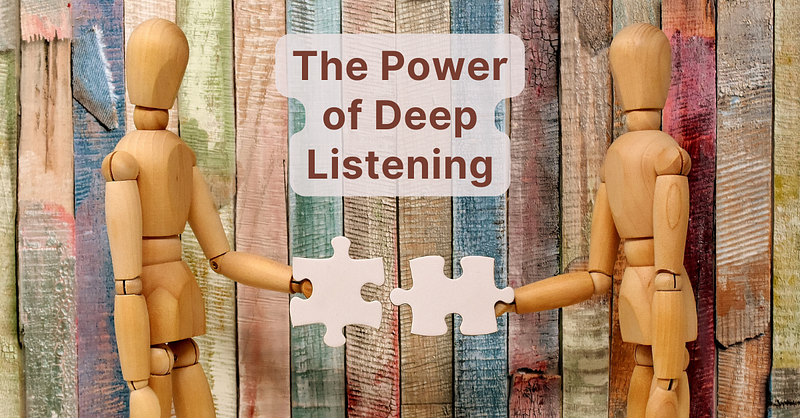
There are at least three different levels of listening. Most of us are primarily operating at the first or second level in our day-to-day lives. It is this third level that has the greatest rewards, and not just for your conversations.
A journey to deeper listening
When I first moved to the UK twelve years ago, I wasn’t entirely sure what I was getting into. I knew where I was going, but I hadn’t really looked at the map and thought things through in a present, considered way. As a result, I didn’t notice much of anything around me and I didn’t think to ask.
What I truly didn’t prepare for was the weather. I failed to note the latitude I was aspiring to. Nor the oceans, winds, and their relationships to the jumpers in all the shopfronts warmly suggesting their wisdom which I did not heed. This is how — owing to an unfortunate series of escalating events — I found myself that first winter of 2010 wandering in a blizzard up Hull road in old York, clutching a bag of wet summery clothes, pondering whether I was marching toward my completely preventable and nonsensical death.
Reader, I survived and bought a winter coat.
The struggle in everyone’s story
A lot has changed since then. As I acclimated to my new surroundings, things that were once unknown, uncomfortable and a struggle have become unremarkable, commonplace, done with ease.
In between then and now, there was a long period of time when I wondered why everything was so difficult. I knew there was something I was missing, but I wasn’t sure what. I wanted to know. I wanted to see what others didn’t. I wanted to be on top of my game.
As this desire got stronger, I grew quiter. And in that space, a sort of noticing flourished.
Everything was a story of sorts. And every story had a secret struggle. The things not being said.
My own was about getting over myself. It was about slowing down, quieting to notice things. To learn to listen. To not just the large warning signs, but also the nuances. And when I did that, not only did I become more comfortable, prepared, and at ease, but I increased my capacity to hear others and help them sit with their struggles too.
It was there and then that my listening journey truly began.
The three levels of listening
We learn the basics of listening and conversational turn-taking at a very young age. At that same time, we are also acquiring a huge amount of social knowledge about language and its use. In sociolinguistics, this is called pragmatics. These language skills develop without much conscious attention paid to them and we may or may not take notice of the benefits we gain as we level up in these areas.
Listening is much the same. We learn how without overt instruction and we can improve with little conscious effort. However, if we want to increase our skills — and reap the benefits of that investment — we must learn, notice, and practice listening at deeper levels than where we are currently comfortable.
Below are the three basic levels of listening. Where is your current comfort level? And in which situations or contexts might you already be listening more deeply?
1. Listening to respond
Also called ‘listening to speak’, this level is the most natural for us. Listening at this level is self-focussed and there is an internal dialogue going on, but misunderstandings may occur or participants may not feel heard.
2. Listening for information
Also called ‘listening to hear’, this level is more active, where we are free from distractions and intently focussed on what the other person has to say. To become a great listener, learning to not be selective about when or to whom you apply this type of listening is a great first step.
3. Listening to understand
This is a fully active type of listening, requiring practice over time. With this level of listening, you not only take into account the words being said, but the full meaning and the environment and context, to gain a deeper sense of the other person’s thoughts, feelings, wishes and expectations.
Getting to these higher levels of listening (and staying there) is a real challenge. Not only does it involve acquiring new skills, but listening to understand means that the stream of input is much greater. You have to filter that extra context and information, while you’re still trying to maintain a conversation.
It is surprisingly hard at first, but gets easier over time. And of course, the benefits you gain from this make the effort worthwhile.
When I started coaching others and first learned about these three levels of listening, I struggled with them in a very specific way. I thought that deep listening had to do with taking in all the information and making the other person feel heard by reflecting back what they said or asking an insightful question.
The challenge I faced is that after about only two minutes of doing this, I could no longer hold onto all the information they provided in my head, nor all my possible responses to that information.
However, by drawing my attention back to others, I realised that it wasn’t necessary to ‘prove’ I was listening, to reflect back something said five thoughts prior. The listening could speak for itself.
If you’re filling your head with your thoughts, you’re not making room for the insights of others. The solution is to hold all the thoughts in your head lightly and let them go as needed.
More importantly, deep listening means staying with the person in the current moment, not in your head with your own ideas. This is partly about building self-trust— when you believe that you can always respond based on what was just said, you have no need to hold onto anything. It’s just a distraction.
Lastly, while listening to understand is incredibly important, it isn’t always required for every situation. Becoming a better listener involves not only knowing how to listen deeply, but when.
The wisdom you get when you learn to listen deeply
I realise now that I may have lived my life never sinking through the surface of what listening really is. There are depths to conversations I rarely experience in my day-to-day interactions. Perhaps this explains my trusty crutch of ‘having a bad memory’ — it’s very hard to recall details if you weren’t really hearing them in the first place!
When you practice listening at deeper levels you notice that it get easier to listen, everywhere, all the time. Not at first of course. The trade-off is that it gets infinitely harder to multi-task. It’s an impossibility; and the reality is that nobody ever truly multi-tasks. That’s a good thing.
With deeper listening, here’s what also doesn’t happen anymore:
- Checking out of a conversation
- Misreading what is being communicated (in a big way; small misunderstandings will still happen)
- Letting yourself get maxed out on people and talking
- Being unaware when you can’t listen. For example, if you have limited capacity or are over-tired.
Here’s what you gain instead:
- Learning how and when you can be social
- Feeling better about what you communicate to others
- Greater assurance that you’ve read things right
- Doing better, more thoughtful work
- Quieting your mind
Deeper listening has benefitted me personally as a coach, a partner, and friend. I spend more time focussing on the person I’m supporting, rather than the problem they’re having. I can let go of judgement and create spaces for people to open up and speak more freely. I’m clearer about what’s expected of me and I feel more confident that when I do speak, what I have to say is relevant to the person I’m connecting with. As a result, my relationships are deeper and more fulfilling.
The path to deep listening
Like most things, time and practice will get you there.
It was over a decade ago when I spent my first several months adjusting to my new life in the UK, feeling completely overwhelmed by the experience. The British people all around me were speaking my language, but with differing accents and words I’d not heard before.
It took time to make sense of it all. It took practice to hear the new sounds, learn what sorts of things their nuances were telling me, and be able to use that information to connect with people more deeply. I leaned on the moments when I had greater capacity; that’s when things became easier and noticing came naturally. I gave myself space when I was deep in the struggle.
Which is to say, listening to yourself and learning from your story so far is a great starting point. This is true for any journey you may go on.
Here’s three takeaway questions to help you get started:
- When is it easiest for you to listen to understand?
- When is it hardest?
- What do you notice about that?
Kim is a life-long overthinker who has overcome many challenges to turn her mental energy into a super skill for getting things done and feeling great about it. She’s on a mission to help others do the same. Join the expert thinkers who are gaining clarity and focus with weekly insights in the Hold That Thought newsletter.