
If You Live in the Suburbs, You Are Contributing to Climate Change
Unfortunately, no matter what you do, the very fact of living in the suburbs is disastrously harmful to the planet.
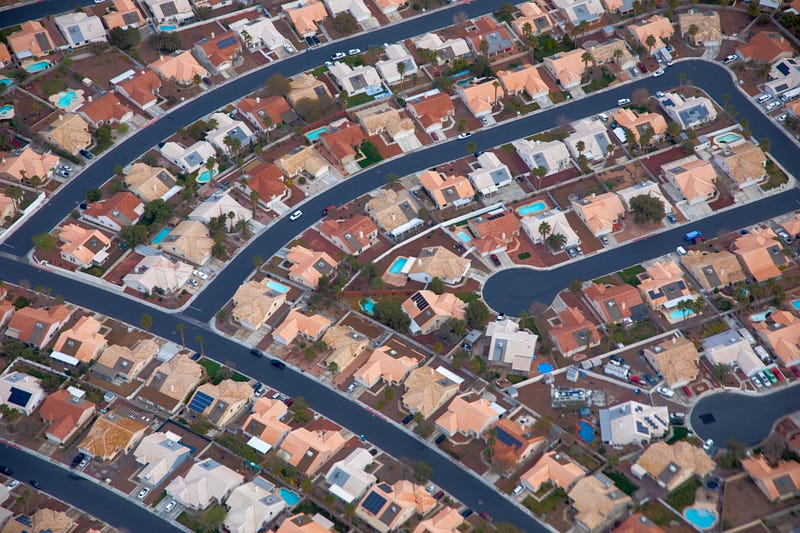
Do you live in the suburbs? Do you live in a single-family home surrounded by a green lawn in a planned development community that consists of other single-family homes surrounded by green lawns? Do you need to get in the car in your garage to go absolutely anywhere? Do you think that you are helping to fight climate change by driving an electric vehicle, recycling, composting, installing solar panels on your roof, and living a “green lifestyle?”
Unfortunately, no matter what you do, the very fact of living in the suburbs is harmful to the planet. Suburbanization and urban sprawl are unsustainable and have historically played a major role in creating climate change, much to the chagrin of suburbanites all over the world.
While the racial history of suburbanization has thankfully been receiving more attention as of late (e.g. white-flight, red-lining, zoning, etc.), the ecological and environmental damage of suburbanization continues to receive scant attention. Suburbanization and suburbia, as processes of urban design and forms of living, are wholly incompatible with all efforts to seriously mitigate climate change.
Based on sprawl, or spreading out across ever increasing expanses of land, suburbanization is unsustainable and harmful to the environment. Yes, many major cities around the world were originally built by draining and transforming swamps and marshes and destroying local flora and fauna — not to mention the genocide or forced removal of indigenous peoples at the hand of settler-colonialists who treated them as though they were part of the local flora and fauna — but at least cities have density. Land, thus, is shared by many more people, as are resources. With the advent of suburbanization, however, private developers and advertisers began to sell people a new lifestyle, a lifestyle that was embraced by the US government and used as propaganda known as the “American dream.”
To sell people this dream, private developers — many of whom received public subsidies — began to build horizontally outward from city centers instead of vertically upward. In so doing, they repeated the same ecocide that many large cities committed centuries ago, but on a much larger scale, simply in order to sell single-family homes to people.
Along with this comes all of the infrastructure required for Americans to live there, including roads and highways, sewage, water delivery and treatment facilities, electrical and telephone wiring, not to mention the climate control for each individual house and the automobiles required to move about. Each home built needs to be connected to this entire system, often requiring that this system grows at a massive scale to service all of the homes that sprawl across huge expanses of land that has come to be known as suburbia.
Where each home currently stands, complex ecosystems once flourished. People may also have been part of this ecosystem. To add insult to injury, many of these homeowners have replaced these rich ecologies with unimaginative, rote green lawns (an unfortunate holdover of the landscape design of eighteenth century British country homes); by some estimates, nearly one third of all water in the US is used to water these lawns, merely so that they look green. Saying that this is a profound waste of water is an understatement, especially given how many parts of the world, including in the US, are experiencing severe droughts.
Many of these areas that have been suburbanized are finally facing an ecological reckoning. Most of these suburbs should have never been built in the first place, as many of them are located in areas that are increasingly vulnerable to hurricanes, floods, fires, extreme heat, earthquakes, and drought, all of which are becoming more severe, in part, because of the ecological destruction they are founded upon.
In Florida, for example, developers today even have the gall to completely wipe out entire ecosystems where they want to build and sell homes and then carve out human-made “nature reserves” within these planned communities. It is a testament to the power of advertising and marketing, and the “American dream” propaganda machine.
While there are many other critiques that have already been leveled at the suburbs, such as how they have sucked many financial resources out of cities for eduction, social services, and public transportation, further impoverishing the mainly Black and Brown folk who were not originally offered a ticket to suburbia, or how the suburbs are dreary, drab, and dull places, but the purpose of this article is to shed some light on the toxicity of suburbia in terms of the environment and climate change.
So for those of you currently living in the suburbs, all of the low-hanging fruit (e.g. EVs, solar panels on roofs, recycling and composting, etc.) will not help to combat climate change. The very fact that you live in the suburbs is a far larger problem that can only be fixed by a major structural change in the way millions of Americans live. Instead of investing in short-term fixes that, at best, may help to barely slow-down the worst of climate change’s impacts on the planet, we must invest more boldly and more seriously in ending and even reversing suburbanization.
Ecologies are resilient and they can once again thrive in these places that are now suburbs but hopefully in the (near) future will be devoid of ecocidal human intervention. We should incentivize people to leave the suburbs in favor of existing and new dense cities. And to those who do not view density favorably, it is because they have not yet experienced properly managed density and cities, which are humanity’s greatest invention. But if low density is what they really want, then they must live in a way that is not harmful to their surroundings and the environment, (and there are, indeed, many notable examples of this, such as the Naturhus in Sweden). Doing away with suburbs entirely is required, along with many other difficult yet fundamental structural changes in the way we live, if we are to have any chance at all at surviving on this plant.


