
If You Have Writer’s Block, Try Changing Your Tool
The tools you use affect your thought process
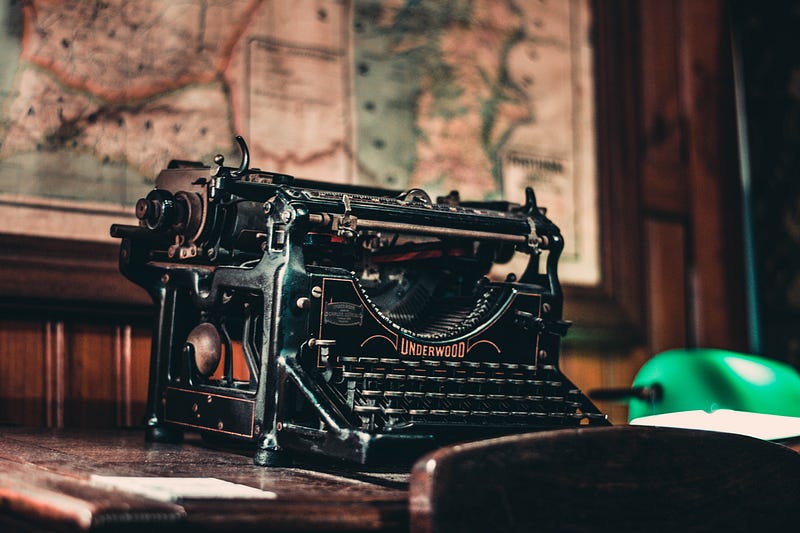
If you are a writer, you are most likely to have experienced a period when you felt your imagination finally ran out or when you struggled to put your thoughts into words. You can try many different things to break the mental block, such as having a break from writing, trying writing in a genre you have not written, rewriting what you have written before, and so on.
But, how about our writing tools? Most writers probably use a computer as it comes with many handy instruments such as spell checkers, predictive text, and formatting tools. It is also conveniently connected to the internet if any research is needed. But trying a different tool may also break your mental block.
Tools and thoughts
The correlation between tools and thought is not easy to demonstrate. But Nietzsche noticed the link as early as the late nineteenth century after he started using a typewriter called writing ball at the time. He wrote (quoted in Kittler, F. A. (1999) Gramophone, Film, Typewriter),
our writing tools are also working on our thoughts
T. S. Eliot (The New York Times (25 September 1988)‘ANYTHING I WRITE IS GOOD’: LETTERS OF T.S. ELIOT) also noticed the change to his writing style in his poetry when using a typewriter. In 1916, he wrote to his poet friend Conrad Aiken that
Composing on the typewriter, I find that I am sloughing off all my long sentences which I used to dote upon. Short, staccato, like modern French prose. The typewriter makes for lucidity, but I am not sure that it encourages subtlety. . .
I use a typewriter from time to time, not as the main writing tool, but as a positive distraction from my writing. I noticed that as soon as I start typing on my typewriter, the dam bursts and the words start flowing again. These words may not be what I want to keep but they break the block. And that’s a good enough reason for me to use my typewriter from time to time. Normally once I start getting my ideas again, I switch to my laptop and continue.
I don’t know the reason for this. But it may be to do with the speed of transcribing. As the typewriter is still cranky to me, it slows me down. My antique mechanical machine cannot keep up with my flowing thoughts, whereas my laptop is often almost synchronized with my brain.
Perhaps when my fingers are on the keyboards and nothing to type, it frustrates my brain, creating a vicious circle called writer’s block. On the other hand, as the typewriter is always behind my thought, only my well-thought ideas get transcribed, which keeps the words flowing.
This is just my observation, not based on scientific theory. But it works for me. I also agree with Eliot about the language becoming lucid and short. This may not necessarily a good thing if that’s not the style you’re aiming for. The reason for this is, perhaps that as my brain accumulates more ideas, I try to put all down as quickly as possible to keep up with my brain speed. Thus the language becomes short and concise as if taking notes in a lecture. Again, this is just a guess, but it works to get me back into writing.
I don’t know if my writing tools are really affecting my thoughts. But it affects my writing style, which helps organize my ideas.
How about a good old mighty pen
I admit I have not used a pen for years except when I fill in a health survey at a doctor’s office. But the children are still encouraged to take notes in a class for learning benefits. P. A. Mueller and D. M. Oppenheimer (Psychological Science (2014); The Pen Is Mightier Than the Keyboard: Advantages of Longhand Over Laptop Note Taking) examined the different cognitive processes between note-taking using a laptop and a pen. They found that
participants using laptops were more inclined to take verbatim notes than participants who wrote longhand, thus hurting learning.
They continued to explain
longhand note takers engage in more processing than laptop note takers, thus selecting more important information to include in their notes, which enables them to study this content more efficiently
This is similar to my earlier assumption about typewriters— Typewriter is slowing me down, thus the writing becomes more concise. The slow process is making me study my ideas more efficiently, thus braking my mental block. By using a pen at school, the children are actually processing and digesting the new knowledge while writing down.
Calligraphy
I’m sure calligraphy is not the most favorite or practical way of writing a story today, but the philosophy of it may help us break the writer’s block. A renowned Zen monk and teacher, Shunryu Suzuki (Weatherhill, Inc (1970); Zen Mind, Beginner’s Mind) wrote
The Zen way of calligraphy is to write in the most straightforward, simple way as if you were a beginner, not trying to make something skillful or beautiful, but simply writing with full attention as if you were discovering what you were writing for the first time; then your full nature will be in your writing. This is the way of practice moment after moment.
His teaching goes on to explain the importance of nothingness. When you write, you need to be free from unnecessary thoughts and simply let your true mind come out. This is easier said than done. But typewriter, pen, or calligraphy, the idea is similar — to remove any needless thoughts and find the true sense.
The art of calligraphy is fascinating and it’s well beyond the scope of this article. But it involves making the ink, right posture, breathing, and mental preparation as well as brushing techniques. These routines may help you you set in the right frame of mind for your writing.
Final thoughts
Many writers probably own at least one typewriter as we feel nostalgic about it. We perhaps inherently know that it brings our true nature, or a modern keyboard is not quite satisfying.
For many, writing is an art form which naturally takes time to accomplish. A laptop is an amazing thing but should never exceed our minds. A predictive text sometimes shows up even before my mind thinks. While it’s useful, it may be distorting our thoughts causing mental congestion.
If you feel you are not in the right frame of mind, try slowing down the transcribing process by changing your tools. Take out your typewriter or find that lost fountain pen in the drawer. If nothing works, there is always chisel and stone.