If you have a fear of rejection, read this
Imagine this…
You are sitting in the audience as part of a live studio recording for a television talk show.
Leading the panel is one of your favourite hosts.
He’s why you came today.
The cameras are rolling. The lights are bright, and the air is studio-sterile. The debate among the guests is interesting and light-hearted for now. The audience is in high spirits, laughing; engaged.
You feel a sharp nudge in your right side. It’s a gun. The man to your side tells you to get on the mic, live on TV, and declare your love for picking your nose and eating the boogers, or he’ll shoot you and the panellists.
Would you be nervous?
Would you fear criticism; public ridicule; rejection at this point?
Of course you would.
It is normal to fear criticism for things that are obviously socially unacceptable.
The thing is, for some of us, we experience anxiety in perfectly normal situations.
Nervous around other people.
Anxious to call someone up or ask for a raise.
Worried about a presentation.
Hesitant to ask someone out or strike up a conversation with a stranger.
Fearful of sharing and promoting one’s art.
These fears are over-blown and, though it is normal to feel some nerves, being completely avoidant and unnecessarily anxious is not necessary.
It stops us from reaching our goals and our potential.
It stops us from living free, expressive, playful and happy lives.
We have shame when there is something about what you’ve done that you think is not socially acceptable.
Something led to you judging yourself harshly for not living up to some standard you set for yourself.
Some shame is normal, but when we allow our self-judgement to define who we are, that’s when it can get tricky.
This is often the result of repeated negative self-criticism, even if the initial stimulus came from someone else.
This is what some psychologists would call ‘toxic shame.’
It is taking our mistakes and making them a part of our identity.
Rather than saying: ’I did a bad thing,’ which is something you can get past, you would instead say: ‘I am a bad person,’ which festers in you.
I’ve struggled with this.
I was shy and barely spoke at school and was criticised for it. It made me dislike this part of myself immensely. It made me view myself as inadequate.
When we view ourselves as not ‘normal,’ we feel we need to keep secrets, so as not to ‘blow our cover’ in front of others (that is shame).
When we keep hiding our perceived flaws, bottling them up, they persist and sometimes grow.
Hiding what we dislike about ourselves creates tension, which manifests as being withdrawn, anxious and depressed.
This anxiety leads to a very constricted and avoidant life.
This needs to end. It is no way to live.
To understand how to unravel this shame, and live healthy lives again, let’s first unpack why it is that we fear rejection.
We fear it because we are social beings, and don’t want to be banished from our communities; from other people.
Whether we want to admit it or not, we regard social ties as extremely valuable.
When we perceive ourselves to be doing things that are potentially socially unacceptable, there is a higher risk of rejection.
That’s why we feel nervous.
It’s all subjective.
If we view ourselves as inherently worthy and good, we will not fear rejection as much as someone who holds the negative view about themselves.
Make sense?
If we believe ourselves to be bad in some way, we fear rejection more, because we believe in the risk. It is right there in front of us.
The risk is real, and it is terrifying. So we get anxious, or we avoid the experience entirely.
If, for example, you believed yourself to be an inherently awful person, you would fear public speaking more than the guy who only had a couple of surface-level doubts about themselves.
When we truly love ourselves, we have less to fear. Less to lose. Our identities are not reliant on keeping secret our perceived flaws.
If we hate ourselves and attract criticism, that is confirmation of our negative identity — our poor self-image.
They say: ’your art is bad,’ but we hear: ‘you are bad.’
It’s no longer the act that’s getting criticised. It’s the denial of our very soul.
This will hurt like hell.
It hurts so much because we believe the rejection to be real, and we think it to be about ourselves.
This is rarely spoken about. This is the crux of the problem. But it is also the birthplace of the cure.
Rejection seems like more of a risk when we believe our very identities to be worthy of dismissal.
If we like ourselves and get rejected, nothing changes. There is nothing to confirm. You are simply you — a good person.
Do you see the power in understanding this?
This is why some people don’t seem to ‘give a fuck,’ and others, well, really do.
Those who truly don’t give a fuck genuinely like themselves.
It makes sense, then, that to heal, we need to shift our view of us as bad or inadequate, to the other side — that we are good; acceptable; ‘normal’ people.
We need to view ourselves as good; as worthy, and we need to believe it.
That’s it.
How to do that?
We need to change our self-image.
When we have overblown shame, it is because of our crappy self-image. It’s the identity we have crafted through years of negative self-judgement.
We need to apply the same ‘technique’ we used in building up a negative picture of ourselves, to creating a positive self-image.
And we do that through words, images and feelings.
They all interconnect. To keep it simple, I focus on feelings.
Yes, feelings seem lame and woo woo.
But feelings are what solidified your shame and self-doubt in the first place.
When you associate negative feelings with yourself in certain situations, this will inform the mental imagery (and language) you link to yourself in those environments.
They are like a patchwork of memories, real or false — it doesn’t matter. We hold them in our minds because they have been charged emotionally — with feelings.
To create positively-charged images in our mind, we start with this: a simple daily meditation.
Meditate on loving yourself. Start by noticing the feelings and sensations in your body. Let them reveal themselves to you.
Then, direct feelings of warmth; acceptance; love towards you. Let them appear, grow and spread.
You might also say the mantra ‘I love you’ repeatedly in your mind as you imagine yourself — your outline.
Feel the feelings of love wash over you.
You need to associate good feelings with YOU.
Doing this will slowly rewire your brain.
This is what will create a healthy self-image over time. Don’t get hung up on the technicalities of it all. You need to feel good about yourself again.
This will lead to you automatically finding positive pictures and memories of yourself again, and it will also construct new, positive imagery from scratch.
“Your nervous system cannot tell the difference between an imagined experience and a ‘real’ experience.” Maxwell Maltz
These images will gradually form a new mesh in your mind. This is your new, healthy self-image.
This is what will heal your shame. Other things will help too, like physically facing your fears incrementally, but this is the place to start.
Cheesy?
Maybe.
Does it work? Yes. Over time. It needs practice.
It needs repeating. Just like you repeatedly berated yourself over the years, you need to repeatedly love yourself to erase the negative and populate your mind with the positive (though it doesn’t need to take anywhere near as long!).
Start with the commitment to love yourself again. Then do this daily meditation for at least ten minutes every day for thirty days. Then keep going.
See how it changes you.
Write to me to tell me how it’s working.
You will start to feel better about yourself. And when you do, your fears surrounding criticism will begin to lose their hold.
Because why should they?
If you are an inherently good, loveable person, who cares whether someone else judges you?
That’s the trick.
Welcome to freedom.
See you on the other side.
—
Do you want to be mentally stronger than most people?
If you enjoyed this, you will love my free illustrated booklet for you:
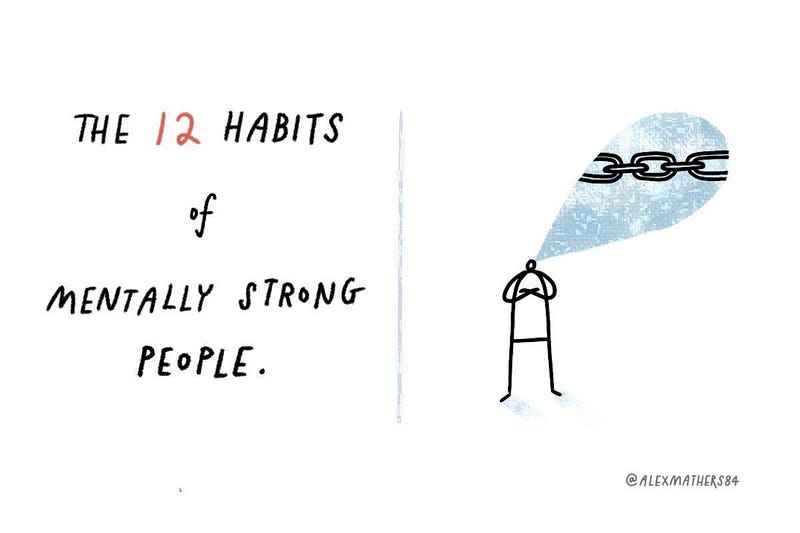
‘The 12 Habits of Mentally Strong People.’
Yours free today for a short time, when you subscribe to my Substack newsletter.