
If You Are on a Path of Deep Transformation, Be Sure to Ask Yourself These Ten Questions
Number 5: Am I trying to escape?

Maps are not the territory. This we know. But, even so — maps, pointers, and wise guidance are crucial when you are on a path of deep transformation. (Especially if you don’t have a dedicated spiritual teacher, which is the case for most of us nowadays.) So to check I am heading in the right direction with a healthy perspective, I regularly ask myself the following questions.
Four are inspired by the Einstein of consciousness, Integral Philosopher Ken Wilber. One is drawn from the work of master-synthesiser, Wait but Why’s Tim Urban. One comes from the originator of the idea of Unividualism, Philosopher Tim Freke. One is from Vedic philosophy (specifically the Taittiriya Upanishad). And the rest are sourced from wise guidance I have picked up over the years.
Here are the ten.
1. Am I routinely experiencing the wow in life?
Whenever I get too absorbed in the day-to-day routine, I go out into nature and look at a tree or a field or across a lake and remind myself of the fundamental mystery of life. In fact, the two fundamental mysteries.
There is something rather than nothing.
We humans are conscious of this something and aware that we are so.
Reflecting on this gives me that wow moment. Just wow. And I am back, connected.
Key takeaway: If you are not routinely experiencing the wow factor in life, you are probably off course.
2. Am I becoming a better human?
What you see below is a map showing the stages of human development (taken from Ken Wilber’s work). Both from a societal perspective and an individual perspective. It is not made up. It is real and based on heaps of research.
For a really good summary of developmental stages, see this article: An Overview of Developmental Stages of Consciousness
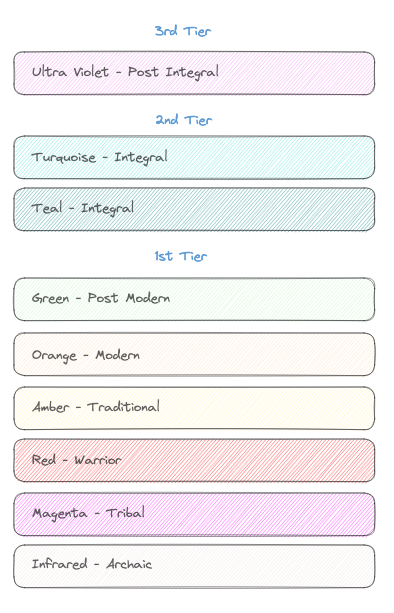
All of us humans have the potential to grow through these stages and become better humans. As a society, we have grown up through Archaic, Tribal, Warrior, and Traditional. And we are now fighting it out between Modern and Postmodern. (Read as right vs left, if you want).
As individuals and as a society, we need to get to 2nd Tier, Integral. Otherwise we are, likely, doomed. Before 2nd Tier, we reject and fight against the other stages. When we get to 2nd Tier and above, we stop fighting and, instead, accept and embrace the other stages. No more fighting. More peace. More love. More ability to progress.
It looks from the diagram like there is just one line of development. But, actually, there are several, for example: visual-spatial, linguistic, interpersonal, logical-mathematical, kinesthetic, and naturalistic. So you can grow and transform along any of these lines.
There are numerous practices to get from where you are now (which is likely 1st Tier) to 2nd Tier. We need to do these practices.
I’ll leave it there. But there is much more to say about this map.
Key takeaway: The above developmental map is real. All of us humans have the potential to grow through these stages. As individuals and as a society we need to get to 2nd Tier. And fast.
3. Am I seeing the whole picture?
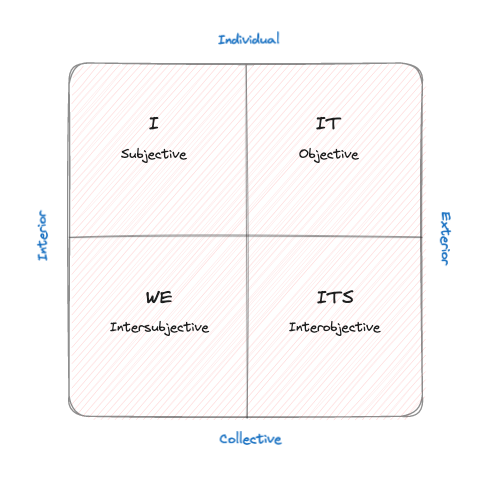
Here’s another from Ken Wilber. The four quadrant model. It’s a bit of a hike through it, but if you bear with me I think you will see that this simple model is of immense value. It goes like this.
The Universe is made of holons. A holon is something in its own right, contains subordinate parts, and is part of a larger structure of holons. In other words, a holon is a whole, a part, and contains subordinate parts. So it’s holons all the way up and all the way down in what has been termed a holarchy (as opposed to a hierarchy). Examples of holons would be atoms, molecules, cells, organs, humans, families, and cities.
The above diagram applies to all holons. Holons as individuals have an interior and an exterior component. A collective of holons also has an interior and exterior component.
To give an example. Let’s apply this to humans living in a society of humans. The following is what would appear in each of the boxes.
- Individual, interior (top, left): Values, thoughts, feelings, self concept
- Individual, exterior (top right): Behaviour, appearance, body language, and tone of voice
- Collective, interior (bottom left): Shared values, culture, paradigms, and ethics
- Collective, exterior (bottom right): Systems, structures, laws, norms, social interactions
Why am I telling you all this?
Because you can use the four quadrants to check if your perspective is too narrow. For example, if you think that the material world is the only reality, your truth is only partial. You are excluding the interior perspective. On the other hand, if you think that your subjective inner experience is the only thing that is real and true, you are stuck in the individual interior quadrant and excluding the other quadrants.
Key takeaway: If we are convinced we are right about something, it is useful to check against this model. We are likely right, but also likely only partially. And it is the same for everybody else of course.
4. Am I seeing myself as a victim?
When I start blaming others. Or ruminating on their perceived wrongs. Or their faults. When I say things like: Just my luck. Or mutter internally: Why me? I am a victim.
And whenever I am seeing myself as a victim, I am hopeless and helpless and powerless. And I am forgetting that…
Life doesn’t happen to you, it happens for you
Whatever happens in life, you can use it to learn and grow and become a better human.
Key takeaway: Life doesn’t happen to you, it happens for you.
5. Am I trying to escape?
In meditation, I often find myself subtly trying to get somewhere else. To get out of this place. Out of this body. Anywhere, just not here. Any place, just not this place. Doing something else, just not this.
This effort, whether subtle or not, is futile, counterproductive, and is not what meditation is about. Meditation is about being here and now in the present moment.
And, anyway, there is no escape hatch. This is it. This is your life. There is nowhere to go. This is you.
Key takeaway: There is no escape hatch.
6. Am I staying open and curious?
Have I closed down? Do I think I know something for sure? Am I in some discussion and arguing my side with vigour and certainty? Hm, suspicious.
Whether we like it or not, our mind is conditioned by our biological makeup, our upbringing, our close society, and our world. And in the end, we are seeing the world through this conditioned mind.
I have often bragged to myself and anybody who will listen that I have gone beyond my conditioning because I left my religious background and country of birth. But I couldn’t be more wrong. And life is very quick to remind me of this fact.
It is almost impossible to not see the world through the conditioned mind. But what you can do is try to stay open and stay curious. Have “beginner’s mind”.
As Japanese Zen master, Shunryu Suzuki said:
In the beginner’s mind there are many possibilities, but in the expert’s mind there are few
And as Greek philosopher Socrates said:
The more I know, the more I realise I know nothing
Key takeaway: Stay open and curious. Aim to have beginner’s mind.
7. Is my transformation journey including all aspects of growth?
The transformation journey has many aspects. Ken Wilber captures it beautifully with his framework: Wake Up, Grow Up, Clean Up, Open Up, and Show Up.
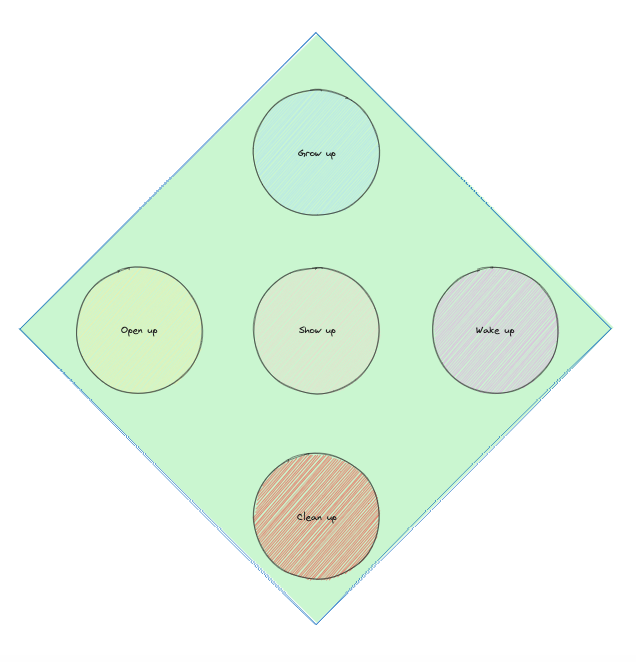
- Wake Up: This is about recognising the non-dual awareness at the core of our being.
- Grow Up: This is about moving through the developmental stages to 2nd Tier and above (see Am I becoming a better human above).
- Clean Up: This is about working with our shadow. The shadow is the part of us that we deny and then push down.
- Open Up: This is about emotional fluidity and sexuality.
- Show Up: This is about taking everything you have and showing up in the world for the benefit of others.
To read more about these aspects, this article is excellent: Wake Up, Grow Up, Clean Up, Show Up. (Open Up came later, that’s why it is not included.)
Key takeaway: In your transformation journey, make sure you are covering all aspects of growth.
8. Am I confusing states with stages?
It can be that you have an amazing bliss-filled meditation session. A feeling of connection to everything. Compassion for the suffering of the world. A Satori experience even. Satori being a glimpse of truth or a sudden moment of awakening. But all these are just states. They will pass. States are not to be confused with stages.
Stages — we are back to Wilber’s developmental model above. Stages are permanent shifts. When you reach a certain stage, you are there and you don’t go back.
Key takeaway: Enjoy your blissful states, but don’t confuse states with stages.
9. Am I being too human-centric?
Humans have not been around for long. Quoting Tim Urban from this wonderful article: Putting Time in Perspective.
If the Earth formed at midnight and the present moment is the next midnight, 24 hours later, modern humans have been around since 11:59:59pm — 1 second. And if human history itself spans 24 hours from one midnight to the next, 14 minutes represents the time since Christ.
Here it is in a picture:
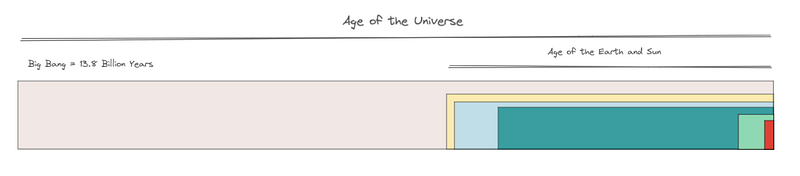
The age of the universe is 13.8 billion years. The age of the earth and sun is 4.6 billion years. That red box is the emergence of Mammals (200 million years ago). And behaviourally modern humans don’t come around until the very last tiny slither of that, 60,000 years ago.
Humans are also very small (compared to things like planets, stars, solar systems, and galaxies).
Our solar system is made up of a star, Earth plus seven other planets, and countless smaller bodies such as dwarf planets, asteroids, and comets.
There are 3,916 solar systems within our Milky Way galaxy.
It is estimated that there are roughly 200 billion galaxies in the observable universe.
Key takeaway: Continue your journey. You never know what you will discover. But keep perspective. Humans are small and haven’t been around that long. Also, see the two mysteries in Am I routinely experiencing the wow in life above.
10. Who am I?
This is the big one. I ask myself this one every morning at the end of my morning meditation routine. I can go deep. I can experience directly that I am pure awareness. But then I must not get carried away. I must remember that I am not only that. In Vedic philosophy, the 5 koshas (sheafs) describe it so well.
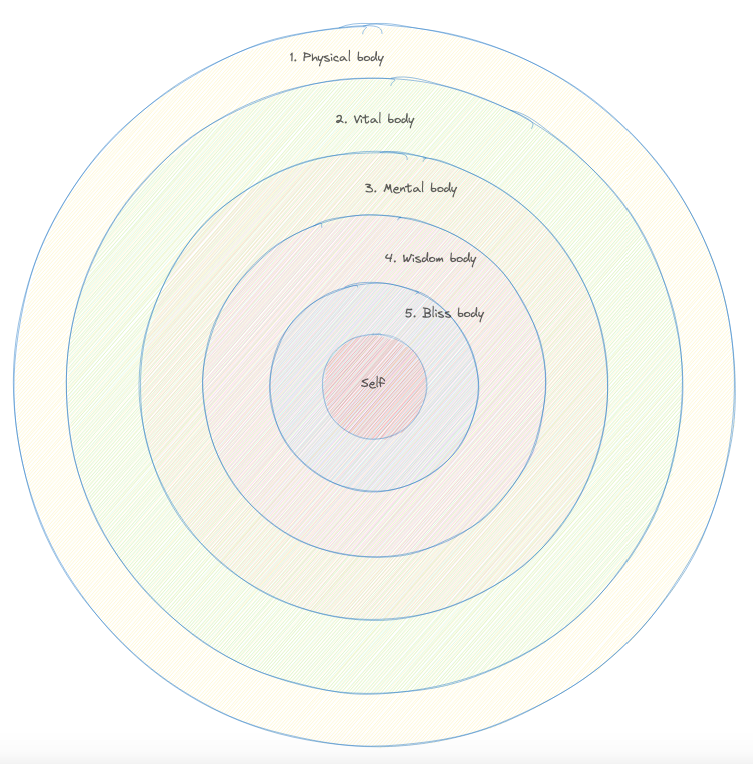
We are the physical body, energetic body, thinking and feeling body, intuitive body, and bliss body. And, according to the model — at the very centre we are Self with a large S or Brahma or God.
Key takeaway: Yes we are the awareness in which everything arises. But we aren’t only that.
And that’s a pretty good place to end.


