
If Women Really Want Equality, Why Men Still Do Dangerous Work?
Spoiler alert: this isn’t the gotcha argument some people think it is
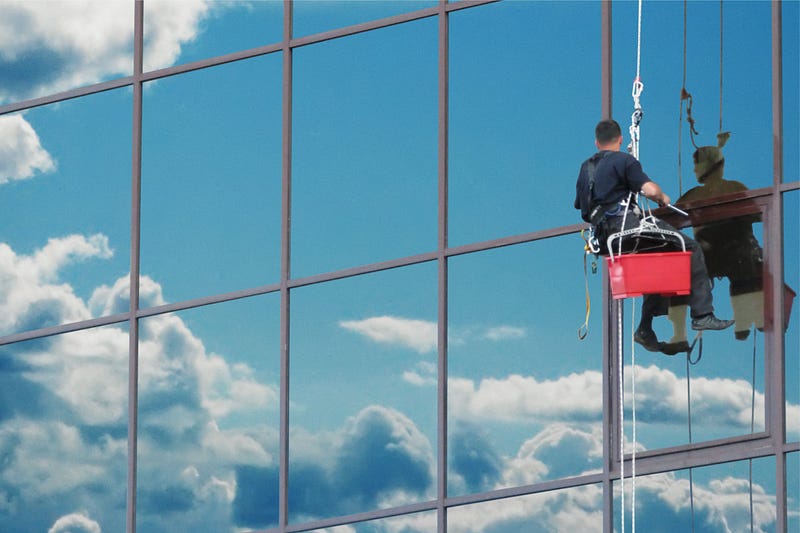
Whenever I talk about gender roles, there’s always at least one guy chiming in with a remark that ‘if women and men are truly so similar, then they should get their hands dirty instead of leaving all that to men.’
I even got a few comments like this on my latest piece about the myth of ‘Man the Hunter’ and the new research that disproves it in an attempt to… disprove that research.
Well. You got me there.
Clearly, our prehistoric ancestors just couldn’t possibly be egalitarian because we got to where we are today seamlessly and without having to resort to implementing legal, economic and cultural restrictions on women’s autonomy. Oh, wait…
However, this whole argument that women are unwilling to do hard jobs isn’t only used against the idea that gender roles are largely socially constructed but also against gender equality and feminism in general.
Because if we truly wanted equality, there apparently would be swarms of women flocking to collect the bins and work on oil rigs and dig up stuff in the mines. But we only care about it when it suits us, you see.
Right. And yet when you actually look at the current data on dangerous and demanding jobs as well as the history of those fields — and the workplace in general — it paints a different picture from the one set out by people convinced this is the ultimate anti-feminist gotcha.
Because it really isn’t.
Women do plenty of dangerous jobs, too
I’ve recently come across an interesting data analysis via Caroline Criado Perez’s newsletter Invisible Women — yup, she’s the author of the book by the same name.
The research was initially done by the Washington Post and focused on workplace injuries using the annual survey of 230,000 employers conducted by the Bureau of Labor Statistics in the US.
The good news is that, overall, Americans are getting less hurt at work.
But the bad news is that the number of occupational injuries from violent attacks — which include being shoved, choked, punched, kicked and bitten — has only been increasing in recent years. And that increase has come almost entirely in attacks against… women.
As per the analysis, the occupational groups that experienced the most non-fatal but still severe injuries are psychiatric aids, psychiatric technicians, teaching assistants, personal care aides, psychiatric aides and techs, elementary teachers and registered nurses. In short: people working in the healthcare and education sectors which are both heavily female-dominated.
I’ve met several psychiatric and personal care aides as my late grandmother struggled with a nasty case of dementia and depression for over a decade, and this, unfortunately, rings true. These are exceptionally mentally and physically challenging jobs that can oftentimes even be dangerous. And they’re performed overwhelmingly by women.
If you look at similar data in the UK, though, while both fatal and non-fatal workplace injuries have steadily declined for years, the rate of non-fatal injuries is now nearly the same for women and men. In the early 2000s, roughly 2.7% of all female workers and 4.5% of all male workers got hurt. But a couple of years ago it was only 1.6% and 2% respectively.
Now, while it’s true that fatal occupational injuries still most often happen in fields dominated by men — like construction or fishing — non-fatal injuries are as common, or even more common in countries like the US, among women. So clearly, we aren’t staying away from industries that are dangerous and require getting our hands dirty.
But if there were any injury statistics resulting from unpaid care labour — there aren’t, but globally, women still perform 75% of such work, which involves looking after the elderly and those with physical and mental illnesses — I’m pretty sure these numbers would be even higher.
Still, I have a hunch that none of the above is proof enough for people who say that ‘women don’t take dangerous jobs.’ No, the low rate of female blue-collar workers is all the information they need to shut down feminism forever.
But there are a few good reasons why that’s the case, too.
Male-dominated professions are still male-dominated for a reason
For most of human history, and across different civilisations and periods, both men and women worked.
In the last 10,000 years, that work was primarily related to farming.
True, peasant women also performed domestic labour, but this was by no means the only work they were expected to do. They did almost the same agricultural jobs as men did in the fields. And judging by the scores of farms headed solely by widowed or single women, that included the most physically demanding ones, such as ploughing.
But then the Industrial Revolution happened, and, well, things took a different turn.
Historical sources on women’s work back then are unfortunately not complete. However, we do know that many women worked in factories — especially textile ones — some worked in the mines, and some had their own trades. We also know they weren’t paid as much as men, and there were many obstacles to women’s employment — including lack of access to education and, in the case of unmarried women, lack of legal existence.
But then, as certain occupations became professionalised, women were gradually excluded from many of them, sometimes violently. For instance, Scottish female mule-spinners at some point even became targets of violent attacks of the male mule-spinners trying to reduce the competition in their occupation.
Several laws were also passed that further forced women to retreat from the public world and into the domestic sphere, including the Mines and Collieries Act of 1842 which prohibited women from working underground. Because, as its supporters claimed, women wearing trousers in the presence of men made them ‘unsuitable for marriage and unfit to be mothers.’
Despite all that, most working-class women continued to work, but only in the fields where they were allowed — in the kitchens, service, or fields. That briefly changed during the wars, of course, when women replaced men even in the most demanding fields like heavy industrial work.
But it’s just 50 years ago that women’s role in the economy actually began to change. That’s barely the length of two generations, by the way.
Many countries only allowed women to enter specific fields, like mining, in the late 1980s. Even today, over 90 countries continue to uphold legal restrictions on women’s employment — barring them from working at night and entering some professions — and worldwide, women have just three-fourths of the legal rights afforded to men.
Still, we’re now seeing an influx of women into traditionally male-dominated fields, including those with higher rates of fatal injuries.
For instance, in the US, women’s job growth in construction is now nearly five times faster than overall job growth in the field. In the UK, there has been a 138.3% increase in the number of girls and women enrolling in construction trade apprenticeships and a 366% increase in women entering trades in the last five years.
Only when women enter those fields they don’t just expose themselves to the dangers associated with the job.
They also expose themselves to the dangers of working in a male-dominated environment — including a statistically higher risk of sexual harassment and gender discrimination.
Things are looking up, it just takes time
It takes an insane level of brain worms to act surprised that there aren’t yet as many women in blue-collar jobs as men after men literally pushed them out of many of these professions up until — checks notes — mere few decades ago.
Or to claim that women never did any hard work or contributed to society and could just spend their whole lives in the comforts of their cosy homes lying down on big, fluffy sofas.
Most of your female ancestors likely ploughed the fields, Steve. But hey — if you want to see more women taking on typically male jobs, you can do plenty to help.
You can advocate for blue-collar environments to be more welcoming and inclusive of women since there are still many structural and societal barriers that make it difficult for us to enter them.
You can get involved in your local community and help with school programs or fairs encouraging girls to pursue nontraditional careers. And encourage boys and young men in your life to pursue nontraditional careers for men.
What’s that? Ah, yes. You don’t really care if more women enter those professions. Of course not.
But people who do and think it isn’t fair that yet another generation of girls and boys have to grow up feeling that they need to limit themselves and not pursue their passions just because of their gender have been doing all of the above and more.
And that’s precisely why we’re seeing an uptick in women joining male-dominated fields.
Still, although there seems to be a greater acceptance of equality today than 20 or 30 years ago, I don’t think there’s a true belief in it yet.
We continue to think of women as these unbearably delicate creatures incapable — or unwilling — of getting their hands dirty, which is evident in the way so many people dismiss care work as something light and easy and fun even though it’s not.
And we continue to think of men as tough and unfeeling machines who have to risk their safety simply because they’re men.
Neither is good.
The bottom line is that women are more than willing to do dirty, challenging and dangerous work.
But what we’re witnessing today is nothing new. If anything, women taking on those jobs represents a return to the historical status quo.
We can keep denying it, of course, or accept that women are an intrinsic part of the working world and make the adjustments necessary to support them as a part of it.
Similarly, we can make adjustments and support men who want to be stay-at-home-fathers or enter currently female-dominated industries.
Because it’s neither logical nor beneficial to divide the world based on largely socially constructed proclivities of men and women.
It’s anything but.
If you value my work and want to support it, buy me a cup of coffee! For more of my content, subscribe to my Substack newsletter or check out my other social media platforms.