
Why Hanging Is The Exercise You Never Knew You Needed
And how to do it properly and progressively
The older we get, the more immobile and inflexible we get.
Regardless of any parts of our body, there’s bound to be some sort of tightness that we’re feeling but most of us don’t address it consistently enough. We often look for an easy way out and even if a couple of exercise recommendations are provided, we continue to push them aside.
The reasons for this are plentiful and they make sense:
- Mobility doesn’t pay the bills
- “I have more important things to do than stretching”
- “I don’t have enough time to do any of these exercises”
As a 9–5 worker, I totally get it. The benefits outweigh the cons, at least in the near term. Many of these benefits can only be seen a couple of weeks, months, or even years down the line. Therefore, it’s hardly seen as an important thing we need to commit to each day.
Sometimes, there’s even a ton of exercises that fitness influencers throw at you by telling you that “All you need to do is X of exercises each day to stay fit FOREVER”. But none of them ever knows what you truly need.
All they know is they have a remedy for a certain problem, and you have to take the initiative to commit to it consistently over a long time.
For instance, if you have issues with a weak hamstring which results in lower back pain or knee injuries, you’ll have to strengthen your hamstrings and knees over time with a couple of bodyweight exercises. Or if you have tight hips, it’s best to do a couple of stretches that target your hips and support muscle groups to loosen those tight hips.
This will pay dividends further down the line especially as you grow older in the future.
But one exercise that most of us 9–5 workers can surely benefit from is: Hanging.
Here’s why.
What Does Hanging Help You With?
This exercise might sound simple and its benefits are anything but basic.
Hanging on the bar not only helps you to reshape your posture, and heal your shoulders, but it also decompresses your entire body. Just with the simple act of hanging on the bar and not having to do anything else, gravity will play its role here.
It decompresses the spine by using gravity to pull the hips away from the shoulders, creating space that are typically more compressed from the modern-day lifestyle.
- Strength Side
Since most of us have the hunch-over posture most of the time due to our sedentary lifestyle, it can help to reshape the bone structure around our shoulders and lats to allow them to move around more smoothly and freely without having that tight feeling anymore.
One of the most important benefits is it increases your grip strength which studies found to be one of the largest predictors of mortality.
This means that the stronger your grip is, the longer you’ll live.
And this makes sense right?
As you get older, your grip strength will weaken naturally since your body starts to degrade and you don’t exercise as regularly anymore. So when it comes time to grab onto something tightly with your hands, you might lose your grip, and bad things can happen.
The further plus here with a stronger grip is winning prizes at carnivals if you’re able to hang on them for a long time!
How Do You Do It?
This might sound as easy as hopping onto the bar and just hanging for as long as you can.
And the second part is probably true but the first part needs some fine-tuning.
The whole point of hanging on the bar is to allow gravity to do its work while you adjust your body such that you’re not doing much to get the most benefit out of this exercise. A couple of things you should keep in mind are that:
- Hands placed shoulder-width apart
- Keep a slight tension in the core
- Breathe through the discomfort
For anyone who has not done this before or is looking to get started with this, it’s best to know how to progress your way up to a dead hang or eventually a one-arm hang. With each progression, make sure you can hold that position for 20–30 seconds before moving on to the next progression.
Your progression could look something like this:
- Hanging with both hands on the bar (Supported) Keep both legs on the floor
- Hanging with both hands on the bar (Supported) Keep 1 leg on the ground and shuffle between each leg
- Hanging with both hands on the bar Keep both legs off the ground
- Hanging with one hand on the bar Keep both legs on the floor while shuffling your hands on the bar since your hand will give out much quicker this round
- Continue with the progression until you’ve reached the 3rd progression where you have 1 hand on the bar with both legs off the ground
This video by Strength Side explains it might be better and does this exercise justice.
This exercise can be done every day but be sure to keep it light so that you don’t overstrain your grip because it can lead to injuries as well.
Where To From Here?
The previous section merely talks about the passive action of hanging but the active action of hanging also has its benefits which is pretty similar to a previous article I’ve written regarding Controlled Articular Rotations (CARs).
In the active case, the goal is to gain better control of your scapular muscles and strengthen them so you can use them when you need to.
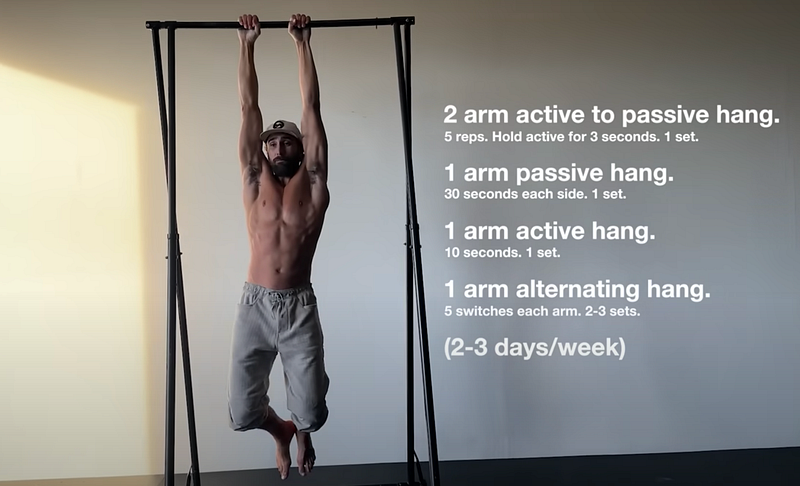
The best way to do this is to alternate between a passive hang to an active hang on both arms before slowly progressing over to a single-arm passive hang to active hang transition.
A typical dead hang session could go something like this:
Hang On Tight!
Exercising regularly with a 9–5 is difficult.
But doing a couple of bodyweight exercises each day that just takes a maximum of 10 minutes shouldn't be that hard. Imagine if you’re able to commit to this routine for 2–3 days/week for the next 3 months, think about how your shoulders, back and posture will feel.
You’ll definitely feel much better than you’re feeling right now. So go ahead and give this exercise a shot!
Join my newsletter to read my articles for free (no Medium paywall) and learn about functional training for longevity through my fitness experiments!
Consider buying me a coffee here!