
Imagine the Chaos if the Sun Disappeared
Imagine what would happen if our local star the Sun just disappeared.
British spelling!
The Sun started shining about 4.6 billion years ago and will continue to do so for another 5 billion years or more. The Sun is a ball of hot plasma heated by nuclear reactions in its core.
The Sun is the most important source of energy for most of the life on Earth, I say most because there is life in the ocean depths that don't depend on the Sun. Around hydrothermal vents, microbes eat nutrient chemicals that form the base of the food chain for more complex communities of organisms.
If you can use your imagination then you might find the next few paragraphs interesting.
OK, so the Sun just instantly disappeared, we would have no idea until just over 8 minutes later when it fell dark, really dark. That 8 minutes is the time it takes for light to travel the 149 million kilometres between the Sun and our planet.
No more bright moon, we are accustomed to seeing the moon shining in the night sky but of course, the moon has no light of its own, moonlight is just reflected sunlight.
Imagine a pitch-black sky with only the distant stars, that is how it would be 24 hours a day.
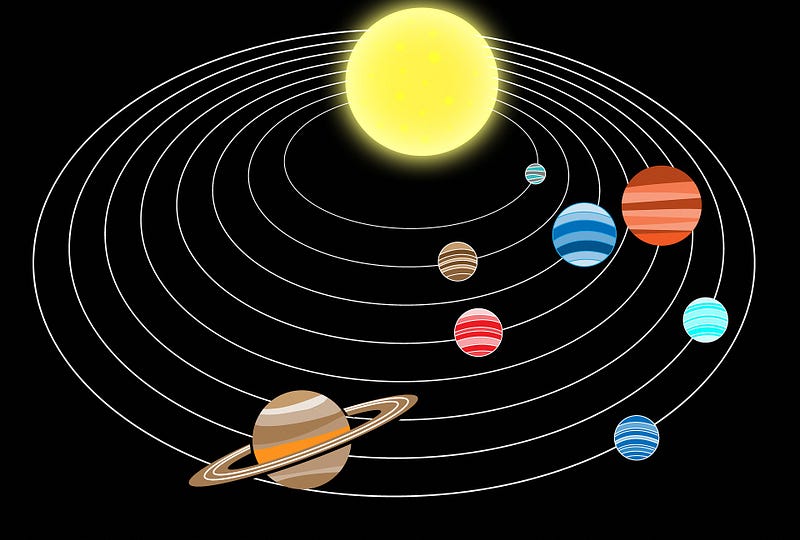
As you know the Sun is by far the most massive object in the Solar System, its gravitation force is the reason all the planets, dwarf planets, moons and all the other celestial objects orbit around it in organised paths.
Gravity waves travel at the same speed as light, and now it gets interesting. Without the Sun its gravitational force will also have ceased. Gravity waves also take just over 8 minutes to reach our planet, this is when planet Earth is released from the Sun's gravitational grip and speeds away in a straight line at 107,000 kilometres per hour.
Mercury and Venus are closer to the Sun so they will have gone on their straight paths before the Earth escaped. The other 5 planets will continue to orbit the position where the Sun was for a little while longer.
Can you imagine the chaos throughout the Solar System?
As the Earth cooled down and the surface of our oceans froze over, life would eventually come to an end. But remember the communities of life around hydrothermal vents deep on the ocean floor, they may survive for a very long time.
As the Earth travels aimlessly through space there could be a slight chance that in the distant future, it could be captured by another star and thaw out. What would be the chances of life starting again?
Back to reality. Primitive life on our world can be traced back at least 3.5 billion years, that is how long evolution has taken to produce the human species.
The Universe holds billions of galaxies each containing billions of stars with unimaginable amounts of planets. Surely there must be other life in that vast area we call the Universe, or could we be so unique that we are indeed alone?
We may never get a definite answer to one of the most important questions we ask, Are we alone in the Universe?


