
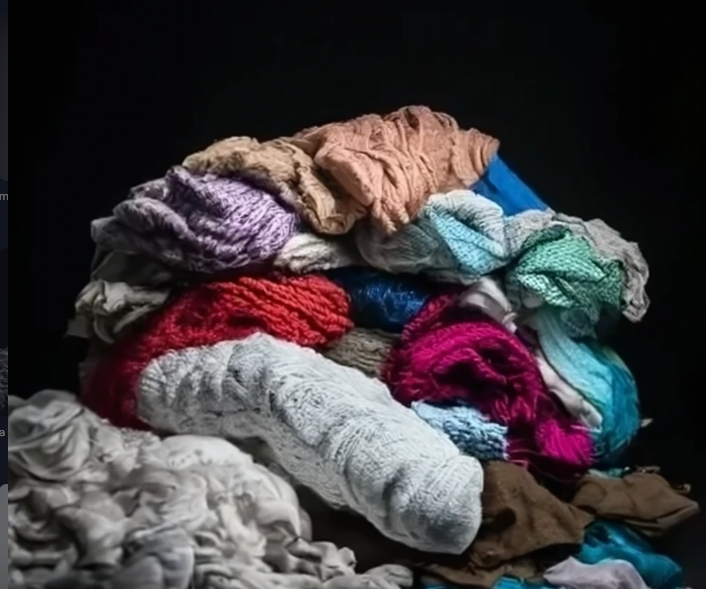
If the people in the USA held onto their textiles instead of tossing away about 200 T-shirts per person annually, we’d be on the path to a better world!
It’s no surprise that the fashion industry ranks as the world’s second-largest polluter. In times before widespread consumerism, individuals would mend and only discard clothing when it was truly beyond repair. This reflected a strong environmental consciousness and commitment to sustainability, although their motive was most;y financial.
Several years ago, Amit Kalra embarked on a quest to find a cost-effective means of expressing personal style. This journey led him to his local thrift store, a realm brimming with discarded treasures waiting to be repurposed. Kalra’s objective extended beyond merely acquiring vintage T-shirts; he sought to seamlessly fuse design and individuality.
In his pursuit of enhancing discovered items, Kalra made a strategic investment in a sewing machine. This allowed him to modify 90s-style garments to align with contemporary aesthetics. Since then, he has dedicated himself to the art of crafting and tailoring his clothes, ensuring that his wardrobe stands as a testament to his unique style.
While perusing thrift store racks, Kalra began questioning the destiny of unchosen garments — the ones deemed not cool or trendy. Leveraging his position in the fashion wholesale sector, he observed firsthand the products he sold ending up in these secondhand stores. This prompted Kalra to delve into the intricacies of the industry’s supply chain, uncovering unsettling realities.
His exploration revealed that the clothes at thrift stores represented only a fraction of the yearly textile and garment waste. In the U.S., a mere 15 percent of this waste is donated or recycled, leaving an alarming 85 percent to accumulate in landfills, equating to nearly 13 million tons annually. This waste amounts to approximately 200 T-shirts per person discarded in the U.S.
In Canada, the discarded clothing could fill a stadium three times the size of Toronto’s, underscoring the magnitude of the issue. Astonishingly, the fashion industry emerged as the second-largest global polluter, trailing only the oil and gas sector. This revelation came as a surprise to Kalra, who had anticipated industries resistant to change, like oil and gas, to dominate environmental concerns.
The sobering reality is that not only do we squander what we consume, but we also expend substantial resources in clothing production. On average, a household’s annual clothing purchases require 1,000 bathtubs of water. Despite the industry’s focus on comfort and trendiness, sustainability and recyclability often take a back seat.
Kalra envisions change as not only possible but imperative. He sees the fashion industry’s proclivity for innovation as an ideal catalyst for embracing sustainable practices. Designing recyclable clothes serves as a foundational step in Kalra’s vision, where a modular approach, akin to constructing with Lego bricks, becomes the norm.
Consider the example of a motorcycle jacket. By incorporating a hidden wireframe, similar to a fish’s skeleton, essential items like buttons and zippers could be easily removed for efficient recycling. This modular design facilitates disassembly, potentially mitigating the economic challenges associated with recycling.
Recycling is a crucial step, but Kalra emphasizes the need to extend efforts to design clothes that are compostable at the end of their lifespan. With an average garment lifespan of three years, even extending this by nine months significantly reduces waste and water impact.
Additionally, Kalra advocates for rethinking the way clothes are dyed. Currently dominated by harsh chemical dyes, with 10–20 percent entering water bodies, he explores alternatives such as spices and herbs to provide unique and environmentally friendly options.
Fashion’s current emphasis on individuality through social media platforms aligns with Kalra’s idea of clothes changing color over time. This natural evolution could be achieved through dyeing methods that utilize household items like turmeric, offering both uniqueness and eco-friendliness.
The fiercely competitive $2.4 trillion fashion industry, according to Kalra, presents an opportunity for businesses to differentiate themselves by offering scalable products that become more unique over time. By embracing sustainability, companies could gain a significant competitive advantage, aligning with the growing consumer demand for environmentally friendly choices.
While there’s no one-step solution, Kalra believes that designing clothes with their end-of-life in mind is a pragmatic starting point. The fashion industry, with its propensity for change, can lead the way toward a sustainable future under Amit Kalra’s visionary guidance.


