
TECHNOLOGY | SOCIETY | A BREAKDOWN
How To Better Our Relationships With Social Media Apps?
10 ways to have lives outside our mobile apps
I recently stumbled upon this YouTube parody about social media apps. It was one funny video because it is so apt and relatable for the current times we live in.
This got me thinking if just for one moment, imagine you are one of these popular social media apps of the 21st century (Facebook, Twitter, Instagram, TikTok, Snapchat, Siri, Alexa, MySpace, etc),
— How would you feel? — What will you do? — What do you hope to accomplish and what do you hope will change? — Or on the flip side, what would you hope NOT to do and achieve?
As I began to ponder upon these questions, I drew parallels between the “behaviors” of these social media apps and that of human beings.
4 ways how social media apps are like humans or is it the other way round?
1.Fighting for attention
Social media apps are constantly trying to fight for your attention, with their designs, their gamification, their notifications bells and banners, the entire experience of making you feel “wanted”, “desired” or better yet, “indispensable”!
Aren't we humans trying to do the same too?
Almost every day, someone is desiring your attention; your spouse, family, kids, colleagues, associates, bosses.
And typically, they come with a “ what is it in for me?” self-entitled mindset.
2. Fighting for your time
Most apps are designed to keep you hooked for financial gain, in exchange, you give up your most valuable resource that no amount of money can buy back, your time.
This is very similar to the abovementioned point, where almost every day, someone wants our time for their own needs if we aren’t self-aware or skilled at practicing personal boundaries.
3. Fighting to be the number one app on the app store
Because social media apps are competitive, they are designed to keep you hooked without you realizing it. And sometimes, the design experience of these apps can evolve and go as far as to the point of losing the elements that make us humane in the first place, such as compassion, love, affection, kindness, and creativity.
This is akin to the competitive capitalistic society we live in, where the winner-is-the-one-who-is-at-the-top of all leaderboards and society pay recognition to the number one, never the middle or the most improved.
Don’t we tend to gravitate towards the author who published a book that is “ 3x Pulitzer Prize” or “#1 New York Times bestseller” but not if a book has no awards tagged to it?
4. Disrespecting your personal space
By fighting to be part of your life, some apps may even have cookies or certain tracking software in place, when you download them, without yourself realizing it.
And these apps may even not give you the option to opt-out, thus forcing you to actually give consent to your browsing behavior and privacy. Notice how certain ads or social media posts are popping up within seconds or in a day, that is related to what you have thought, searched, or clicked even?
This is analogous to the practice of personal boundaries and how we can struggle to find the balance of saying “yes” and “no” at the appropriate times to the people in our lives.
2 major effects of social apps we cannot ignore
1. Disruption to our most powerful resource — our brains
At first glance, apps are seemingly making things easier for us by giving us all the answers and help within a spoken word or a tap.
But in actual fact, they are making our brain work less, and in turn, changes the way how our brain works, or otherwise known as, rewiring the synapses, resulting in possible cognitive decline in years to come.
Digital dementia is real, brain degeneration is real.
Humans are wired for efficiency. So in a world of overload, it is no surprise then when in doubt, humans turned to the fastest and easiest way to get answers.
In the past, they will turn to books or their networks of homo sapiens and actually interact with human beings. And now, because of the speed at which our apps can give us what we crave, we use our brains lesser, we even questioned less the legitimacy of the source and accuracy of answers these apps tell us.
In some modern societies, it has also been reported that many of the younger generations have lost touch with basic survival skills like cleaning the house and cooking, and interpersonal skills because of the way they are being brought up with social apps. They are termed “Generation Hopeless”.
2. Disruption to Relationships with self and others
Prolonged use of social media apps can cause one to feel more disconnected and isolated. Depression, poor sleep anxiety, FOMO can all set in, not to mention, it is also easier to shaming others online and spreading fake news.
There’s even a new behavior, known as, Phubbing, which is basically “the act of snubbing someone you’re talking with in person in favor of your phone. Quite simply, it’s phone snubbing.”
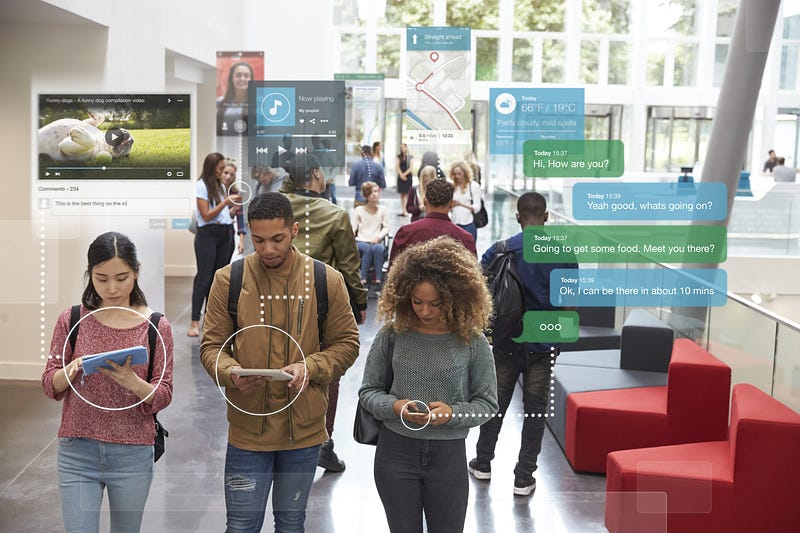
Would you ever want these social media apps to be people? If not, then why aren't we changing our relationships with them, influencing the technologists to redesign the way how apps are designed, with their original intention to make our lives better, to aid us, and not to paralyze us.
10 ways we can humanize our social media apps
So in the meantime, what can we do to regain our “humanity” at the individual level, while technocrats, policymakers, and societies are either still in the dark or still debating on how best we can move forward or somewhere in between?
These are some ways we can start incorporating into how we use our apps, many of the pointers are suggested by the Center of Humane Technology. (I personally employ at least 7 of them)
- Turn off all notifications from all except some important people— do you really need the constant ding, bing, zing, and banners popping here and there?
- Go grayscale, trick the brain— the brain is more attracted to a myriad of colors. When it sees tones of black and white, it is less inclined to stay on the app that it is looking for.
- Reduce quick-access apps on the home screen, better yet, remove it. — Out of sight, out of mind. I personally have completely remove home screen apps for at least 4 years now.
- Use the search bar to look for your apps, by actually spelling and typing. — Because of the “extra” step, the brain is less likely to actually want to look for that app. Also, spelling words is a good form of mental exercise.
- Charge the device outside your bedroom / or place it far away from you when asleep — Mentally give yourself that space to really disconnect and rest. You are also reducing the exposure of wifi or Bluetooth circulating in your sanctuary. If you rely on your phone as your alarm, get a cheap analog clock. Your brain and health will thank you in years to come. By the way, this is a step I’m still working on as I realize that if I want to track my sleep pattern, the phone is always required to be “by your bedside”, which is something I struggle to find a fine balance with.
- Send audios instead of text messages. — Wouldn’t it be lovely to hear each other’s voices instead of constantly reading? Also, it adds a certain element of reality to the message conveyed.
- Set social apps “curfew” screen time on your smartphone. — Iphones have now been updated to allow us to set downtimes for a group or specific apps.
- Turn on Night mode / Do-Not-Disturb mode — Like the abovementioned point, you can also schedule a complete DND mode. Night mode also changes the screen color to filter less blue light from our screens.
- Cut all social media apps for the time period — An extreme measure perhaps? But sometimes, it is necessary for a reset.
- And in the words of my late and wise grandma, “Girl, go out and live a life you are born for!
Parting Thoughts
It seems like there will always be a 3rd party in our relationships these days. Our digital devices (smartphones, tablets, smartwatches, mp3 players, etc.).
Have we really forget the simple golden rules of social engagement and succumb to just the game of analytics engagement? Have we become less creative by thinking that all solutions have to always involve an app?
Be not the slaves to our tools, but masters of our mind. Now more than ever, its time to change the systems, before we become just mere cogs in the wheels of the system.
Related reads
- The Crisis of Social Media [Freedom House]
- Nearly 90% of the world’s internet users are being monitored [Mashable]
- Millennials will benefit and suffer due to their hyperconnected lives [PewResearch]
Hello there, Thanks for reading. I am honored and grateful for your time. I don’t claim to know everything, but I will always strive to share every single bit of truth with thought and humility.
If you like to read more of my stories and be inspired along the way, Let’s connect. One real story at a time, one practical move at a time.